Author: Jayashree

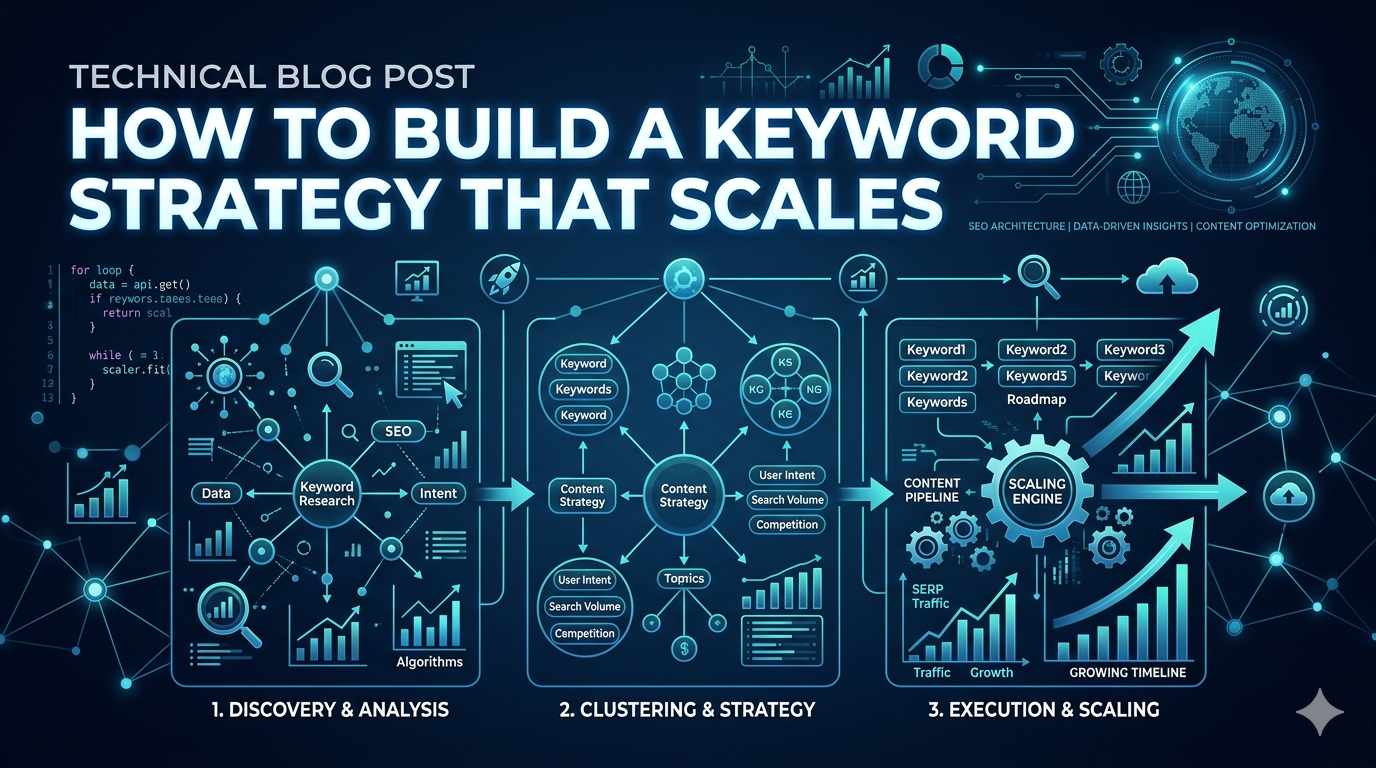
  • How to Build a Keyword Strategy That Scales

    How to Build a Keyword Strategy That Scales

    How to Build a Keyword Strategy That Scales

    Picture your website: a vast, uncharted territory. Keywords? They’re the maps, guiding explorers to your hidden riches. But what occurs when your adventures balloon, morphing into something grander? That’s precisely when a keyword strategy that scales becomes essential. It’s designed to evolve, to expand alongside your enterprise. Forget merely pinpointing correct terms; it’s about architecting a resilient, living mechanism that powers your organic ascension for years to come.

    Within this all-encompassing guide, we’ll plunge into the craft of forging a keyword strategy that scales. Discover pinpointing keywords ripe with possibility, arranging them into rational groupings, and scrutinizing your advancement, ensuring perpetual headway in the appropriate direction. Fasten your seatbelts; we’re launching a quest set to metamorphose your site from concealed treasure into a flourishing hub.

    Understanding the Foundations of a Scalable Keyword Strategy

    Before jumping into the how-tos, let’s nail down what renders a keyword strategy scalable. It transcends merely accumulating an immense roster of keywords; it’s about devising a mechanism to bend, not break, under shifting marketplace dynamics, search engine logic, and your venture’s upward trajectory. Imagine erecting a house: a bedrock is paramount before subsequent expansions.

    A keyword strategy that scales rests upon pivotal tenets. First, it’s fact-fueled, leaning on investigation and dissection, not intuition. Second, it’s neatly arrayed, knitting keywords into coherent threads and motifs. Third, it possesses give, enabling keyword infusions and re-calibrations as your venture morphs. Last, it lends itself to metrics, scrutinizing advancement and spotlighting areas begging for enhancement.

    Witness a modest local bakery blossoming into a regional empire. Its introductory keyword strategy might zero in on phrases like “premier bakery nearby.” Expansion necessitates a shift toward broader phrases, perhaps “artisanal bread courier” or “bespoke cake orders via web.” A keyword strategy that scales lets them flex to meet fresh demands.

    Step 1: Identifying Your Core Keywords and Seed Topics

    Every victorious keyword strategy germinates from pinpointing principal keywords and seedling motifs. These terms define your venture and draw your target audience. Picture them as the tree’s trunk, giving rise to all else.

    Commence by brainstorming a catalog of verbiage mirroring your wares, aid, and intended audience. Step into your ideal client’s persona: what might they input into a search engine to locate you? Embrace breadth initially; refinement can occur later.

    With a roster of potential keywords in hand, wield instruments like search engine’s Keyword Planner, Ahrefs, or SEMrush, to evaluate search intensity, rivalry, and linked phrasing. Seek keywords boasting elevated search intensity combined with diminished to moderate rivalry metrics. These sweet spots unlock paramount organic escalation prospects. Remember, your keyword strategy that scales pivots on these seedling terms – choose judiciously.

    Revisiting the bakery theme, its principal keywords encompass “bakery,” “bread,” “cakes,” and “pastries.” Seedling motifs span “wedding confectioneries,” “wheat-free bread,” and “tailored desserts.”

    Step 2: Expanding Your Keyword Universe with Long-Tail Keywords

    Long-tail keywords: protracted, ultra-specific phrases aimed at specialized demographics. While their search intensity lags behind core keywords, conversion rates frequently surge, a byproduct of heightened alignment with user intent. Picture them as the foliage, enriching the overall strategy with nuances.

    To unearth long-tail keywords, mine instruments to expose related terms and queries. Target phrases housing core keywords yet enriched with granular specifics. For instance, pivot from mere “bakery” toward “leading birthday cake bakery within Chicago’s core” or “wheat-free bakery offering web-based orders.” Here, the keyword strategy that scales genuinely gains form, stretching outward.

    Another potent reservoir resides within your site. Scrutinize query reports, pinpointing terms guiding patrons. Further, sift through client feedback, spotlighting recurrent queries and apprehensions.

    The bakery might unearth long-tail gems like “vegan cupcakes near me,” “bespoke graduation cake concepts,” or “how to arrange wedding cake purchases on the web.” Such pinpointed phrasing unlocks access to an extended audience, snaring specialized traffic.

    Step 3: Organizing Your Keywords into Topical Clusters

    Having amassed a substantial keyword inventory, arraying them into topical clusters commands primacy. This entails amassing keywords united by common themes. Picture arranging texts; segregation between fiction and fact mirrors the necessity to prevent unlinked keywords from mingling.

    Topical clustering cultivates concentrated content, bolstering search engine placement and amplifying user engagement. Furthermore, it streamlines your keyword strategy’s governance, refining advancement tracking. A superior keyword strategy that scales is inherently streamlined and dissectible.

    To forge topical clusters, commence by spotlighting core themes germane to your venture. Subsequently, marshal keywords into fitting categories founded on intent. Envision the bakery carving out clusters for “wedding confectioneries,” “birthday confectioneries,” “wheat-free selections,” and “web-based orders.”

    Within clusters, subordinate them based on narrowed foci. The “wedding confectioneries” cluster might bear sub-groupings for “tiered creations,” “rustic creations,” and “modern creations.”

    Step 4: Creating Content That Targets Your Keyword Clusters

    With keyword clusters established, architect content zeroed in on each. This weaves together blogs, articles, and site pages optimized for cluster keywords. Envision constructing a home upon foundational footings: specialized rooms for defined tasks.

    While assembling content, emphasize audience service: reply to queries, mend predicaments, and dispense salient data. Abstain from keyword stuffing; spotlight superior, compelling content worthy of reads. A keyword strategy that scales incorporates user-centric content planning.

    For each cluster, erect a keystone page serving as a central hub. This page supplies a sweeping overview, interlacing relevant site content. The bakery might host a “wedding confectioneries” keystone, interlacing blog posts tackling “tiered creation designs” and “optimal flavor selections.”

    Supplement keystone pages with content tackling narrowed keywords. This manifests as blogs, articles, videos, or infographics. Prioritize pertinent, enlightening, and captivating media. This anchors the keyword strategy that scales with robust content.

    Step 5: Optimizing Your Website for Search Engines

    Assembling superior content forms merely half the combat; optimizing your site for search engines to ease content discovery proves paramount. This ensures technical robustness, mobile adaptability, and expedited loading. A keyword strategy that scales falters if search engines struggle to index your site.

    Launch by refining site title tags and meta summaries. These snippets dot search engine results pages (SERPs). Condense titles, ensuring descriptive qualities while interlacing target keywords. Infuse meta summaries with persuasion, enticing clicks to your site.

    Subsequently, amplify site headings and subheadings. Employ descriptive headings housing target keywords, tempering extravagance. Aim for seamless readability, circumventing keyword bloating. Above all, a keyword strategy that scales champions user delight.

    Finally, verify mobile responsiveness and expedited loading. Search engines favor mobile-ready sites, underscoring mobile device optimization. Exploit mobile-friendly testing instruments to gauge site fitness. Speed impacts rankings, emphasizing cross-device rapid loading.

    Step 6: Building High-Quality Backlinks

    Backlinks, hyperlinks from external domains pointing toward yours, epitomize pivotal ranking determinants within search algorithms. Visualize them as validation tokens: amplified superior backlinks beget elevated search engine placement. A robust keyword strategy that scales integrates a reciprocal backlink tactic.

    Forging premium backlinks demands vigor, yet proves indispensable for sustained organic escalation. Craft compelling content capable of eliciting links. This spans blogs, articles, videos, infographics, and open-access instruments. Yet, a keyword strategy that scales necessitates backlink integrity, curtailing corners.

    Proactively engage fellow industry actors, imploring content links. While performing outreach, exude politeness, proffering reciprocation. Present guest writing or content promotion across social channels.

    Engage communities by sharing expertise, fielding queries, and dispensing insight. Over time, industry-wide recognition may bloom, eliciting site links.

    Step 7: Tracking Your Progress and Making Adjustments

    Post keyword strategy deployment, monitoring advancement commands primacy. This involves scrutinizing site traffic, rankings, and conversions, distinguishing functional aspects. A keyword strategy that scales inherently iterates, refining based on insight.

    Exploit web analytics to gauge traffic and conversions. Closely watch organic traffic, pinpointing referral conduits. Observe keywords sparking surge and optimized conversion rates. Performance monitoring remains intrinsic to a keyword strategy that scales.

    Similarly, harness tracking instruments to observe site rankings by target keywords. Chart rank shifts over time, pinpointing slipping spots. Take notes on what works to make improvements and continue to see growth.

    Base alterations on solid metrics. When performance lags, assay distinct keywords, alternative content, or intensified backlink initiatives. Prioritize agility. It is important to always be open to change, in order to have a keyword strategy that scales.

    The Future of Scalable Keyword Strategies

    The digital terrain eternally evolves, mandating keyword strategy agility. As search engine logic refines and user habits morph, modify your methodology to preserve forward momentum. Bear in mind, a keyword strategy that scales constitutes a sustained endeavor, surpassing short-term endeavors.

    Trends sculpting the landscape of keyword strategies encompass the ascent of computerized brainpower. Artificial intellect guides pinpointing novel keywords, scrutinizing competitors, and refining content. Personalizing content heightens engagement and elevates conversion metrics.

    The escalation of voice-enabled search patterns assumes importance. Adjust content for spoken queries. Target conversational phrasing. Your keyword strategy that scales should address voice searches to stay relevant.

    Primarily, prospective keyword strategies orbit enhanced user involvement. Search engines progressively champion user-friendly websites. This elevates the mandate for speedy, intuitive sites. Moreover, prioritize superior, relevant, and engrossing content.

    Conclusion: Building a Keyword Strategy for Long-Term Growth

    Engineering a keyword strategy that scales transcends instantaneous results; it constitutes a lasting business commitment. It mandates focus and modification. However, bountiful rewards arise: augmented organic traffic, elevated search prominence, and amplified leads.

    The most important takeaways include:

    • Forge a robust platform of bedrock keywords.
    • Broaden your keyword compass via long-tail phrasing.
    • Arrange keywords by topical affinity.
    • Assemble cluster-optimized content.
    • Refine your site.
    • Cultivate backlinks.
    • Observe advancement and recalibrate.

    By adhering to these principles, engineer a keyword strategy that scales with your enterprise, galvanizing self-sustaining progress. Chart, deploy, and refine. The domain of organic expansion awaits!
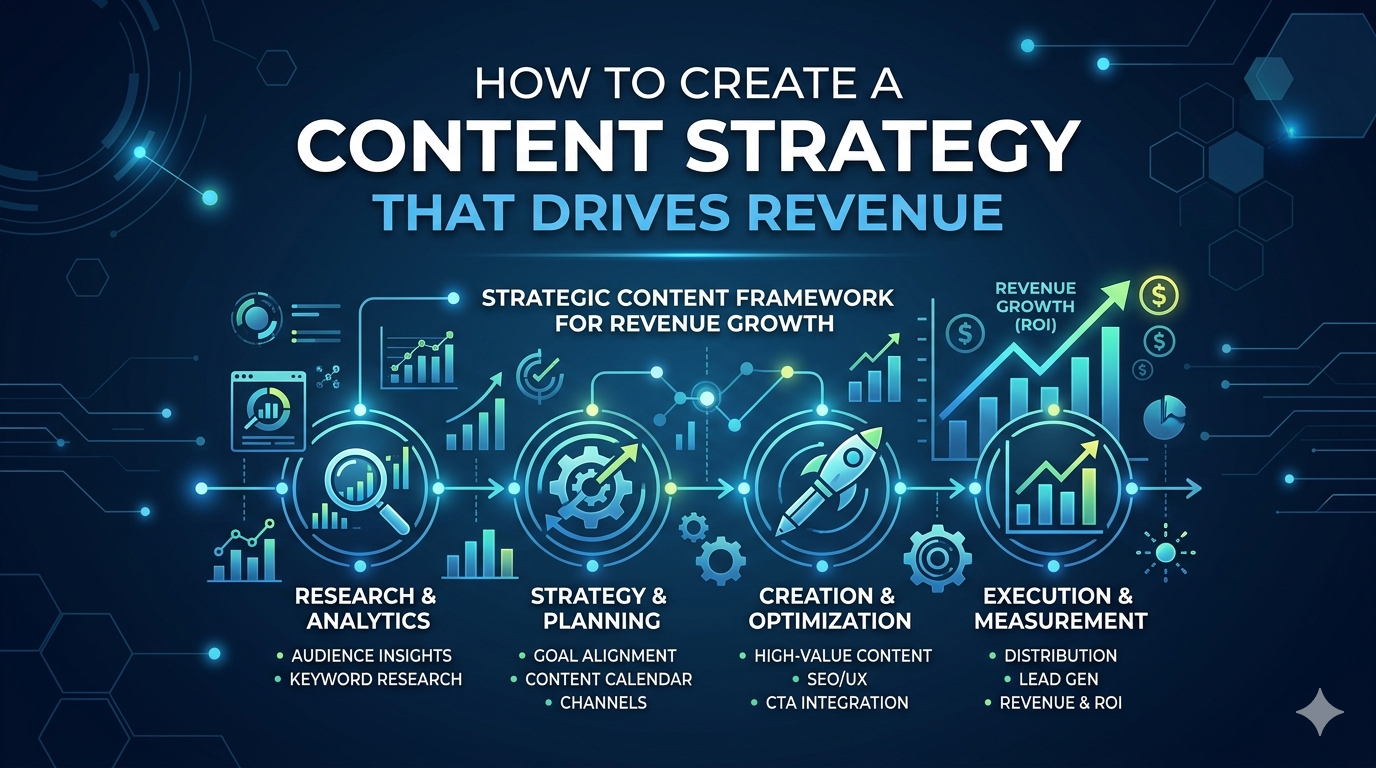
  • How to Create a Content Strategy That Drives Revenue

    How to Create a Content Strategy That Drives Revenue

    How to Create a Content Strategy That Drives Revenue

    Envision a waterway, abounding with expected clients, streaming specifically toward your endeavor. That waterway? The web. Its current? A carefully assembled content strategy. It transcends simple blog entries. Think strategically composing and conveying significant, pertinent, and reliable substance. The aim? Attract and hold a plainly characterized audience. The ultimate objective? Drive worthwhile customer action. Excessively frequently, organizations treat content creation as an idea in retrospect, a task to finish. Articles are distributed sporadically, with little respect for audience needs or business targets. The end? A dribble, not a surge, of income. Let’s plunge into building a content strategy that genuinely moves the needle, changing your online presence into a revenue-generating powerhouse.

    Step 1: Know Thyself (and Thy Audience)

    Before composing a solitary word, a perfectly clear comprehension of your business goals and your ideal customer is fundamental. What are your targets? Lift brand mindfulness? Produce leads? Drive deals? Each objective requests an alternate way to deal with content creation. Simultaneously, an intensive comprehension of your audience is paramount. What are their key challenges? What questions do they pose? Where do they invest their energy on the web? Begin by making definite buyer personas. Give them names, ages, callings, and inspirations. Comprehend their desires and their apprehensions. This knowledge will be important while creating content that reverberates with them on a profound level. Envision offering project the executives programming. Your optimal customer may be ‘Sarah, the overpowered project supervisor,’ battling to keep her group on target, continually fighting cutoff times. Your content, along these lines, ought to address these particular difficulties.

    Step 2: Define Your Content Pillars

    Picture content pillars as the bedrock subjects supporting your whole content strategy. These center themes should be exceedingly applicable to both your audience and your endeavor. Wide enough for an assortment of subtopics, yet sufficiently explicit to keep up core interest. For our project the board programming model, potential content pillars could include: ‘Project The board Accepted procedures,’ ‘Group Coordinated effort Strategies,’ ‘Time Usage Strategies,’ and ‘Programming Usage Guides.’ Under every pillar, a scope of content designs can be made: blog entries, articles, infographics, recordings, podcasts, and online classes. Guarantee all content lines up with at least one of your center pillars.

    Step 3: Keyword Research: Uncover the Language of Your Audience

    Keyword research is the keystone of any fruitful content strategy. Find the terms and expressions your target audience is effectively looking for on the web. These keywords should be consolidated into your content to improve its visibility in search engine results pages (SERPs). Utilize keyword research instruments to distinguish high-volume, low-competition keywords pertinent to your content pillars. Consider broad, general keywords (e.g., ‘project the board’) and long-tail keywords (e.g., ‘best project the board programming for little groups’). Long-tail keywords are progressively explicit, frequently flaunting a higher change rate because of their focused aim. Coordinations is key. Keywords should be integrated normally into your titles, headings, and body duplicate. Stay away from keyword stuffing; it can negatively affect your search engine rankings. Make content that is both educational and streamlined for search.

    Step 4: Map Content to the Buyer’s Journey

    The purchaser’s excursion envelops the means your clients take. From beginning mindfulness to the last buy choice. Regularly, it comprises of three phases: Mindfulness, Thought, and Choice. At each stage, your audience has differing needs, looking for different types of content. Awareness Stage: Content ought to teach your audience about their concern, presenting potential arrangements. Blog entries, articles, infographics, and web-based social networking updates are extraordinary models. Consideration Stage: Content ought to think about various arrangements, featuring the upsides of your item or administration. Case studies, white papers, online classes, and item demos are awesome decisions. Decision Stage: Content ought to give social confirmation, consoling your audience that they are settling on the correct decision. Tributes, surveys, evaluating pages, and free trials work best here. Guide your content to the purchaser’s excursion to ensure you are conveying the correct message to the perfect individual at the perfect time, expanding your odds of change. A content strategy is fundamental for this.

    Step 5: Content Creation: Quality Over Quantity

    Making top-notch content is principal. Basically creating articles is not enough. Your content should be important, captivating, and educational. Give one of a kind insights, tackle issues, and engage your audience. Put resources into proficient scholars, editors, and designers. Guarantee content is very much explored, elegantly composed, and outwardly engaging. Use an assortment of content configurations to keep your audience connected. Try different things with blog entries, articles, recordings, podcasts, infographics, digital books, and online classes. Repurpose your content to amplify its range. Transform a blog entry into a series of web-based social networking updates, or a online class into a digital book. Continuously organize quality over amount. One outstanding bit of content is worth more than ten mediocre ones. A solid content strategy underscores value. Making a content strategy is important.

    Step 6: Distribution: Get Your Content Seen

    Making extraordinary content is just a large portion of the fight. You additionally need to ensure it gets seen by your target audience. Foster an extensive appropriation plan that incorporates both natural and paid channels. Organic Channels: Spotlight search engine streamlining (SEO) to improve your content’s visibility in query items. Share your content via web-based networking media platforms where your audience is dynamic. Construct an email list, sending normal pamphlets to your supporters. Take part in online networks and discussions. Paid Channels: Use paid publicizing to contact a more extensive audience. Run web-based social networking advertisements focusing on explicit socioeconomics and interests. Use pay-per-click (PPC) promoting to target pertinent keywords. Band together with influencers to advance your content to their adherents. Track your outcomes, changing your dissemination strategy in like manner. A content strategy requires appropriate distribution for success. Making a content strategy is a process.

    Step 7: Measurement and Analysis: Track Your Results

    The last step is to gauge and analyze your outcomes. Track key measurements, for example, site traffic, leads produced, deals transformations, and web-based social networking engagement. Use analytics instruments to distinguish which content is performing admirably and which is most certainly not. Analyze your information to comprehend what is working. Change your content strategy in like manner. Ceaselessly explore and streamline to improve your outcomes. A content strategy flourishes with information driven choices. A content strategy is not a set-it-and-overlook it activity. It’s an continuous procedure of creation, dissemination, estimation, and analysis. By consistently refining your strategy, you guarantee your content is dependably pertinent, connecting with, and powerful at driving income. Your content strategy is key. Without a content strategy, you’re lost. The content strategy guides your decisions.

    Step 8: Content Audits: Keeping Things Fresh

    Standard content reviews are critical for keeping up the viability of your content strategy. A content review includes methodically assessing all your current content to distinguish what is working, what is not, and what should be refreshed or expelled. This procedure distinguishes holes in your content library, guarantees your content is precise and cutting-edge, and streamlines your content for search engines. During a content review, assess each bit of content dependent on components, for example, Relevance to your target audience, Precision of data, SEO execution (keyword rankings, traffic), Engagement measurements (page sees, time on page, social offers), Change rates (leads, deals). In light of your discoveries, make a move to improve your content. This may include: Refreshing obsolete data, Streamlining content for pertinent keywords, Re-purposing content into various configurations, Expelling low-performing content, Making new content to fill holes. Content reviews ought to be directed at least once every year, or all the more regularly if your business is quickly changing. They are basic for keeping your content strategy new and successful.

    Step 9: Building a Content Calendar

    A content schedule is a device for arranging and planning your content creation and appropriation endeavors. It gives a visual diagram of your content plan, helping you remain on track and guarantee you are reliably distributing important content to your audience. Your content schedule ought to incorporate the accompanying data: Content title, Content arrangement (blog entry, video, infographic, and so on.), Target keyword(s), Target audience, Distribution date, Distribution channels, Author/maker. By utilizing a content schedule, you can: Plan your content ahead of time, Guarantee your content is lined up with your business goals, Keep up a predictable distributing schedule, Abstain from content bottlenecks, Work together adequately with your group. There are numerous content schedule apparatuses accessible, going from straightforward spreadsheets to modern project the board platforms. Pick an instrument that addresses your issues and fits into your work process. A content strategy uses a calendar.

    Step 10: Content Personalization: Speaking Directly to Your Audience

    Customization is fundamental for catching and holding your audience’s attention. Content customization includes fitting your content to the requirements and interests of individual users. This is accomplished through an assortment of strategies, for example: Sectioning your audience dependent on socioeconomics, interests, and conduct, Utilizing dynamic content to show diverse content to various users, Customizing email promoting efforts, Prescribing pertinent content dependent on user history. By customizing your content, you can: Increment engagement, Improve change rates, Fabricate more grounded associations with your audience, Upgrade customer loyalty. Customization requires information. Gather data about your audience to tailor your content successfully. This is finished through site analytics, email promoting platforms, and customer relationship the board (CRM) frameworks. The more you think about your audience, the better you can customize your content and drive income. A content strategy benefits from personalization.

    Step 11: Optimizing for Voice Search

    With the ascent of voice partners like Siri, Alexa, and Google Assistant, voice search is getting progressively significant. To streamline your content for voice search, center around noting questions that individuals are probably going to inquire verbally. Utilize regular language and conversational keywords. Consider the kinds of inquiries your target audience may ask identified with your items or administrations. At that point, make content that gives clear and succinct answers. Use organized information markup to enable search engines to comprehend the setting of your content. This will build the probability that your content will be highlighted in voice query items. Additionally, ensure your site is versatile, as numerous voice quests are directed on mobile phones. A content strategy should consider voice search.

    Step 12: Fostering Community Engagement

    Making a solid feeling of community around your image is basic for building loyalty and driving income. Empower your audience to draw in with your content by: Posing inquiries and inciting conversations in your blog entries and web-based social networking updates, Reacting to remarks and input in an auspicious way, Facilitating online occasions and online classes, Making a discussion or online community where your audience can interface with one another. By cultivating community engagement, you can: Manufacture more grounded associations with your audience, Increase important bits of knowledge into their needs and inclinations, Produce leads and drive deals through verbal publicizing, Increment brand mindfulness and loyalty. A content strategy builds community.

    Step 13: Staying Ahead of the Curve

    The universe of content promoting is continually developing. New innovations, platforms, and patterns are rising constantly. To remain in front of the bend, you have to: Persistently screen industry news and patterns, Explore different avenues regarding new content configurations and appropriation channels, Go to industry gatherings and workshops, System with other content advertisers, Willingly adjust your content strategy varying. By remaining educated and versatile, you guarantee your content strategy stays viable, driving income for your business. A content strategy requires constant learning. Creating a content strategy and keeping it fresh is important.

    Conclusion

    Making a content strategy that drives income is not an overnight undertaking. It requires cautious arranging, reliable execution, and continuous improvement. The prizes are justified. By following these means, transform your online presence into a lead generation and sales motor. Focus on understanding your audience, creating content, dispersing it successfully, estimating your outcomes. With a very much characterized content strategy, you can draw in, and change your target audience into paying clients, driving income development for your business. Your content strategy is the way to long haul achievement. A content strategy helps you win.

  • How to Do SEO Audits Step-by-Step (With Templates)

    How to Do SEO Audits Step-by-Step (With Templates)

    How to Do SEO Audits Step-by-Step (With Templates)

    Think of your website. Is it humming along, or sputtering? An SEO audit? Consider it that crucial check-up. Making sure everything’s firing on all cylinders. Ensuring peak performance. This guide? It’s your roadmap. A step-by-step journey through a complete SEO examination. And? We’ve included templates. Streamlining the whole shebang.

    What is an SEO Audit and Why Do You Need One?

    An SEO audit? It’s a deep dive. Assessing how well your website dances with search engine results. Where does it shine? Where does it stumble? Think doctor’s visit. Pinpointing issues. These issues? They’re silently sabotaging your site’s potential to snag organic traffic. Why are these audits vital? The digital world. Relentless change. Algorithms shift. Competitors adjust. User habits? Mutable. Constant vigilance. Continuous tweaks. Audits make that possible.

    Step 1: Crawl Your Website

    First? Explore your website. Every nook. Every cranny. Web crawlers. Tools systematically mapping out your digital domain. Spotting broken links. Missing images. Technical hiccups. Imagine a digital cartographer. Charting your website’s landscape. Tools abound! Screaming Frog SEO Spider. Sitebulb. DeepCrawl. Screaming Frog? It offers a free version. Up to 500 URLs. Perfect for smaller sites. These crawlers? They provide valuable intel. Structure. Content. Technical SEO bits. Identifying issues preventing proper indexing. Missing title tags? Duplicate content? Sluggish loading times? Crawlers flag them all. Issues that can torpedo your SEO.

    Step 2: Analyze Website Indexing

    Crawled? Great. Now, how well is Google seeing you? Indexing is key. Search engines adding your website’s precious pages to their vast database. Making you eligible. Ready to appear in search results. How to check? The site: operator. A simple trick. Type site:yourdomain.com. A list appears. Pages Google has already cataloged. A major difference between total pages and indexed pages? Red flag! Pages blocked? Robots.txt at fault? Noindex tag lurking? Crawl errors abound? Find them. Fix them. Ensure your voice is heard.

    Step 3: Evaluate Website Architecture

    Architecture. Structure. Organization. Key to a user-friendly experience. And search engine love. Clear hierarchy. Logical linking. A simple URL strategy. Think of it like the very bones of your presence. A flat architecture is preferred. Everything easily accessible from the homepage. Deeper architectures can be troublesome. Requiring multiple clicks. Search engines struggle. Indexing becomes difficult. URLs? Keep them neat. Simple. Keywords are welcome. Internal linking? Absolutely critical. Helping search engines understand relationships. Between pages. Boosting user engagement. Pathways to explore further.

    Step 4: Assess On-Page SEO Elements

    On-page SEO. Fine-tuning individual pages. Boosting their ranking potential. Title tags. Meta descriptions. Header tags. Content. Image optimization. These bits? Information gold for search engines. Unveiling the purpose of each page. Title tags? Prime real estate. Concise. Compelling. Relevant keywords are a must. Meta descriptions? Short. Sweet. Appearing beneath the title tag. While they don’t directly influence rankings, they definitely entice clicks. Compelling descriptions. A must. Header tags (H1, H2, H3)? Structure. Context. The H1 tag? The main headline. H2 tags? Subheadings. Using these effectively improves readability. Makes it easier for search engines to comprehend. Content? King. Original. Valuable. Engaging. Relevant. Target audience is everything. Keywords are welcome. Careful of stuffing. Negatively impacts rankings. Image optimization? Size. Compression. Descriptive alt text. All crucial. Alt text? Information for search engines. Boosting visibility in image search results.

    Step 5: Analyze Content Quality and Relevance

    Content. The very heart of SEO. High-quality content. Essential. Attracting. Engaging. Improving rankings. Your voice. Expertise. Value. Analyzing content quality? Originality. Accuracy. Readability. Engagement. Unique content. Valuable insights. Avoid duplication. Thin content? Penalties await. Accuracy? A must. Updated content. Protects credibility. Readability? Clear. Concise. Headings. Subheadings. Bullet points. Shorter paragraphs. Simple language. Engagement? Key. Time spent on site. Images. Videos. Interactive elements. Keep your audience hooked. Search intent matters. What questions do users have? Content answers those questions. Clearly. Helpfully.

    Step 6: Evaluate Mobile Friendliness

    Mobile. Essential. Not optional. Google uses mobile-first indexing. Mobile version reigns supreme. A non-mobile-friendly site? Ranking penalties await. Google’s Mobile-Friendly Test. Your tool. Analysis. Recommendations. Responsive design. Page speed. Mobile usability. Responsive design? Adapts to screen sizes. Seamless user experience. Desktops. Tablets. Smartphones. Page speed? Critical for mobile. Quick loading. Low bounce rate. Optimize images. Code minimization. Browser caching. Boost mobile speed. Mobile usability? Navigation. Interaction. Clear menus. Large buttons. Sufficient spacing. Avoid intrusive pop-ups. A smooth mobile experience. Is crucial.

    Step 7: Assess Website Speed and Performance

    Speed. Performance. Crucial. User experience. Search engine rankings. Slow loading? High bounce rate. Decreased engagement. Lower conversions. Users expect speed. Abandonment looms. Google cares about speed. Faster sites rank higher. Tools? Google PageSpeed Insights. GTmetrix. WebPageTest. Analysis. Recommendations. Server response time. Image optimization. Code minification. Caching. Server response time? Bottleneck alert? Optimize your server. A CDN. A reliable host. Image optimization? Reduce file size. Maintain quality. Code minification? Removing unnecessary characters. Caching? Storing data for quick access. Browser caching. Server-side caching.

    Step 8: Analyze Backlink Profile

    Backlinks. Links from other sites. Crucial. Ranking factor. Votes of confidence. Trustworthy. Valuable resources. High-quality backlinks. Higher rankings. Factors to consider? Number. Quality. Anchor text. Diversity. Tools? Ahrefs. SEMrush. Moz Link Explorer. Analyze. Number? Important. Quality? More important. High-quality links? From reputable sites? Worth more than hundreds of spammy links. Focus. Relevance. Domain authority. Anchor text? Clickable text. Natural. Diverse. Avoid repetition. Manipulative link building. Diversity? Essential. Blogs. News sites. Industry directories. Social media.

    Step 9: Review Technical SEO Issues

    Technical SEO. Fine-tuning the under-the-hood bits. XML sitemaps. Robots.txt file. Canonical tags. Structured data markup. SSL certificate. These help search engines. Crawl. Index. Understand. XML sitemap? Lists all pages. Discoverability. Submit to Google Search Console. Robots.txt? Controls crawling. Sensitive content. Duplicate content. Canonical tags? Preferred version. Prevents duplicate content. Structured data markup? Provides context. Improves visibility. Rich snippets. SSL certificate? Encrypts communication. Protects user data. A ranking factor. Preferred by Google.

    Step 10: Implement Recommendations and Track Progress

    Implement. Track. The final steps. Prioritize recommendations. Impact. Resources. Low-hanging fruit first. Easy implementation. Big results. Timeline. Responsibility. Project management tools. Track progress. Ensure everything is on track. Monitor website performance. Organic traffic. Keyword rankings. Bounce rate. Conversion rates. Google Analytics. Google Search Console. Analytics? Traffic. User behavior. Conversions. Search Console? Indexing. Crawl errors. Keyword rankings. Adjust. Continuous. Monitoring. Testing. Optimization. SEO isn’t a one-off. It’s a process. Recurring.

    SEO Audit Templates

    Streamline your audits with these handy templates:

    • Technical SEO Audit Template: Covers all the technical elements.
    • On-Page SEO Audit Template: Focuses on individual pages.
    • Backlink Audit Template: Helps analyze your backlink landscape.
    • Content Audit Template: Helps evaluate content quality.

    Conclusion

    SEO audits? They’re vital. Improving rankings. Attracting traffic. Follow the steps. Use the templates. Discover the strengths. Fix the weaknesses. SEO? Ongoing. Constant vigilance. Testing. Optimizing. Start your audit today. Take your website further.

  • Internal Linking Strategies That Boost Organic Traffic

    Internal Linking Strategies That Boost Organic Traffic

    Internal Linking Strategies That Boost Organic Traffic

    The Untold Story of How Internal Links Transformed Our Website Traffic

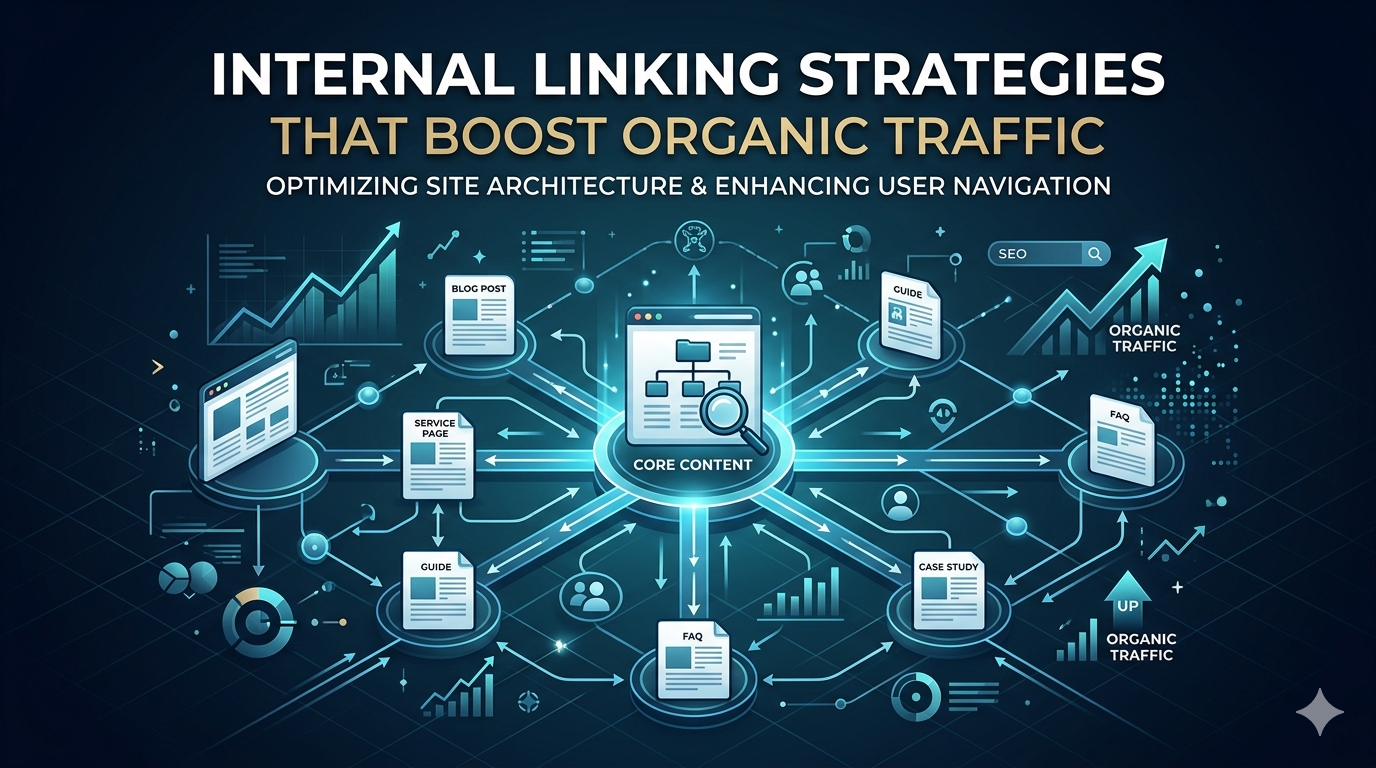
    Picture a website as a sprawling metropolis. Individual pages? Buildings. But without roads, people get lost. Search engines? Confused. That’s where internal linking comes to the rescue. Roads, guiding users and search engine crawlers. Navigating the relationships within your content. In this tale, we pull back the curtain on internal linking strategies, sharing our journey and hard-won wisdom on implementation. Prepare for a boost in organic traffic.

    Chapter 1: The Problem – A Disconnected Website

    Our story begins with a jolt of awareness. We were sitting on a goldmine of content, valuable yes, but scattered, adrift. Blog posts, product pages, guides…islands in a digital sea. Visitors struggled to connect the dots. Search engines too. User experience suffered. Visibility? Limited. Older gems were buried. Newer posts? Lost in the shuffle. The answer, it turned out, lay in a powerful internal linking strategy.

    Chapter 2: The Foundation – Understanding Internal Links

    Before the deep dive, a quick level-set. What are these internal linking strategies, exactly? A simple hyperlink from one page on your site to another. That’s it. But their impact? Far from simple. Crucial, even. Why?

    • Improved Navigation: Internal links act as breadcrumbs, guiding users deeper, encouraging exploration, and extending their stay.
    • Enhanced Crawlability: Search engine crawlers follow these links like detectives, indexing every corner of your site. A smart internal linking strategy? Guaranteed access for those digital sleuths.
    • Distribution of Link Equity: Think of it as digital karma. Internal links spread the love (or “link juice”), boosting the ranking potential across your domain.
    • Contextual Relevance: By connecting related content, you’re sending signals. “This page is about this,” you whisper to the search engines, improving ranking for relevant searches.

    Internal linking strategies are a cornerstone. Build on them.

    Chapter 3: The Blueprint – Planning Your Internal Linking Strategy

    Like any grand design, a potent internal linking strategy demands a plan. Our blueprint, laid bare:

    Step 1: Content Audit

    First, take stock. A thorough sweep of your existing content. Identify your cornerstones. Those authoritative pages, the bedrock of your website. Then, spot the supporting cast. Related content, ready to link and be linked. These pages are the heart of your internal linking strategy.

    Step 2: Keyword Mapping

    Now, the treasure map. Chart the keywords each page is hunting. Opportunities will surface. A blog post on “SEO secrets”? Link it from any page breathing SEO. See internal linking strategies as a key, unlocking your keyword strategy.

    Step 3: Anchor Text Optimization

    Anchor text. The clickable words, the gateway. They shout context, relevance. Descriptive, keyword-rich – aim for that. But tread carefully. Overdoing it feels…off. Natural language wins. Variation matters too. A healthy, diverse internal linking strategy requires it.

    Step 4: Link Placement

    Where you plant the link matters. Bury it in the content’s heart, where eyes will find it, clicks will happen. The footer? Sidebar? Often ignored. Context is king. Those are the links that juice internal linking strategies.

    Chapter 4: The Construction – Implementing Internal Links

    Plan in hand? Time to build. A few hard-won tips:

    Tip 1: Start with Your Cornerstone Content

    Begin at the heart. Link from your cornerstones to their kin. Spread that link equity, lift those important pages. Consider these pages the engine room of your internal linking strategies.

    Tip 2: Link from New to Old

    Fresh content? Don’t forget the elders. Link back to relevant older posts. Give them a nudge. Keep them breathing. Simple. Potent. A cornerstone of any formidable internal linking strategy.

    Tip 3: Use Contextual Links

    As noted, context rules. Links nestled in the heart of your content provide aid precisely when needed. They whisper relevance to search engines. They’re the foundation of internal linking strategies that truly deliver.

    Tip 4: Avoid Excessive Linking

    Yes, internal linking is vital. But restraint is key. Don’t stuff your content. It dilutes the power and smacks of spam. Value trumps volume. A few well-aimed links eclipse a swarm of duds. Good internal linking strategies are a gift, not a burden.

    Tip 5: Use Relevant Anchor Text

    Let anchor text speak truth. Reflect the linked page’s soul. Help users anticipate the journey. Signal relevance to search engines. Strategic anchor text is the lifeblood of thriving internal linking strategies.

    Chapter 5: The Tools – Streamlining Your Internal Linking Efforts

    Streamline your internal linking strategies. Some tools can help. Our favorites:

    Screaming Frog SEO Spider

    Crawl your site. Unearth internal and external links. Expose broken links, lurking problems. Essential for auditing and nurturing your internal linking strategy.

    Ahrefs

    An SEO powerhouse. Site audits, internal linking opportunities exposed. Track performance over time. For advanced internal linking strategies, Ahrefs is indispensable.

    Google Search Console

    Insights into Google’s view of your site. Identify indexing woes, crawl errors. Monitor. Maintain healthy internal linking strategies.

    Chapter 6: The Roadblocks – Common Internal Linking Mistakes

    Even with fire in your belly, missteps happen. Common internal linking strategies pitfalls:

    Mistake 1: Orphan Pages

    Pages adrift, no internal links to guide them. Hidden from search engines. Doomed to obscurity. Ensure every page has a lifeline. Avoiding these is key to effective internal linking strategies.

    Mistake 2: Broken Links

    Links to nowhere. A dead end for users. A dent in your rankings. Hunt them down. Fix them fast. Maintaining link health is crucial for successful internal linking strategies.

    Mistake 3: Irrelevant Links

    Mismatched links confuse users, dilute your efforts. Keep it relevant. Offer value. Relevance is non-negotiable in effective internal linking strategies.

    Mistake 4: Over-Optimization

    Stuffing, excessive optimization…search engines frown. Aim for natural. Deliver value. Prioritize user experience. Naturalness is the secret to sustainable internal linking strategies.

    Chapter 7: The Results – Witnessing the Transformation

    Post-implementation? Organic traffic surged. Older content revived. Newer posts climbed higher. User engagement soared. Visitors explored deeper, stayed longer. The evidence was clear: internal linking strategies deliver.

    Chapter 8: The Evolution – Continuous Improvement

    Internal linking strategies aren’t a one-shot deal. They demand vigilance, refinement. Review, adapt, evolve. The digital world shifts. Your internal linking strategy must, too.

    Conclusion: The Power of Connection

    In short? Internal linking strategies are mighty. They amplify organic traffic, delight users, boost visibility. Plan, implement, connect. Build a cohesive, user-friendly site. Climb those search rankings. Audit, map, optimize. Avoid the traps. Unlock your website’s potential. Fuel growth. Planning, relevance, evolution – the keys. See internal linking strategies as vital to SEO. Pave the path to lasting success.

  • How to Build Topic Clusters That Rank in AI Search

    How to Build Topic Clusters That Rank in AI Search

    How to Build Topic Clusters That Rank in AI Search

    Picture this: a library where books are strewn about haphazardly. Utter chaos. Finding anything would be a Herculean task, wouldn’t it? That’s precisely how many websites appear to search engines, a disorganized mess. But, imagine the alternative. You meticulously organize your site into interconnected sections. Users, along with AI, can effortlessly discover precisely what they seek. That, friends, is the sheer might of topic clusters. We’re poised to delve into crafting topic clusters, designed not just for human comprehension, but also to send your rankings soaring in the realm of AI-powered search engines.

    In this exhaustive guide, prepare to plunge into the depths of topic clusters. Grasp their essence, their vital role in today’s SEO landscape, and crucially master the art of constructing them to reign supreme in AI search outcomes. Ready yourself to revolutionize your content approach and witness an explosion in organic traffic!

    What Are Topic Clusters and Why Do They Matter for AI Search?

    At its heart, a topic cluster represents a strategic content framework. It centers your website’s content around a main idea, or “pillar page.” This pillar page gives a thorough explanation of the broad topic. Meanwhile, related “cluster content” explores particular aspects, connecting back to the pillar page and to one another. The result? A network of interconnected content that communicates authority and relevance to search engines, especially those driven by artificial intelligence.

    Envision it thus: the pillar page is the sturdy trunk of a mighty tree, its cluster content the far-reaching branches. Each branch connects back to that central trunk, bolstering the entire structure. This interconnectedness? Absolutely vital, for several key reasons:

    • Improved Search Engine Crawling: Search engine bots, especially those sophisticated AI-driven crawlers, can effortlessly traverse your website. They’ll grasp the intricate links between your content. This elevates crawling efficiency. Pages get indexed more effectively.
    • Enhanced Topical Authority: By meticulously building a comprehensive collection of content on one specific topic, you emerge as the go-to expert in that field. Search engines recognize your website as the invaluable resource for users on the hunt for information.
    • Increased User Engagement: Topic clusters craft a seamless user journey, leading visitors intuitively through related content. The result? Extended visits, lower bounce rates, and a heightened likelihood of turning visitors into conversions.
    • Better Keyword Ranking: By strategically targeting a spectrum of related keywords inside your cluster content, you can amplify your overall keyword ranking. Watch that organic traffic surge toward your website!

    In this era dominated by AI search, topic clusters are not just important; they’re absolutely essential. AI algorithms? They’re engineered to decipher the context and relationships woven between distinct pieces of content. By erecting topic clusters, you essentially educate the AI, revealing your website’s core purpose and its relevance to users’ specific searches. Anticipate remarkable enhancements in search engine rankings and a deluge of organic traffic!

    Step-by-Step Guide to Building High-Ranking Topic Clusters

    Now that we’ve grasped the significance of topic clusters, let’s get practical. We’ll dive into the actual steps for building them. Here’s where meticulous planning becomes paramount.

    Step 1: Keyword Research and Topic Selection

    The bedrock of any thriving topic cluster? Solid keyword research. Uncover the topics and keywords that your ideal audience actively searches for. Ensure alignment with your overarching business objectives. Begin by simply brainstorming prospective core topics. What main areas of expertise define your business? What specific problems do you solve for those customers?

    Armed with your topic list, unleash keyword research tools – think Google Keyword Planner, Ahrefs, SEMrush, or Moz Keyword Explorer – to pinpoint relevant keywords and their corresponding search volumes. Seek keywords striking a harmonious balance between search volume and competition. These represent your realistic opportunities for achieving high rankings.

    The primary keyword, , must be considered throughout this process. Don’t dismiss long-tail keywords – those extended, ultra-specific phrases users type into search engines. While often exhibiting lower search volumes, long-tail keywords can prove remarkably easier to rank for, drawing in a highly targeted, qualified audience.

    Pay close attention to the intent propelling each search. What objective underlies a user’s keyword search? Are they on a quest for information, scouting products, or seeking particular services? Deciphering search intent empowers you to mold content perfectly tailored to their precise needs.

    Having compiled your keyword data, dissect it meticulously to unearth potential pillar page topics and spark imaginative cluster content concepts. Scan for broad keywords flaunting high search volumes, poised to anchor robust pillar pages. Then, pinpoint pertinent long-tail keywords, primed to energize your cluster content. A sharp eye for detail is required. The primary keyword, , should be integrated naturally.

    Step 2: Create Your Pillar Page

    Your pillar page stands as the keystone of your entire topic cluster. It must embody a sweeping, in-depth resource, meticulously dissecting the broad topic. Picture it as a comprehensive 101 guide or the ultimate compendium on the subject. Aim your pillar page toward a broad keyword, boasting substantial search volume. Imbue it with impeccable writing, rich informativeness, and captivating engagement.

    As you craft your pillar page, bear these key principles in mind:

    • Prioritize delivering unadulterated value to your reader. Directly answer their burning questions, proactively solve their challenges, and furnish actionable, real-world advice.
    • Employ crystal-clear, succinct language. Banish jargon and overly technical terms that might alienate your target audience.
    • Meticulously optimize for seamless readability. Skillfully deploy headings, subheadings, bullet points, and strategically placed images to visually segment the text, enhancing ease of reading.
    • Incorporate a user-friendly table of contents. Equip readers with effortless navigation, empowering them to pinpoint precisely the information they crave.
    • Strategically weave in internal links, connecting to your associated cluster content. Solidify the interconnected web of content defining the quintessential topic cluster.

    Remember, the pillar page transcends mere keyword ranking. It’s about solidifying your position as a trusted authority on the topic. It’s about crafting an invaluable, go-to resource for your audience. The primary keyword, , must be integrated carefully to avoid keyword stuffing, but must be present to ensure search relevance.

    Step 3: Develop Your Cluster Content

    Your cluster content should explore specific subtopics related to your central pillar page. Each piece should target a long-tail keyword. Each should deliver profound insight into that particular facet. Consider each as a mini-guide or a focused tutorial, shining a light on a specific dimension of the broader topic championed by your pillar page.

    As you sculpt your cluster content, hold these directives close:

    • Prioritize topics exhibiting laser-like relevance to your pillar page. The overarching aim? Forge a cohesive compendium, delivering a holistic portrait of the topic in question.
    • Zero in on long-tail keywords, keenly aligned with precise search intent. This strategic move will magnetize highly qualified traffic directly to your virtual doorstep.
    • Furnish exhaustive information paired with immediately implementable advice. Ascend beyond rehashing existing narratives. Offer unparalleled insights, cultivate unique perspectives.
    • Champion readability, relentlessly. Employ headings, subheadings, strategically placed bullet points, and compelling images to visually dissect the text, fostering effortless engagement.
    • Intricately weave internal links, forging connections back to your pillar page and outward to other cluster content. Cement the very fabric of interconnectedness, hallmark of a thriving topic cluster.

    Each cluster content jewel should extend beyond 1000 words, generously lavishing value upon the reader. The ultimate aspiration? Generate content so exceptional, so resonant, that readers eagerly share it with their networks.

    Cluster content evolution is a process. As you generate more content, fresh subtopics worthy of exploration inevitably emerge. Embrace this dynamism! Continuously enrich your topic cluster with insightful, relevant additions. It’s essential to ensure the primary keyword, , appears naturally throughout your content, enhancing relevance without compromising readability.

    Step 4: Internal Linking Strategy

    Internal linking constitutes the essential adhesive binding your topic cluster into a cohesive whole. It represents the art of strategically linking pages within your own website. Masterful internal linking empowers search engines to decode the intricate relationships woven throughout your content. Ultimately, it elevates the overall ranking potential of your site. The primary keyword, , can be used as anchor text where appropriate.

    As you sculpt your internal linking prowess, internalize these guiding principles:

    • Forge links from your pillar page to each and every piece of your cluster content. This reigns supreme in importance. Ensure every gem within your cluster orbits, and links back to, the pillar page.
    • Establish reciprocal links, guiding readers from your cluster content back to the central pillar. This two-way connection anchors a robust relationship between pillar and satellite content.
    • Weave links between your various pieces of cluster content. Construct a rich tapestry of interconnected narratives, radiating signals of authority and pertinence to discerning search engines.
    • Deploy relevant anchor text. Anchor text constitutes the clickable phrase within a link. Employ anchor text echoing the very essence of the content awaiting discovery on the linked page.
    • Temper your enthusiasm; avoid the pitfalls of over-linking. Refrain from inundating your pages with an excessive barrage of internal links. A thoughtfully curated selection of strategically placed links proves far more potent than a deluge of irrelevant distractions.

    A meticulously executed internal linking strategy can dramatically amplify your topic cluster’s ranking potential. It empowers search engines to grasp the underlying architecture of your website and to effortlessly navigate the rich tapestry of relationships nestled within your content. The careful placement of the primary keyword, , in internal link anchor text can further enhance SEO.

    Step 5: Promotion and Outreach

    Exceptional content constitutes only half the equation. You must actively champion your creations. Get them in front of your intended audience. That demands a symphony of tactics, including:

    • Social media marketing: Broadcast your content across the vibrant landscapes of Facebook, Twitter, LinkedIn, and Instagram.
    • Email marketing: Deliver your insights directly to the inboxes of your eagerly awaiting email subscribers.
    • Guest blogging: Contribute insightful guest posts to relevant websites within your industry. Subtly weave in strategic links back to your own domain.
    • Influencer marketing: Forge partnerships with influential voices within your sphere. Enlist their support to amplify the reach of your content.
    • Paid advertising: Unleash the potent force of paid advertising platforms like Google Ads and Facebook Ads, strategically channeling traffic toward your content.

    The overarching objective of promotion and outreach? To maximize exposure. To entice links from external websites. Nurturing a vibrant ecosystem pointing back to your domain. This surge in visibility directly translates into enhanced topic cluster rankings. Ultimately, expect a dramatic influx of organic traffic gracing your virtual doorstep. The primary keyword, , should be incorporated into your promotional materials where relevant.

    Advanced Strategies for Topic Cluster Optimization

    Having erected your foundational topic cluster, you can now marshal advanced strategies to further optimize its performance in the eyes of AI search.

    Semantic SEO

    Semantic SEO transcends mere keyword obsession. It optimizes your content for the underlying meaning and contextual richness interwoven within keywords. Employ related keywords, synonyms, and interconnected concepts to construct a tapestry of information. AI search engines increasingly decode subtle nuances. By embracing semantic SEO principles, you empower AI engines to fully comprehend your content. Rankings will follow.

    Schema Markup

    Schema markup represents specialized code strategically embedded within your website. It delivers enriched information to search engines, illuminating the very essence of your content. Designate content types, authorship, and publication timelines with precision. Schema breathes life into your content, boosting its visibility in search results. It’s important to include the primary keyword, , in your schema markup where appropriate.

    User Experience (UX) Optimization

    User experience reigns supreme. Neglect it, and face the consequences: diminished search engine rankings. If users encounter friction—sluggish loading times, bewildering navigation—expect swift departures. Prioritize intuitive navigation, optimize loading speeds, and embrace mobile-first design principles. Craft content that enthralls, informs, and resonates deeply. A positive user experience fuels engagement, encouraging repeat visits.

    Measuring the Success of Your Topic Clusters

    It’s imperative to meticulously track your topic clusters. Are they fulfilling their intended purpose? Keep a vigilant eye on these pivotal metrics:

    • Organic traffic: Is there a noticeable surge in organic traffic gracing your pillar page and cluster content?
    • Keyword ranking: Are your targeted keywords ascending the ranks in search results?
    • Bounce rate: Is your bounce rate exhibiting a steady decline?
    • Time on page: Are users lingering longer, immersing themselves in your content?
    • Conversion rate: Is your topic cluster demonstrably boosting conversions?

    By diligently monitoring these metrics, you can pinpoint areas ripe for refinement. This data also serves as robust justification for continued investment in topic cluster initiatives. Consistent monitoring, with attention to the primary keyword, , is crucial for optimizing your strategy.

    Conclusion: Topic Clusters are the Future of AI-Driven SEO

    Building topic clusters? A potent strategy. It will supercharge your search engine rankings. It will usher forth a torrent of organic traffic, particularly in this era dominated by AI search. By meticulously organizing content around core themes, forging an interconnected web of information, and optimizing for semantic SEO principles and exemplary user experiences, you’ll cultivate a website that resonates with both users and search engines alike.

    Remember, topic cluster construction represents a long-term investment. It demands dedication, time, and unwavering effort to forge a truly comprehensive compendium of content. Yet, the rewards? Immense. You’ll solidify your standing as an industry authority, attract a deluge of organic traffic, and, ultimately, realize your overarching business objectives. The primary keyword, , should always be a central consideration in your overall SEO strategy. Start building your topic clusters today and watch your website soar in the AI-powered search landscape.

  • What Actually Impacts Google Rankings Today (Beyond Keywords)

    What Actually Impacts Google Rankings Today (Beyond Keywords)

    What Actually Impacts Google Rankings Today (Beyond Keywords)

    Ever imagine thirsting for the perfect cup of English coffee, only to face a wall of search results drowning in the word “coffee”, yet utterly devoid of insight into its taste, its very soul? The internet used to feel like that. A digital desert. But Google grew up. Ranking well today means far more than just cramming digital pages with specific phrases. It’s about crafting an experience. Let’s dive into the real factors that matter now.

    The Keyword Myth: Why Isn’t Everything

    Smash this myth right now: blindly repeating particular search terms won’t catapult you to the top. Yes, including relevant terms is vital. Google needs to grasp your content’s essence. Still, search has mutated, evolved beyond mere word counting. It now dissects context. Quality. User experience. Once, websites got away with stuffing, low-grade content choked with search terms, a futile attempt to game the algorithm. These maneuvers? Heavily penalized. Now? Google’s sophisticated algorithms grasp the intent. They favor genuine value, positive experiences. Today’s approach? Crafting content that’s engaging and thorough. Natural phrases that resonate with your audience.

    User Experience (UX): Google’s Unofficial Ranking Factor

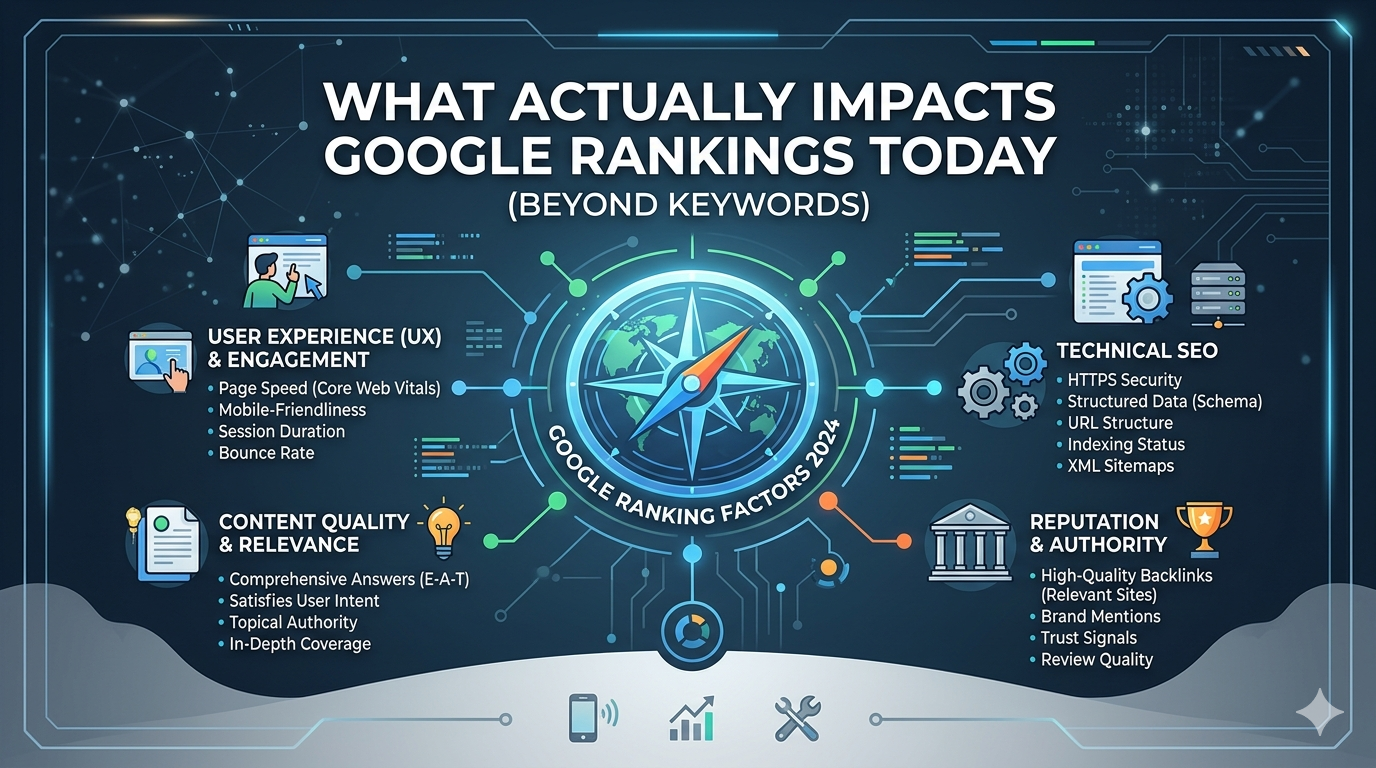
    Google: think of it as a matchmaker. Connecting people with answers. Now, picture this: someone clicks your link. Then immediately bounces back to Google. Signal sent. Your site isn’t hitting the mark. That’s where User Experience (UX) steps in. Google watches user interaction intently. Bounce rate (those who leave after one page). Dwell time (how long they linger). Pages per session (how many they devour). All indicators. Positive UX? It shouts: “This site is useful!” Rankings rise. Negative UX? Rankings plummet. No matter how many phrases you cram in. Improve UX by optimizing design. Streamlining navigation. Delivering engaging content. Mobile-friendly matters. Fast loading is essential. Clear, concise information solves user needs. Prioritizing UX boosts rankings and builds a loyal following. Indirect, yet fundamental.

    Content Quality: The King (and Queen) of Google

    Content is no longer just keywords. It’s value. Answering questions. Engaging. Google’s algorithms? Designed to sniff out, then reward, high-caliber content: informative, accurate, well-crafted. This means going beyond just repeating terms. Offer unique insights. Data. Perspective. High-quality content? It attracts. It holds attention. It encourages sharing. Engagement tells Google: “This site is a treasure!” Rankings soar. Focus on original research. Expert insights. Actionable advice. Keep language clear. Concise. Use headings. Subheadings. Images. Video. Break up the text. Optimize readability. Banish errors. Keep it fresh. Promote it widely. Quality content establishes authority. It attracts organic traffic.

    Technical SEO: The Invisible Foundation for

    Technical SEO? The under-the-hood stuff. The unseen aspects that impact visibility. Content and UX are vital. But technical issues can undermine them. Prevent Google from crawling, from indexing. Technical SEO optimizes structure, code, server configuration. Easy access for search engines. Create a sitemap. Optimize robots.txt. Boost speed. Mobile-friendly? Essential. Addressing technical issues? Significantly improves rankings. Google understands, Google indexes. Fast loading? Better user experience, yes. But it also signals a well-maintained, reliable site. Well-structured? Easier crawling, easier indexing. Visibility increases. Regularly audit. Address issues promptly. Google Search Console. Screaming Frog. Tools to help identify, then resolve. Overlooking technical SEO? Negates all the positives. Content. UX. Prioritize it. Placement is only one piece.

    Link Building: Earning Trust and Authority with

    Links are votes of confidence. Other reputable sites link to you? It shouts: “This site is trustworthy!” Link building is acquiring these backlinks. A crucial factor. But links aren’t equal. Links from high-authority sites in your niche? Worth far more. Google’s algorithms reward strong backlink profiles from trusted sources. Build by earning, not just acquiring. High-quality content others want to link to. Reach out to influencers. Journalists. Promote your content. Guest blogging. Forums. Shareable infographics. Tactics. Avoid black-hat techniques: buying links. Link schemes. Penalties ensue. Focus on genuine relationships. Value for their audience. A strong backlink profile improves rankings. It also boosts visibility, credibility. Contextual use encourages links.

    Mobile-First Indexing: on Every Device

    Most users access the web on mobile. Google shifted. Mobile-first indexing. The mobile version is now used to index, to rank. Not mobile-friendly? Search results suffer. No matter desktop performance. Mobile-first underscores the importance of responsive design. Adaptable. Seamless. Optimize with a mobile-friendly theme. Compress images. Minimize Javascript. CSS. Test on different devices. Ensure a consistent experience. Mobile page speed is critical. Slow loading? Higher bounce rates. Lower rankings. Use Google’s Mobile-Friendly Test. Resolve any issues. Prioritize mobile. Ensure you are well-positioned to succeed. Appropriate use is vital. A mobile-friendly site? Essential for capturing traffic.

    E-A-T: Expertise, Authoritativeness, Trustworthiness and

    E-A-T. Expertise. Authoritativeness. Trustworthiness. Google looks for these. Especially in “Your Money or Your Life” (YMYL) topics. Health. Finances. Safety. Demonstrate E-A-T. Rank well. Expertise? The level of knowledge. Skill. Authoritativeness? Reputation. Influence. Trustworthiness? Accuracy. Honesty. Reliability. Ensure content is well-researched. Factually accurate. Credible sources. Identify the author. Provide credentials. Expertise. Build a strong reputation. Industry events. Guest posts. Reputable sites. Positive reviews. Testimonials. Transparency about ownership. Policies. Accessible contact information. Prioritize E-A-T. Build trust. Demonstrate reliability. Vital in YMYL niches. Accuracy is key. Strategic use should always be within expert content.

    Schema Markup: Helping Google Understand Your

    Schema markup. Structured data. Added to HTML. Helps Google understand the content. Additional context: content type, author, publication date. Improved indexing. Richer search results. Implementing schema? Adding code snippets. Describes the content. Different types for different content: articles, products, events. Google’s Structured Data Markup Helper. Generate appropriate markup. Test it. Google’s Rich Results Test. Ensure correct implementation. Improved understanding. Visually appealing display. Increased click-through rates. Improved rankings. Ensuring appropriate phrases are marked up improves understanding.

    Page Speed: Fast Loading Times for Better

    Page speed. How quickly your site loads. A critical factor. Users expect speed. Slow loading? Frustration. Higher bounce rates. Google considers page speed. Optimize. Several ways to improve it: optimize images, minimize HTTP requests, enable browser caching, use a content delivery network (CDN). Google’s PageSpeed Insights. Identify areas for optimization. Compress images. Reduce file size. Minimize HTTP requests. Combine CSS. JavaScript. Enable browser caching. Returning visitors load faster. Use a CDN. Distribute content across multiple servers. Reduce distance. Improve user experience. Lower bounce rates. Increase rankings. Indirectly improves visibility.

    The Power of Video and

    Video content. Increasingly important. Google loves it. Engaging. Informative. Embedding videos? Increases dwell time. Improves user experience. Opportunity to target in a different format. Optimize titles. Descriptions. Tags. Relevant terms. Transcribe videos. Accessibility. Additional context. Promote videos on YouTube. Other platforms. Attract more visitors. Improve engagement. Boost rankings. High-quality video? Communicates complex information. Engages. Placement within the video description and transcript enhances visibility.

    Staying Ahead of the Curve: Continuous Learning and

    The world of SEO is in constant flux. Google updates its algorithms. Staying ahead requires continuous learning. Adaptation. Keep up with trends. Best practices. Industry blogs. Webinars. Industry experts. Social media. Experiment. See what works. Analyze website performance. Google Analytics. Google Search Console. Identify areas for improvement. Adapt your strategy. Focus on providing value. Positive user experience. Build loyalty. Higher rankings. Never stop learning. Always strive for the best experience. Continuously refine your approach. Ensure your site remains competitive.

    Conclusion: The Holistic Approach to

    High rankings demand a holistic approach. More than just content filled with specific phrases. User experience. Content quality. Technical SEO. Link building. Mobile optimization. E-A-T. Schema markup. Page speed. Video integration. Crucial roles. Improve rankings. Attract more visitors. Achieve online business goals. SEO is a long game. Patience. Persistence. Commitment. Provide value. Embrace the holistic approach. Stay informed. Never stop striving. Create the best experience. Ensure your website remains competitive. Visible. The ultimate goal? Not just to rank high for one particular phrase. It’s building a sustainable online presence. Attract. Engage. A target audience.

  • On-Page SEO Checklist for AI Search Engines

    On-Page SEO Checklist for AI Search Engines

    On-Page SEO Checklist for AI Search Engines

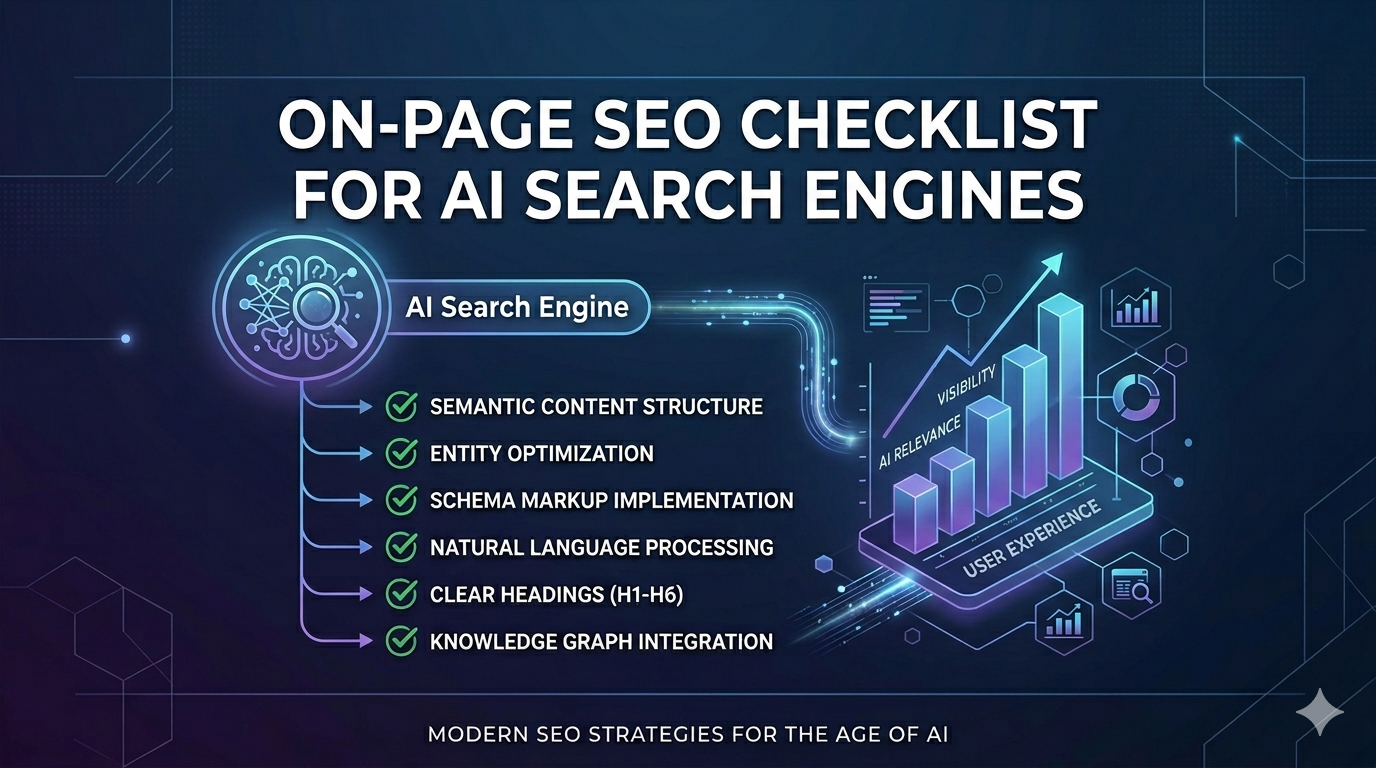
    Picture this: a digital realm where search engines grasp content with the same nuanced understanding as a human. It’s not a futuristic fantasy; it’s our reality, supercharged by artificial intelligence. Yet, even amidst this AI revolution, the core principles of on-page SEO remain vital. This is our story – a narrative of strategic adaptation in this brave new world. Today, we’re pulling back the curtain on an on-page SEO guide, meticulously crafted for the age of AI search. Discover how to fine-tune your content, soar in the rankings, and magnetize organic traffic.

    The Dawn of AI-Powered Search

    Forget keyword-stuffing relics. We’re witnessing a seismic shift – from rudimentary, keyword-centric algorithms to the sophisticated comprehension of AI. Search engines now dissect content contextually, weighing its relevance, authority, and the overall user journey. This sea change demands a reimagined on-page SEO approach. Think: natural language woven seamlessly, comprehensive coverage that leaves no stone unturned, and technical brilliance under the hood.

    Keyword Research: The Foundation Still Matters

    Keyword research? Still the bedrock, absolutely. But the game has evolved. We’ve pivoted from obsessing over sheer keyword volume to truly decoding user intent, pinpointing those long-tail gems that mirror specific needs. Dive deep! Analyze queries, dissect related questions, chart the user’s quest. It’s not just about the words themselves; it’s about the burning question behind them. The use of is essential in understanding trends.

    Content Optimization: Crafting for Humans and AI

    Content is king, yes. But in this AI epoch, content that is relevant, engrossing, and utterly comprehensive? That wears the crown. AI algorithms favor content that doesn’t just answer; it resolves user queries. Unique angles, demonstrated know-how. Keyword stuffing is out. Creating stellar, insightful, and expertly structured content is in. A delicate dance: writing for both human eyes and AI brains, balancing readability with razor-sharp accuracy. Relevance, authority, trustworthiness. These are your guiding stars. For an AI search engine, is more than just a phrase; it’s a philosophy.

    Headline Optimization

    That headline? Your opening act. Make it count. Compelling, crystal clear, a true reflection of what lies beneath. Weave in primary keywords naturally, but never at the expense of clarity or that vital user allure. A masterful headline? Skyrocketing click-through rates, a beacon to AI algorithms. Succinct. Informative. Emotionally resonant.

    Body Content Optimization

    The body of your content should be an expedition to deliver detailed answers to every user inquiry. Subheadings are your map, structuring content logically for humans and AI alike. Keywords? Incorporate them, organically. Avoid the pitfall of overstuffing. Valuable insights reign supreme. Back up claims with evidence, and sculpt a reading experience that flows. AI algorithms reward substance, clarity, user-centricity. Always focus on enriching the user experience.

    Image Optimization

    Images aren’t just window dressing; they’re integral. Go high-quality, relevance is key. Descriptive keywords in file names and alt text are non-negotiable – this helps AI understand the image’s context while boosting accessibility. Optimize for speed, compress ruthlessly. Page load times are a ranking heavyweight. is a visual and textual experience.

    Technical SEO: Ensuring Crawlability and Indexability

    Technical SEO? The bedrock upon which all your other SEO efforts stand. Make sure search engine bots can easily crawl and index your website. Optimize site architecture. Craft a sitemap. Use robots.txt to guide the crawlers. A technically flawless website is essential. It’s how AI search engines assess your content and decide where you land in the rankings. A well-structured site is key.

    Mobile-First Indexing

    Mobile isn’t the future; it’s the now. Mobile-first indexing is non-negotiable. A fully responsive website, a seamless user experience across all devices – these are your table stakes. Mobile optimization? Page speed, simplified navigation, mobile-friendly design. Forget optional. A mobile-friendly website is utterly, unequivocally essential. The use of is essential for attracting mobile users.

    Site Speed Optimization

    Page load speed? A ranking titan on both desktop and mobile. Optimize images, embrace browser caching, slash those HTTP requests. Google PageSpeed Insights is your friend; use it to pinpoint areas for rapid improvement. A lightning-fast website delights users and signals quality to those all-important AI algorithms. A faster site is a better site.

    Schema Markup

    Schema markup speaks directly to search engines, handing them structured data about your content. Context, meaning – it’s all there. Implement schema markup to shine a light on your articles, products, events, every piece of the puzzle. The result? Enhanced visibility, juiced-up click-through rates. Schema markup is the language of search engines. The use of enhances the search engine experience.

    User Experience (UX): Prioritizing Engagement and Satisfaction

    User experience is ascending the SEO throne. AI algorithms scrutinize user behavior – bounce rate, dwell time, page views. The verdict? A thumbs-up or thumbs-down on your content’s quality and relevance. Craft a website that’s a joy to use – intuitive navigation, compelling calls to action, content that captivates. A happy user isn’t just a vanity metric; it drives conversions and cements customer loyalty. A happy user is a valuable asset.

    Content Readability

    Readability matters, hugely. Short paragraphs, clear headings, bullet points to break up the text. A conversational tone, ditching the jargon. Readable content equals engaged users equals more time spent on your website. Simplicity is key.

    Interlinking

    Internal linking is your website’s circulatory system, guiding users and signaling importance to search engines. Link strategically, using descriptive anchor text. A cohesive, informative user experience is the prize. A well-linked site is a well-organized site.

    Call to Action (CTA)

    Every page needs a clear call to action – guiding users to their next step. Subscribe, download, purchase – CTAs are your business compass. Compelling language, visually striking designs. A clear CTA is a conversion driver. The use of is essential for driving action.

    Adaptability: Staying Ahead of the Curve

    The SEO landscape is in perpetual motion, AI algorithms ever-evolving. Stay informed, embrace new practices, adapt ruthlessly. Continuous learning and experimentation are survival skills. The only constant is change. is a continuous process of adaptation.

    Monitoring and Analysis

    Track everything. Google Analytics, Google Search Console – these are your eyes in the digital darkness. Monitor rankings, traffic, user behavior. Data-driven decisions are the only decisions that matter. Data is your compass. The use of provides valuable insights.

    Algorithm Updates

    Algorithm updates from the search engine giants? Pay attention. Understand their potential impact, adjust your sails accordingly. Industry blogs and forums are your early warning system. Awareness is key. The use of keeps you informed.

    Conclusion: Embracing the AI-Driven Future of SEO

    AI search engines have reshaped the SEO landscape, demanding elevated content, exceptional user experiences, and unshakeable technical foundations. This on-page SEO guide is your toolkit. Optimize for AI algorithms, ascend the rankings, magnetize organic traffic. Remember, SEO is a marathon, not a sprint. Adaptability is your winning strategy. Embrace this AI-powered future and unlock your website’s true potential. The future of search is here.

    Key takeaways:

    • User intent and long-tail keywords are your North Star.
    • Content must be stellar: informative, engaging, high-quality.
    • Technical soundness and mobile-friendliness are non-negotiable.
    • User experience and engagement are paramount.
    • Stay informed, adapt continuously.

    Implement these strategies and watch your website flourish in this age of AI-powered search.

  • Technical SEO Mistakes That Kill Your Rankings

    Technical SEO Mistakes That Kill Your Rankings

    Technical SEO Mistakes That Kill Your Rankings

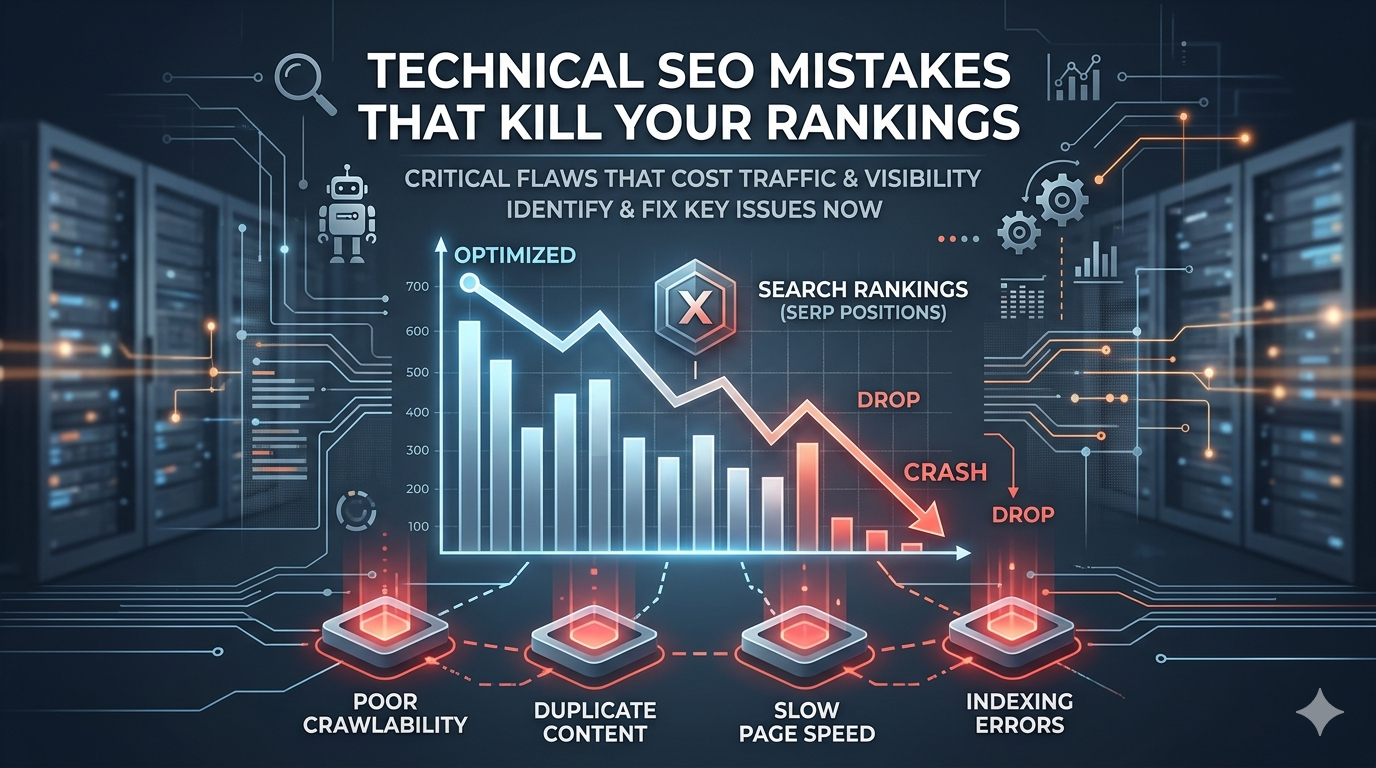
    Envision your website: a grand vessel poised to navigate the vast digital ocean. Its design? Impeccable. Content? Rich and inviting, beckoning new visitors. But imagine a stealthy leak, hidden deep within, threatening to sink your ambitions. This “leak” often manifests as technical SEO missteps. They’re silent killers, capable of derailing even the most ingenious content plans. Within this guide, we’ll chart a course through the often-treacherous waters of technical SEO, exposing prevalent pitfalls. We’ll equip you with insights to keep your online presence buoyant and scaling the heights of search engine results.

    The Foundation is Key: Crawlability and Indexability

    Before search engines even entertain the notion of ranking your site, they need to find it. Then, understand it. This begins with crawling – digital bots exploring every nook and cranny of your site. Is your site tough to crawl and index? It’s akin to reading a book with entire chapters missing! Technical SEO makes sure search engines can easily reach, understand, and properly categorize your content. This is absolutely essential.

    Mistake #1: Robots.txt Misconfiguration

    Think of the robots.txt file as a gatekeeper, carefully instructing search engine bots on what to explore and what to avoid on your site. A misplaced “do not enter” directive can accidentally block search engines from cataloging pages that are vital. Imagine telling the postal service not to deliver to your best patrons. Routinely check your robots.txt file. Make certain it’s not hindering search engine access. I recall a client once blocking their entire site, all because they disallowed “/”. The crawler ignored everything. Seemingly minor, this error took weeks to pinpoint, costing a fortune in revenue and lost traffic. Paying attention to these subtle technical SEO details prevents catastrophes.

    Mistake #2: Orphan Pages

    Orphan pages… imagine lost children, wandering your website with no links pointing to them. Search engines struggle to find these isolated pages. This results in limited exposure and wasted ranking opportunities. Every page needs to be part of a well-connected web, linked via meaningful internal connections. Employ a website crawler to pinpoint these neglected pages. Then, incorporate them into your site’s internal linking. Audits frequently reveal surprising numbers of these pages. They frequently contain superb material, simply undiscovered.

    Mistake #3: No XML Sitemap

    Consider an XML sitemap: a roadmap. Search engine bots utilize it, guiding them through your site’s structure. It showcases your important pages, streamlining discovery. Submitting an XML sitemap signals a desire to be crawled and considered for ranking. Without one? It’s like inviting guests to a mansion without a floor plan. Revise your XML sitemap frequently, reflecting any content and structural changes. Minding these fundamental technical SEO aspects can dramatically boost overall performance.

    Speed Matters: Website Performance and User Experience

    In our high-speed digital age, website speed isn’t just nice. It’s essential. People expect lightning-fast loading. Search engines favor sites that deliver a superb user experience. Slow loading? It frustrates users, increases bounce rates, and lowers rankings. Technical SEO is key in enhancing site performance, ensuring top-tier user experiences. Consider this, for instance: A huge e-commerce platform saw a 2% bump in conversions for every 100ms shaved off page load times. That’s a direct connection between technical SEO and hard cash.

    Mistake #4: Unoptimized Images

    Bulky, unoptimized images can significantly bog down loading speed. Compress images before uploading, without sacrificing visual appeal. Use correct file types (JPEG for photos, PNG for graphics). Make certain images are sized correctly for display. Implementing lazy loading also boosts perceived performance; images load only when visible. Overlooking image optimization: a common technical SEO blunder. But it hurts user experience and search engine rankings.

    Mistake #5: Lack of Browser Caching

    Browser caching lets web browsers store static resources (images, CSS, JavaScript) locally. No need to re-download on subsequent visits. Enabling browser caching improves load speeds, especially for returning users. Set up your web server to fully harness browser caching. A simple technical SEO fix. The rewards can be substantial.

    Mistake #6: Unminified CSS and JavaScript

    Minifying CSS and JavaScript entails stripping unnecessary characters (whitespace, comments) from code. This shrinks file sizes, enhancing load speeds. Employ online minification tools, or tweak your build process to automate minification. Seemingly minor? This boosts overall site speed. An element of technical SEO that yields compounding dividends.

    Mobile-First Indexing: Optimizing for Mobile Devices

    Most web traffic now originates from mobile devices. Search engines have transitioned to mobile-first indexing. They primarily use the mobile version of a site for indexing and ranking. Is your site not mobile-optimized? You’re practically invisible. Technical SEO for mobile means ensuring your site is responsive, loads quickly on phones, and delivers a smooth user experience across all devices.

    Mistake #7: Non-Responsive Design

    A responsive website adapts to any screen size. It provides optimal viewing on desktops, tablets, phones. A non-responsive site frustrates mobile users. Expect high bounce rates. Implement a responsive design framework. Guarantee accessibility and user-friendliness on all devices. Mobile’s ascendancy makes responsive design a technical SEO cornerstone. No longer a suggestion. A requirement.

    Mistake #8: Mobile Page Speed Issues

    Mobile users often face slower internet than desktop users. Mobile page speed optimization is key for a great user experience. Use Google’s PageSpeed Insights to find mobile speed issues. Then, apply recommended fixes. Optimize mobile page speed. Cater to the growing mobile audience. Optimizing mobile page speed matters because search engines weigh page speed as a ranking signal, especially on mobile. Slow speeds translate to poor user experience, higher bounce rates, and diminished search rankings.

    Mistake #9: Intrusive Interstitials on Mobile

    Intrusive interstitials (pop-ups that mask content on mobile) hurt user experience and rankings. Avoid interstitials that block content. Instead, concentrate on a clean, user-friendly mobile journey. Google explicitly states intrusive interstitials can trigger search penalties. This technical SEO best practice aligns perfectly with user-centered design.

    Structured Data: Helping Search Engines Understand Your Content

    Structured data markup adds code. It provides search engines with insights about your content. It helps them discern context and meaning, letting them showcase content in rich snippets and enhanced search results. Technical SEO uses structured data to improve search engine comprehension and amplify visibility. Think of it as adding labels to products, enabling easier discovery.

    Mistake #10: Lack of Schema Markup

    Schema markup? A structured data form. It uses a standardized vocabulary to explain your content. Implementing schema improves visibility and click-through rates. Use Google’s Structured Data Markup Helper to generate schema. Neglecting schema is a lost opportunity. Enhance visibility, attract organic traffic. Underutilized by many, schema offers a competitive edge to those who embrace it.

    Mistake #11: Incorrect Schema Implementation

    Incorrect schema can confuse search engines, potentially harming rankings. Validate schema using Google’s Rich Results Test. Is it implemented correctly? Regularly check your schema for errors. Quickly fix any issues. Accuracy is paramount in technical SEO. Make certain your schema is accurate. Schema validation: core technical SEO.

    Mistake #12: Inconsistent NAP Information

    NAP (Name, Address, Phone Number): crucial for local SEO. Is your NAP consistent across your site, online directories, and social media? Inconsistent NAP confuses search engines, hurting local search rankings. Use a consistent format for NAP. Update as needed. Accurate NAP is essential for technical SEO, particularly for businesses targeting local patronage.

    Duplicate Content: Avoiding Penalties

    Duplicate content confuses search engines, diminishing ranking potential. Avoid creating duplicate content. Fix any existing duplication. Technical SEO identifies and resolves these issues, ensuring proper indexing and ranking.

    Mistake #13: Internal Duplicate Content

    Internal duplication: the same content appears on multiple pages. This stems from URL parameters, session IDs, printer-friendly versions. Use canonical tags. Specify the preferred page version. Stop search engines from indexing duplicates. Canonical tags: a foundational technical SEO practice.

    Mistake #14: External Duplicate Content

    External duplication: your content appears on other sites without attribution. Use rel=”canonical” tags. Point to the original source. Stop other sites from outranking you. Protect your content. An important facet of technical SEO and content ownership. Copyright can be complex. Canonical tags can safeguard original content, maintaining ranking power.

    Mistake #15: Not Using 301 Redirects Correctly

    301 redirects? Permanent redirects. They tell search engines that a page has permanently moved. Use 301s when moving a page. Ensure ranking signals pass from the old URL to the new one. Improper use leads to lost traffic and ranking potential. Technical SEO relies on correct 301 implementation. Maintain site structure and rankings during migrations or content changes.

    Security First: HTTPS and Website Security

    Website security? Not just best practice. A ranking factor. Search engines favor sites using HTTPS (Hypertext Transfer Protocol Secure). Data transmitted between the site and users is encrypted. Technical SEO ensures a secure website. Use HTTPS. Protect user data. An HTTPS implementation is indispensable.

    Mistake #16: Not Having an SSL Certificate

    An SSL (Secure Sockets Layer) certificate is needed to enable HTTPS. Obtain an SSL from a trusted authority. Secure your site. Without an SSL, rankings will suffer. User trust erodes. A bare minimum for technical SEO.

    Mistake #17: Mixed Content Errors

    Mixed content errors? A site loads both HTTPS and HTTP resources. This compromises security, triggering browser warnings. Load all resources over HTTPS. Avert mixed content errors. Address mixed content. A critical step for security and technical SEO.

    Beyond the Basics: Advanced Technical SEO Considerations

    Fundamental mistakes addressed? Move to advanced considerations. Optimize for voice search. Implement accelerated mobile pages (AMP). Use structured data for rich snippets and knowledge graphs. Technical SEO: a constant optimization and refinement.

    Mistake #18: Ignoring Core Web Vitals

    Core Web Vitals? Metrics Google uses to measure user experience. Loading speed, interactivity, visual stability. Optimize for Core Web Vitals. Improve rankings. Elevate user experience. Use Google’s PageSpeed Insights. Measure vitals. Find areas for improvement. Follow these new but important technical SEO aspects.

    Mistake #19: Not Monitoring Your Website’s Health

    Regularly monitor website health. Quickly identify and address technical SEO issues. Use tools like Google Search Console and Analytics. Track performance. Identify errors. Proactive monitoring lets you stay ahead. Prevent issues from impacting rankings. Technical SEO maintenance? As important as setup. Continuous monitoring: the key.

    Mistake #20: Not Auditing Your Site Regularly

    A technical SEO audit? A deep dive into your site’s technical underpinnings. Find areas for improvement. Conduct regular audits. Optimize for search engines. Provide a superlative user experience. Technical SEO audits should be an ongoing strategy. Regular audits keep your website healthy. It performs well in search results. Ignoring technical SEO is like ignoring a house’s foundation. Eventually, it crumbles. Address these mistakes. Improve rankings. Draw organic traffic. Deliver a stellar user experience.

    Conclusion: Technical SEO is an Ongoing Journey

    Technical SEO isn’t a one-time fix. Optimization and maintenance are ongoing. Understand mistakes. Implement best practices. Ensure proper crawling, indexing, and ranking. Prioritize technical SEO. It is key to your SEO strategy. Watch your site climb. The key takeaways are:

    • Ensure crawlability and indexability with robots.txt and XML sitemaps.
    • Optimize website speed and mobile-friendliness for user experience.
    • Implement structured data to enhance search engine understanding.
    • Address duplicate content issues to avoid penalties.
    • Prioritize website security with HTTPS and SSL certificates.
    • Monitor website health and conduct regular technical SEO audits.
  • How SEO Works in 2026: A Complete Beginner-to-Advanced Guide

    How SEO Works in 2026: A Complete Beginner-to-Advanced Guide

    How SEO Works in 2026 A Complete Beginner-to-Advanced Guide

    Picture this: A digital realm where algorithms whisper secrets, understood only by the sharpest minds. That’s SEO in 2026. Gone are the days of cheap tricks. Now, it’s about grasping the nuanced dance between what users want, content that truly matters, and where tech is headed. This guide? It’s your map through the basics, the twists and turns, and the cutting-edge moves in search engine optimization. Buckle up; you’re not just keeping pace, you’re leading the charge.

    The Foundation: Understanding Core SEO Principles

    Before peering into tomorrow, let’s anchor ourselves today. At its core, SEO is about lighting up your website for search engines – think Google, Bing, even DuckDuckGo. But it’s not just about being seen. It’s about drawing in the right crowd. People genuinely keen on what you’re offering. How? A blend of tactics:

    • Keyword Research: Unearthing the words your dream audience types when hunting for answers.
    • On-Page Optimization: Sculpting your site’s content and bones to charm search engines.
    • Off-Page Optimization: Bolstering your site’s clout with backlinks and nods from social media.
    • Technical SEO: Ensuring your site runs like a dream – blazing fast, plays nice on phones, and is indexed correctly.

    These cornerstones? Still vital in 2026. The devil, however, is in the details – details that have morphed considerably.

    The Shifting Sands: How SEO Has Evolved

    SEO? It’s no statue. It’s a river, constantly reshaped by algorithm tweaks, tech leaps, and the ever-fickle user behavior. What clicked in 2020 is likely ancient history now. A few major shifts have redrawn the SEO map:

    • The Rise of AI: Search engines are leaning heavily on smart machines to suss out what users really want and serve up spot-on results.
    • Mobile-First Indexing: Google now looks at your mobile site first when deciding how to rank you.
    • Voice Search Optimization: As voice assistants become commonplace, speaking the language of voice search is non-negotiable.
    • E-A-T (Expertise, Authoritativeness, Trustworthiness): Google prizes sites dripping with know-how, credibility, and reliability.
    • User Experience (UX): A smooth, enjoyable visit is a major ranking signal. Sites that are a breeze to navigate, load in a flash, and are easy on the eyes tend to climb the ranks.

    These currents will keep shaping SEO through 2026 and beyond.

    AI-Powered SEO: The Algorithm’s New Brain

    AI isn’t just hype. It’s the engine powering SEO‘s future. Search engines are harnessing AI to grasp the meaning behind searches, dissect site content, and tailor results. Here’s AI’s footprint on SEO:

    • Natural Language Processing (NLP): AI can now decipher the subtleties of human language, unlocking the real intent behind searches.
    • Machine Learning (ML): ML can spot patterns in search data, enabling search engines to fine-tune their ranking systems.
    • RankBrain: Google’s AI, RankBrain, watches how people interact with search results to gauge relevance and quality.

    To thrive in SEO 2026, understanding AI isn’t optional. It’s key. That means crafting top-notch, relevant content that nails what users are after.

    Voice Search Optimization: Speaking to the Future

    Voice search is rewriting how people engage with search engines. With smart speakers everywhere, more and more are speaking their searches. Winning at voice search demands a different playbook than traditional SEO:

    • Long-Tail Keywords: Voice searches tend to be longer, more conversational.
    • Natural Language: Talk like a human in your content. Mirror how people speak.
    • Answer Questions Directly: Serve up quick, clear answers to common questions in your field.
    • Local SEO: Voice search is often about finding local gems – restaurants, shops, you name it.

    By gearing up for voice search, you can tap into a surging market and broaden your reach.

    E-A-T: Building Trust and Authority in a Skeptical World

    In a world swimming in misinformation, trust is gold. Google puts a premium on sites that radiate expertise, authority, and trustworthiness (E-A-T). Here’s how to supercharge your site’s E-A-T:

    • Expertise: Flaunt your knowledge. Produce killer content that screams expertise.
    • Authoritativeness: Become a go-to voice in your industry. Get your name out there in reputable publications.
    • Trustworthiness: Be upfront about who you are, your policies, and how you handle user data. Protect privacy.

    Building E-A-T takes time. But it’s the bedrock of lasting SEO glory. SEO? It’s also about forging a brand people believe in.

    Mobile-First Indexing: Optimizing for the Small Screen

    Most web traffic now happens on phones. Google gets it. That’s why they’ve switched to mobile-first indexing, judging your site based on its mobile version. To ace this:

    • Responsive Design: Make sure your site snaps to fit any screen size.
    • Mobile-Friendly Content: Craft content that’s a pleasure to read and navigate on phones.
    • Fast Loading Speeds: Optimize like crazy for lightning-fast loading on mobile.
    • Mobile Usability: Ensure your site is dead-simple to use on phones, with clear navigation and a smooth design.

    Ignoring mobile? That’s a major SEO own-goal.

    The Power of User Experience (UX)

    User experience is a kingmaker in 2026. Search engines want results that are not just relevant but deliver a fantastic experience. Nail your site’s UX by:

    • Website Speed: Speed. Is. Everything.
    • Navigation: Make it brain-dead easy for users to find what they need.
    • Content Readability: Use clear, punchy language. Break up walls of text with headings, images, and white space.
    • Visual Design: Create a site that’s visually appealing and easy on the eyes.
    • Accessibility: Ensure your site is usable by everyone, including those with disabilities.

    Great UX? It fuels engagement, slashes bounce rates, and boosts rankings. SEO lives and dies by it.

    The Future of Link Building: Quality Over Quantity

    Link building still matters. But the game has changed. A handful of killer backlinks from reputable sites trumps a mountain of junk links. Smart link-building moves:

    • Content Marketing: Pump out content so good, other sites can’t resist linking to it.
    • Guest Blogging: Share your wisdom on other sites in your niche.
    • Broken Link Building: Find dead links on other sites and offer your content as a replacement.
    • Resource Page Link Building: Hunt down resource pages in your field and ask to be added.

    Focus on building bridges with other site owners and crafting content worth sharing. Great SEO is about sparking natural shares and links.

    Local SEO: Reaching Customers in Your Community

    If you serve a local crowd, local SEO is non-negotiable. Boost your local game by:

    • Google My Business: Claim and fine-tune your Google My Business profile.
    • Local Citations: Get listed in online directories and local citation hubs.
    • Reviews: Encourage happy customers to sing your praises online.
    • Local Content: Create content that resonates with your local community.

    By zeroing in on local search, you can pull in more local customers and amplify your online presence. Local SEO is a straight shot to potential buyers.

    Measuring Your SEO Success: Key Metrics to Track

    To know if your SEO is working, keep tabs on these:

    • Organic Traffic: How many visitors are landing on your site from search engines?
    • Keyword Rankings: Where do you rank for your target keywords?
    • Bounce Rate: How quickly are people leaving your site after landing on a page?
    • Conversion Rate: Are visitors taking the actions you want them to take (buying, signing up, etc.)?
    • Domain Authority: A score that reflects your site’s overall clout.

    Use these insights to spot areas for improvement. Effective SEO demands constant attention and course correction.

    Advanced SEO Strategies for 2026

    Beyond the basics, these next-level tactics can give you an edge in 2026 SEO:

    • Schema Markup: Implement schema to feed search engines more details about your content.
    • Content Clusters: Group your content around specific themes to build topical authority.
    • Video SEO: Optimize your videos to attract more viewers.
    • Personalized SEO: Tailor your SEO to specific user groups based on their interests.

    These advanced moves can help you break from the pack and climb higher.

    Staying Ahead of the Curve: Continuous Learning and Adaptation

    SEO never sleeps. Stay sharp by hitting up industry events, devouring SEO blogs, and following the SEO thought leaders. Be ready to pivot your strategy as algorithms shift and user behavior evolves. The secret to long-term SEO triumph? Never stop learning, never stop adapting.

    Conclusion: Mastering SEO in 2026

    SEO in 2026 is complex, dynamic. It calls for a deep grasp of what users want, tech trends, and algorithm updates. Nail the basics, stay ahead of trends, deploy advanced moves, and you’ll climb the ranks, draw more traffic, and grow your business. Remember: SEO is a marathon, not a sprint. It demands constant learning, adaptability, and a relentless focus on delivering value. Embrace it, and you’ll unlock its power. The field is ever-changing, and the future will hold unforeseen twists. But with a solid grounding and a proactive stance, you can confidently steer through it. SEO is a journey, not a destination. Ultimately, it’s about connecting with people and arming them with the information they crave. It’s more than a skillset; it’s a strategic approach to building a thriving online presence. Always keep in mind, when done ethically and well, it’s a win for both search engines and users.

  • How to Find Low-Competition Keywords That Actually Convert

    How to Find Low-Competition Keywords That Actually Convert

    How to Find Low-Competition Keywords That Actually Convert

    The Quest for Undiscovered Keywords: A Digital Marketing Fable

    The digital marketplace? A chaotic bazaar. Businesses elbowing, clamoring, begging for attention. The goal? That top spot. The search engine summit. Giants clash. Small fry? Often flattened. But… a secret path exists. A quiet trail. It promises targeted traffic. More importantly… conversions. A tale, then. Of unearthing those low-competition keywords. Ones that can revolutionize your SEO. Ones that summon the right customers.

    Picture this: you’re a wizard with sourdough. Your bread? Legendary. Instead of slugging it out for “bread” (a keyword warzone), you pinpoint a niche. Perhaps… “artisan sourdough bread San Francisco.” See? The potency of less-contested keywords. Prepare for a guide. One that reveals these gems. One that arms you not just to rank higher, but to lure customers, wallets open, ready to indulge.

    Why Low-Competition Keywords Matter: The David vs. Goliath Scenario

    SEO? A battleground. Keywords? The weapons. High-competition keywords, think “digital marketing services,” are fortresses. Established players, loaded with resources, guard them jealously. Direct assault? A fool’s errand. David facing Goliath with… a dandelion. Low-competition keywords? Ah, those level the field. These are the niche terms. The whispers your target audience utters. Few others? They’re not listening. These keywords let smaller businesses ascend. Achieve rankings. Grab attention. Without bankrupting themselves.

    Envision fishing… in a serene, uncrowded lake. Everyone else? Thrashing the overfished waters of trendy keywords. You? Patiently reeling in treasures from a secluded cove. Low-competition keywords? Sharper focus. Indicating… heightened user intent. Someone seeking “best organic dog food for sensitive stomachs”? Practically brandishing a credit card. A stark contrast to someone vaguely Googling “dog food.” Zero in on these precise terms. Attract leads. Qualified. Primed to convert.

    Step 1: Unleashing the Power of Keyword Research Tools

    The quest? Begins with the proper tools. A treasure chest awaits. Resources galore. Each offering singular peeks into keyword buzz, competition intensity, related terms. Some carry price tags. Many? Offer free peeks or trials. And those? Can still unlock fortunes.

    Google Keyword Planner: a steadfast ally. Dispensing search volume stats. Keyword whispers directly from Google’s oracle. Yes, it woos advertisers. But the insights? Pure gold for SEO seekers. SEMrush: a powerhouse unleashed. Comprehensive keyword scouting, rival analysis, site audits… It’s a one-stop command center. Ahrefs? Another titan. Celebrated for backlink autopsies and keyword hunts. See which phrases your rivals covet. Sniff out potential windfalls.

    Long Tail Pro? Laser-focused. Pinpointing those long-tail keywords. Often less bruising. Highly specific. Helps dissect keyword competitiveness. Reveals profitable niches. Moz Keyword Explorer? Keyword clues, difficulty scores, opportunity whispers… guiding you to prioritize your efforts. Ubersuggest, birthed by Neil Patel, delivers keyword notions, content inklings, competitor dissections. AnswerThePublic? A quirky marvel. Visualizes questions bubbling around a keyword. Unearths content goldmines.

    The key? Experiment. Find the tools that resonate with your soul (and budget). Each offers a unique lens. Blend insights from multiple sources. Achieve keyword nirvana. The more you wield these tools, the sharper your senses. The faster you spot ripe low-competition keyword opportunities. The hunt for worthy keywords? Never underestimate its importance.

    Step 2: Diving Deep with Long-Tail Keywords

    Long-tail keywords? The unsung champions of SEO. Lengthier, precise phrases. Uttered by those nearing a purchase. Example? Instead of “running shoes,” imagine “best running shoes for flat feet on concrete.” Lower search volume? Yes. But also… significantly lighter competition.

    Their beauty? Precision. They lure a hyper-focused audience. Amplifying conversion likelihood. Someone hunting “organic lavender essential oil for sleep”? They’re practically dreaming of clicking “buy.” Target this phrase. Attract eager customers. Moreover, ranking for long-tail keywords? Often smoother sailing. Fewer websites vying for those specific shores.

    Unearthing these gems requires a mindset shift. Ponder your customers’ questions. What demons are they battling? What yearnings consume them? Employ keyword tools. Brainstorm variations on your core keywords. AnswerThePublic excels at revealing question-based long-tail wonders. Sprinkle modifiers like “best,” “cheap,” “review,” and “for.” The possibilities? Limitless. The rewards? Immense. Conquering long-tail keywords is a monumental step.

    Step 3: Unmasking Hidden Opportunities: Competitor Analysis

    Rivals? Keyword goldmines. Dissecting their websites, their content? Unearths keywords you’ve overlooked. First? Identify your chief competitors. Who already ranks for your coveted keywords? Unleash tools like SEMrush and Ahrefs. Analyze their keyword empires. Expose their ranking secrets. Find keywords they’ve conquered, leaving you in the dust.

    Obsess over their long-tail strategy. What precise phrases do they weave into blog posts, product descriptions? Seek gaps in their keyword armor. Relevant keywords they’ve neglected? A golden chance for you to strike, seizing that traffic. Don’t merely mimic; learn. Identify chances to outshine. Craft superior content. Bestow greater value. Outrank them. In time.

    Beyond the tools, manually explore their online havens. What keywords do they flaunt? What content do they conjure? Note what seems to resonate. Then… improve upon it. Rival analysis? Not about theft. About informed decisions. About forging your own keyword destiny. Discovering potential keywords from competitors is extremely valuable.

    Step 4: The Art of Content Creation: Aligning with User Intent

    Keyword research? Half the skirmish. Once you clutch those low-competition keywords, birth content that mirrors user intent. What do seekers crave when they type those words? Information? Solutions? Products? Your content? Must directly quench their thirst. Gift them invaluable insights. First, grasp the intent shimmering behind each keyword.

    Unleash Google. Seek the keyword. Dissect the top results. What content reigns supreme? Blog posts? Product showcases? Videos? A clue! What Google deems most relevant, most helpful. Conjure content that eclipses the existing landscape. Offer deeper insights. Breathtaking visuals. A captivating user journey. Answer every question. Bestow actionable wisdom.

    Optimize! Weave the target keyword into title, headings, body. But… avoid keyword stuffing. Write naturally. Focus on gifting value. Google? Growing wiser. Deciphering context, meaning. Prioritize quality. The apex content? Eloquent, insightful, engaging. It ensnares users. Beckons them back. Producing content with the right keywords will amplify your reach.

    Step 5: Measuring Success: Tracking Your Keyword Performance

    The final act: track, measure. Unleash Google Analytics and Google Search Console. Monitor keyword ascensions, traffic surges, conversion triumphs. Which keywords fuel the most traffic? Track your average ranking. Monitor conversion rates. Do seekers who utter these keywords actually buy your treasures?

    If a keyword falters, adapt. Revisit your content. Optimize further. Forge stronger backlinks. Share on social winds. Experiment. Discover what resonates. Patience is key. SEO? A marathon, not a sprint. Results blossom over months. But consistent tracking, shrewd adjustments… you’ll gradually conquer rankings. Lure targeted traffic. In droves.

    SEO is a living, breathing process. Constant vigilance is paramount. As search engine algorithms evolve, so must your strategy. Stay attuned to the latest whispers. Continuously refine your content. Maintain your keyword grip. Continue to beckon valuable traffic. Wield those keywords wisely.

    The Low-Competition Keyword Advantage: A Summary of Key Takeaways

    Low-competition keywords? A strategic boon in the SEO arena. Spotting niche terms that resonate. Terms that few others pursue. Focus on these. Ascend higher. Attract qualified prospects. Drive conversions. Embrace the power of long-tail whispers. Precise phrases. High intent. They summon a hyper-targeted audience. Amplifying the chances of a sale.

    Scrutinize rivals. Unearth hidden keyword troves. Learn from their victories. Expose their keyword frailties. Birth content that harmonizes with user intent. Offer solutions. Invaluable insights. Above all… track, adapt. SEO? A perpetual cycle. Demanding relentless optimization. With the right strategy, the proper tools, you’ll unlock the low-competition keyword magic. Achieve your SEO ambitions.

    Recall the artisan baker? Focusing on “artisan sourdough bread San Francisco,” not merely “bread”? Luring customers specifically craving their unique creation. This principle? Universal. Find your niche. Discover your low-competition whispers. Birth content that speaks directly to your audience. The key to SEO triumph. Good keywords will lead you to success.

    Unearthing low-competition keywords that convert isn’t merely about pinpointing simple targets; it’s about tactical agreement with user intent and providing real worth. These keywords often symbolize precise requirements or inquiries, presenting a chance to produce content that directly deals with those apprehensions. This focused approach enhances user experience and boosts conversion rates. Furthermore, concentrating on low-competition keywords can result in a more enduring SEO plan, as these terms are inclined to be less vulnerable to algorithm alterations and competitive stresses. They permit businesses to construct a firm base of pertinent traffic that expands over duration.

    Embracing low-competition keywords also cultivates a more profound comprehension of your audience. By investigating the subtleties of their search requests, you obtain understandings into their likings, discomforts, and purchasing behaviors. This awareness can notify not only your content strategy but also your product progress and customer assistance endeavors. Essentially, the pursuit of low-competition keywords is an investment in constructing a more robust, more customer-focused business. These keywords are not just about SEO; they’re about understanding and serving your audience better.

    Moreover, low-competition keywords can unlock opportunities for content diversification. Instead of concentrating solely on broad, universal topics, you can explore niche areas that reverberate with your target audience. This can steer to the creation of unique and captivating content that stands out from the crowd. By targeting precise requirements and interests, you can attract a devoted following of readers who value your proficiency. The best keywords will boost your content.

    The process of finding these keywords also emboldens a more inventive and calculated approach to content creation. Instead of simply churning out articles based on popular topics, you’re compelled to consider critically about how you can add value and differentiate yourself. This can steer to the development of innovative content formats, such as interactive tools, case studies, and in-depth guides. Creating content with the right keywords is key.

    In addition to driving traffic and conversions, low-competition keywords can also enhance your brand presence. By constantly ranking for applicable terms, you establish yourself as an authority in your niche. This can steer to amplified brand awareness and reliability. Furthermore, positive user experiences with your content can generate word-of-mouth references and social media shares, further amplifying your reach. Utilizing the right keywords will make you more visible.

    The long-term advantages of concentrating on low-competition keywords extend beyond immediate traffic and sales. By building a robust foundation of applicable content, you create a valuable asset that can continue to generate leads and customers for years to come. This sustainable approach to SEO is more resilient to algorithm revisions and competitive pressures. The keywords are essential for long-term traffic.

    In summary, the quest for low-competition keywords is a journey that requires patience, persistence, and a calculated mindset. By investing in keyword research, content creation, and performance tracking, you can unlock a wealth of opportunities to expand your business. Embrace the power of niche terms, focus on user intent, and create content that truly reverberates with your target audience. With the right approach, you can transform your SEO strategy and achieve lasting success. Prioritize finding the right keywords.