Author: Jayashree

  • How to Build a Long-Term Conversion Optimization Roadmap

    How to Build a Long-Term Conversion Optimization Roadmap

    How to Build a Long-Term Conversion Optimization Roadmap

    Embarking on the Conversion Optimization Odyssey

    Picture this: a lone ship, adrift at sea, without so much as a tattered map. Perhaps, by sheer luck, it stumbles upon some distant shore. But is that really the destination it sought? Running a website sans a meticulously crafted conversion optimization roadmap feels strikingly similar. Sure, you might snag a few conversions here and there, yet you’re essentially leaving your fate to the whims of chance. Crafting a sturdy, enduring conversion optimization roadmap? This surpasses mere fleeting victories. It’s akin to charting a deliberate voyage toward sustained expansion and fashioning a user experience so enchanting, it effortlessly transforms visitors into loyal patrons. This isn’t solely about A/B experiments; it’s about genuinely grasping your users’ desires, tracing their digital footprints, and skillfully refining each interaction to gently guide them toward that sweet conversion.

    Consider this guide your cartographer. It’s meticulously designed to assist you in drafting that pivotal map – a meticulously detailed conversion optimization roadmap poised to steer your website toward soaring conversion figures and blissfully content clientele. Prepare to delve into dissecting your present performance, pinpointing pivotal zones ripe for enhancement, prioritizing your endeavors with laser-like precision, and enacting alterations that yield enduring triumphs. It’s a perpetual voyage of refinement, with the roadmap serving as your unwavering navigational star.

    Step 1: Deep Dive into Data – The Foundation of Your Roadmap

    Hold your horses! Before even contemplating A/B tests or a fresh splash of color for those buttons, you must first decipher your current standing. How? Immerse yourself in your website analytics and user behavior metrics. Envision yourself as an archaeologist, diligently unearthing concealed patterns and enlightenment that will inform your conversion optimization roadmap. Forget superficial glances at top-tier metrics. This mandates a thorough probe into user conduct spanning diverse segments and digital junctions.

    • Google Analytics (or Similar): Monitor EVERYTHING! Page views, bounce metrics, time spent lingering on pages, conversion figures, successfully completed goals, and originating traffic sources. Dissect your data by device type, browser in use, geographical location, and demographic slices. This unveils a granular perspective on how disparate user cohorts engage with your digital domain.
    • Heatmaps and Session Recordings: Instruments such as Hotjar or Crazy Egg proffer invaluable glimpses into the authentic ways users interface with your website. Heatmaps spotlight where users click, how they maneuver their mouse pointers, and their scrolling habits. Session recordings? They grant you the privilege of witnessing actual user interactions, spotlighting points of aggravation and areas of ambiguity.
    • User Surveys and Feedback Forms: Never underestimate the sheer potency of directly soliciting your users’ perspectives. Employ platforms such as SurveyMonkey or Typeform to construct precisely targeted surveys that harvest sentiments regarding particular facets of your website. Incorporate feedback mechanisms on pivotal pages to seize real-time user input.
    • Customer Relationship Management (CRM) Data: Seamlessly weave your CRM data into your website analytics to comprehend the holistic customer expedition from initial spark to ultimate conversion. This empowers you to discern the interaction points wielding the most substantial sway over conversion metrics.

    Dissecting this treasure trove of data will empower you to pinpoint the most fertile terrains for conversion optimization. Where are your users abandoning ship? Which pages exhibit alarmingly high bounce rates? What universal stumbling blocks impede their progress? The solutions to these posers will forge the bedrock of your conversion optimization roadmap.

    Step 2: Define Your Conversion Goals – What Are You Trying to Achieve?

    Data secured! Now, delineate your conversion aspirations. These objectives must embody the essence of SMART: Specific, Measurable, Achievable, Relevant, and Time-bound. Transcend the conventional confines of solely inflating overall conversion rates. Ponder the significance of micro-conversions that collectively propel you toward your overarching objective. A scrupulously crafted conversion optimization roadmap pivots upon impeccably lucid objectives. For example, does your principal ambition revolve around amplifying sales figures, nurturing lead generation, or enriching user engagement? Each aspiration necessitates a distinct strategic blueprint and arsenal of tactics.

    • Increase Sales: Should your compass point toward sales elevation, rivet your gaze upon optimizing your product showcases, streamlining the checkout ritual, and refining your pricing architecture. Scrutinize metrics encompassing average transaction value, shopping cart abandonment frequency, and the conversion rate from product display to finalized acquisition.
    • Generate Leads: When the pursuit of lead generation ignites your passion, optimize your landing environments, lead capture conduits, and calls-to-action. Track metrics such as lead conversion efficiency, cost per acquired lead, and the caliber of the leads harvested.
    • Improve User Engagement: In the realm of heightened user engagement, channel your energies into refining your content narrative, simplifying navigation pathways, and cultivating an overarching enriching user journey. Monitor metrics encompassing dwell duration, pages explored per session, and bounce incidence.

    Once you’ve articulated your aspirations, rank them contingent upon their prospective sway and attainability. Which aspirations harbor the potential to exert the most profound impact on your revenue streams? Which aspirations lend themselves most readily to realization? This prioritization paradigm will empower you to judiciously allocate resources and rivet your gaze upon the domains demanding immediate conversion optimization intervention.

    Step 3: Identify Key Conversion Opportunities – Where Can You Make the Biggest Impact?

    Fortified with actionable data and crystal-clear aspirations, you’re primed to pinpoint the pivotal junctures within your website that harbor the grandest potential for metamorphosis. Visualize these as the leverage hubs within your meticulously constructed conversion optimization roadmap. Spotlighting these prospects mandates an acute perception for nuances and a profound comprehension of user inclinations. This juncture marks the ascendancy of your data dissection from Step 1.

    • High-Traffic, Low-Conversion Pages: These digital realms command substantial visitor influx, yet they falter in effectively transmuting mere onlookers into steadfast patrons. Dissect these pages meticulously to unveil the underlying rationale. Are calls-to-action enshrouded in ambiguity? Does the narrative lack coherence or pertinence? Does the aesthetic presentation appear chaotic or distracting?
    • Pages with High Abandonment Rates: These represent digital thresholds where users embark upon the conversion trajectory, only to abruptly veer off course prior to consummating the transaction. Illustrative instances encompass checkout interfaces, registration portals, and lead capture mechanisms. Unearth the sources of friction that compel users to forsake these domains.
    • Mobile Experience: With a preponderant share of web-based traffic now emanating from portable contrivances, ensuring your website’s seamless adaptation to mobile platforms assumes paramount significance. Vet your website across an array of devices and screen dimensions to unearth any impediments to usability. Dedicate scrupulous attention to page rendering velocity, ease of navigation, and form composition.
    • Landing Pages: Your landing pages frequently constitute the inaugural impression prospective patrons form of your brand. Ascertain that they exude clarity, conciseness, and captivating allure. Hone your headlines, narrative, and calls-to-action to amplify conversion efficiency.

    Record each avenue, annotating the precise predicament, the foreseeable ramifications, and the substantiating data bolstering your appraisal. This documentation will function as a touchstone as you sculpt your conversion optimization roadmap.

    Step 4: Prioritize Your Optimization Efforts – Focus on the High-Impact Areas

    With a compendium of prospective conversion optimization avenues at hand, you must now prioritize your endeavors. Given the impossibility of simultaneously tackling all fronts, concentrate your energies upon the arenas poised to yield the most substantial reverberations with the least investment of exertion. Herein resides the utility of a strategic paradigm. A steadfast conversion optimization roadmap necessitates ruthless prioritization.

    • Impact vs. Effort Matrix: Fabricate a matrix that plots each avenue predicated upon its prospective repercussion versus the exertion demanded for its manifestation. Zero in upon the prospects residing within the high-impact, low-effort quadrant. These represent the quick gains that furnish the most substantial rewards for your expenditure.
    • Data-Driven Prioritization: Enlist your data to quantify the prospective reverberations of each prospect. By what magnitude could you elevate conversion metrics via refinement of a particular page? How many incremental leads could you cultivate through enhancement of your lead capture architecture? The amplitude of available data correlates directly with the precision with which you can prioritize your endeavors.
    • Resource Constraints: Weigh your accessible resources, encompassing temporal bandwidth, fiscal allocations, and personnel capacity. Certain optimization initiatives may prove more resource-intensive than their counterparts. Prioritize the prospects that you can realistically realize given your extant resource parameters.
    • A/B Testing Capacity: How many A/B trials can you conduct concurrently? Prioritize the prospects that lend themselves most favorably to A/B experimentation, thereby empowering you to expeditiously validate your postulations and refine your outcomes.

    Once you’ve prioritized your pursuits, sculpt a chronological framework for implementation. Inaugurate your efforts with the high-impact, low-exertion prospects and incrementally advance down the roster. This strategy will facilitate sustained concentration and assure consistent advancement toward your conversion optimization ambitions.

    Step 5: Develop Your Testing Hypotheses – Turning Ideas into Actionable Plans

    With your priorities cemented, it’s imperative to formulate concrete testing conjectures for each avenue. A conjecture constitutes a verifiable assertion that elucidates how an alteration to your website will impinge upon conversion metrics. Regard it as a scientific inquest; you’re proffering a supposition and subjecting it to scrutiny to ascertain its veracity. A meticulously delineated conversion optimization roadmap rests upon sound conjectures. This stage metamorphoses abstract concepts into actionable strategies.

    • Start with the Problem: Define with precision the predicament you’re endeavoring to redress. What precise quandary are you confronting? For example, “Users are forsaking the checkout portal due to exorbitant shipping levies.”
    • Propose a Solution: Extend a tangible remedy to the quandary. What modification do you surmise will ameliorate conversion metrics? For example, “Extending complimentary shipping on orders exceeding $50 will curtail shopping cart abdications.”
    • State the Expected Outcome: Quantify the anticipated repercussions of your resolution. By what proportion do you foresee conversion metrics augmenting? For example, “We anticipate a 15% diminution in shopping cart abdications upon extending complimentary shipping on orders surpassing $50.”
    • Formulate a Testable Hypothesis: Fuse the predicament, resolution, and anticipated repercussions into a verifiable conjecture. For example, “Extending complimentary shipping on orders surpassing $50 will precipitate a 15% diminution in shopping cart abdications.”

    For each conjecture, pinpoint the pivotal metrics that you will scrutinize to gauge the trial’s ramifications. This will assist you in ascertaining whether your conjecture garners substantiation from the data. This constitutes a keystone of any efficacious conversion optimization roadmap.

    Step 6: Implement A/B Testing – Putting Your Hypotheses to the Test

    With your testing conjectures firmly entrenched, it’s opportune to subject them to evaluation via A/B experimentation. A/B experimentation embodies a methodology for juxtaposing dual iterations of a webpage or element to discern which rendition yields superior performance. It serves as a pivotal instrument for validating your conjectures and optimizing your website for conversion. The conversion optimization roadmap discovers its pragmatic manifestation within A/B experimentation.

    • Choose an A/B Testing Tool: Elect an A/B experimentation tool that aligns with your requisites and budgetary constraints. Prominent selections encompass Optimizely, VWO, and Google Optimize.
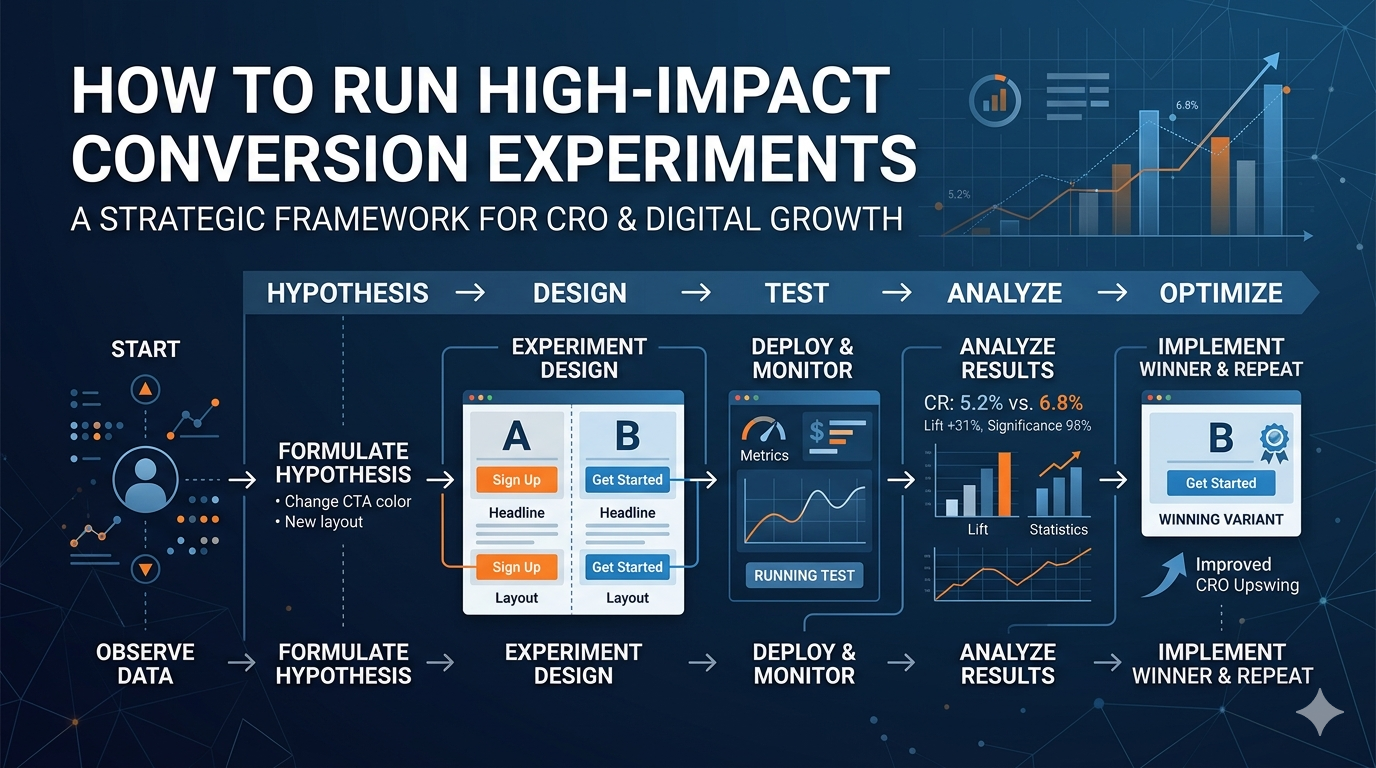
    • Create Variations: Fabricate dual iterations of the webpage or element that you aspire to vet. The control iteration (A) embodies the pristine rendition, while the variation iteration (B) embodies the rendition incorporating the proposed modification.
    • Set Up Your Test: Configure your A/B experimentation tool to partition traffic amid the control and variation iterations. Define your primary and secondary metrics, and stipulate a target sample amplitude.
    • Run the Test: Permit the trial to proceed until it attains statistical significance. This entails accumulating sufficient data to confidently resolve whether the variation iteration outperforms the control iteration.
    • Analyze the Results: Upon culmination of the trial, dissect the outcomes to ascertain which rendition excelled. Did the variation iteration augment conversion metrics as anticipated? Did the outcome attain statistical significance?

    Document the ramifications of each A/B trial, annotating the conjecture, the implemented modifications, the scrutinized metrics, and the deduced conclusions. This documentation will assist you in constructing a knowledge reservoir of efficacious and inefficacious strategies on your website. This process embodies the means by which you refine your conversion optimization endeavors over time.

    Step 7: Analyze and Iterate – Continuous Improvement for Long-Term Success

    A/B experimentation transcends a solitary undertaking; it constitutes a perpetual cycle of dissection and iteration. Upon culmination of an A/B trial, dissect the outcomes to discern the factors that contributed to its success or failure. Leverage these discernments to refine your conjectures and devise novel trials. Your conversion optimization roadmap ought to function as a dynamic chronicle, ceaselessly evolving as you garner deeper insights into your users and their inclinations. It embodies a cycle of inquiry, learning, and recurrence.

    • Document Your Findings: Establish a centralized compendium for all your A/B experimentation ramifications. This compendium will assist you in tracking your advancement and discerning patterns over time.
    • Share Your Learnings: Disseminate your A/B experimentation ramifications among your team to cultivate a milieu of experimentation and perpetual refinement.
    • Refine Your Hypotheses: Employ the insights gleaned from your A/B trials to refine your conjectures and devise novel trials. Shun complacency and dare to challenge your presuppositions and explore unconventional methodologies.
    • Stay Up-to-Date: Remain abreast of the vanguard tendencies and optimal protocols in conversion optimization. Partake in industry symposia, peruse blog publications, and trail thought instigators on social media ecosystems.

    By ceaselessly dissecting and iterating, you can assure that your website remains perpetually optimized for conversion. This will empower you to attain your business aspirations and furnish an enhanced sojourn for your users. The conversion optimization roadmap serves as your guide to this ongoing expedition.

    Step 8: Long-Term Vision – Keeping the Roadmap Alive

    Constructing a conversion optimization roadmap isn’t a fleeting endeavor; it’s an ongoing odyssey. A sustained vision guarantees the roadmap’s enduring pertinence and efficacy. This encompasses periodic evaluations, revisions, and an unwavering allegiance to perpetual refinement. Absent this vision, the roadmap risks obsolescence and forfeiture of its potency. This culminating stage solidifies your conversion optimization roadmap as an enduring constituent of your business blueprint.

    • Schedule Regular Reviews: Designate temporal slots each quarter to scrutinize your roadmap, dissect your ramifications, and revise your priorities.
    • Incorporate New Data: As you accrue supplementary data from your website and your clientele, assimilate this information into your roadmap.
    • Adapt to Changes: The online realm undergoes incessant flux; ergo, your roadmap must exhibit sufficient malleability to acclimate to nascent technologies, inclinations, and user conduct.
    • Seek Feedback: Routinely solicit feedback from your team, your clientele, and industry savants to assure that your roadmap aligns seamlessly with your business ambitions.

    A sustained vision guarantees that your conversion optimization roadmap remains a priceless asset for your enterprise.

    Conclusion: Charting a Course to Conversion Success

    Fabricating a sustained conversion optimization roadmap embodies an investment in your enterprise’s trajectory. It constitutes a cycle of perpetual betterment that mandates data-driven adjudication, strategic prioritization, and an unwavering allegiance to experimentation and iteration. By adhering to the protocols delineated within this compendium, you can architect a roadmap poised to steer your website toward amplified conversion metrics, contented clientele, and enduring triumph. The voyage toward conversion optimization unfolds as an ongoing endeavor, yet armed with a meticulously defined roadmap, you’ll possess the requisite armament to navigate the ever-shifting digital topography and realize your business ambitions. Recall, the most triumphant websites represent those that ceaselessly evolve and acclimate to the exigencies of their users. Uphold experimentation, sustain learning, and perpetuate optimization, and you’ll expeditiously traverse the path toward conversion optimization eminence.
  • How to Turn Insights Into Conversion Improvements

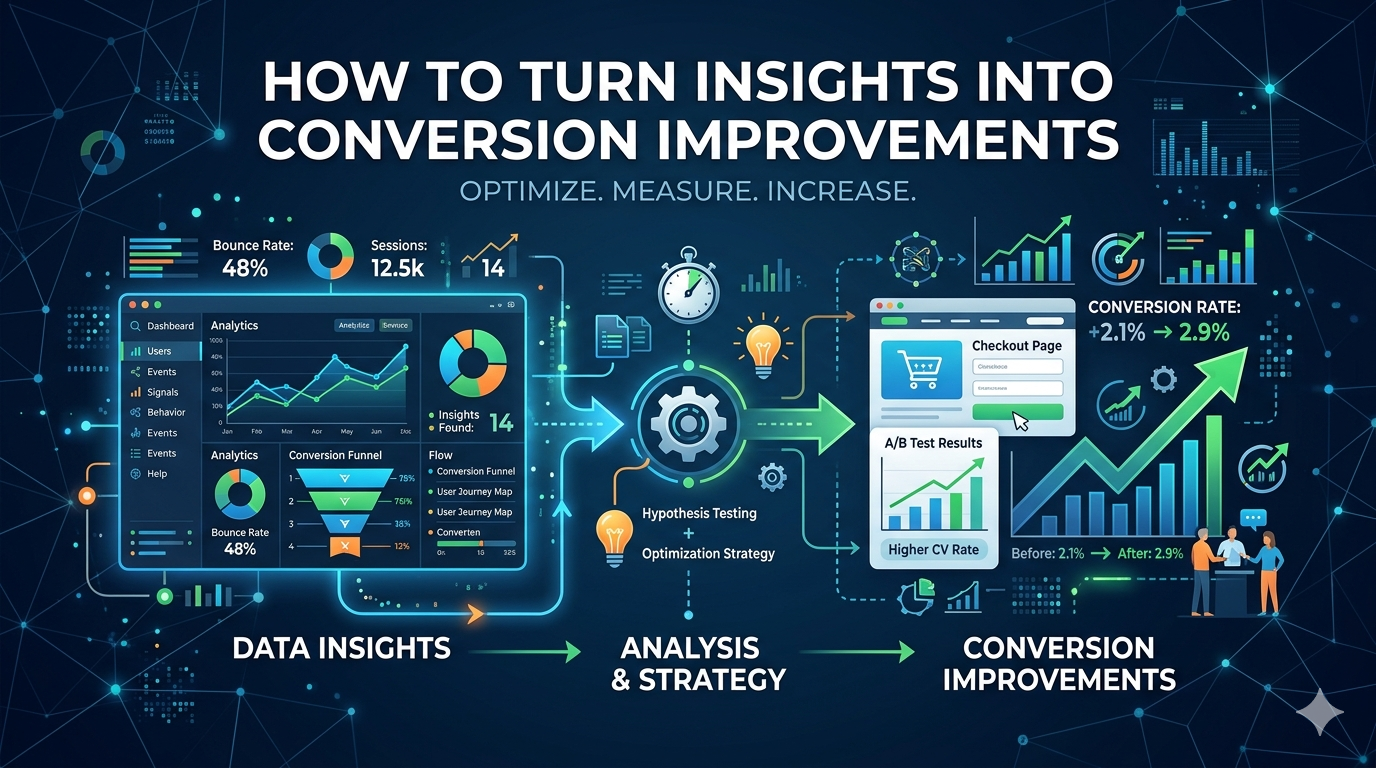
    How to Turn Insights Into Conversion Improvements

    How to Turn Insights Into Conversion Improvements

    How to Turn Insights Into Conversion Improvements

    Picture this: you’re standing at a fork in the road. Before you stretches a landscape brimming with data. Each solitary piece, a possible course. Each metric, a beacon. And the destination? Amplified conversions. It’s more than gathering information; it’s about molding that information into tangible plans. Plans that grip your audience and fuel genuine outcomes. So many enterprises are adrift in data, yet parched for genuine wisdom. We’re here to show you how to slake that thirst. How to nurture a flourishing garden of conversion.

    The Compass: Identifying Key Performance Indicators (KPIs)

    Any expedition requires direction. In the realm of conversion, that’s your Key Performance Indicators (KPIs). Not just random numbers. These are the lifeblood of your site. They mirror user conduct, interest, and the ultimate barometer: triumph. Envision KPIs as your North Star. They steer every choice you make. What do you seek to gain? More closed sales? Potential clientele? Heavier traffic? Pinpointing aims is the starting point for selecting relevant KPIs.

    Examples of essential KPIs:

    • Conversion Rate: The percentage of visitors who take the desired action (purchase, sign-up, etc.).
    • Bounce Rate: The percentage of visitors who bail after viewing a solitary page.
    • Average Session Duration: The average span visitors linger on your site.
    • Click-Through Rate (CTR): The percentage of users who engage with a link or advertisement.
    • Cost Per Acquisition (CPA): The price of gaining a new patron.

    Merely a sampling! The precise KPIs hinge on your enterprise ambitions. Choose metrics that are pertinent, quantifiable, and…well, something you can use. Observing these provides a grounded sense of your site’s health. This lets you spot possibilities for making conversion improvements.

    The Map: Gathering and Analyzing Data

    With a compass set, it’s time to unfurl the map. This map? It’s crafted by amassing and scrutinizing information from myriad origins. Envision yourself as a navigator, charting the unknown. The more data you grab, the brighter that map glows. And the more potential you can find for conversion improvements.

    Some crucial information wells:

    • Google Analytics: Track site movement, user behavior, and conversion specifics. A powerhouse.
    • Heatmaps: Visual depictions of user movement on your digital property. See where they click, what they skim, where they spend their precious attention.
    • Session Recordings: Recorded user journeys. Valuable insights into how patrons steer through your digital domain.
    • Customer Surveys: Immediate feedback from your buyers. Uncover needs, trouble spots, and hopes.
    • A/B Testing Platforms: Pit different forms of your site against one another to find what thrives.

    Scrutinizing such treasure troves demands a sharp eye and a deliberate approach. Seek echoes, flows, and anomalies. Where do patrons drift away? Which areas spark to life? What spills from the mouths of surveyed clients? These answers will shape your effort to amplify conversion improvements. For instance: A high bounce rate on a particular spot may hint at thin content, a chaotic arrangement, or hitches in the wiring. Similarly: Sagging click-through rates on your vital prompts may suggest your wording needs punch. Chart the map closely for conversion improvements.

    The Toolkit: Implementing Data-Driven Changes

    Map in hand, time to assemble your kit. The tools? Plans and methods to enact data-fueled shifts on your site. Now you’re a builder. Data becomes the architectural plan to conjure a more effective, more welcoming place. Your kit should have a range of implements, each to tackle particular conversion worries and foster conversion improvements.

    A handful of must-haves:

    • Website Optimization: Tweak layout, utility, and total feel to elevate the user voyage.
    • Content Marketing: Craft worthwhile, captivating content that draws patrons and turns them into buyers.
    • Call-to-Action Optimization: Forge irresistible prompts that spur users toward desired acts.
    • Landing Page Optimization: Mold high-performing entry points tailored for particular drives or deals.
    • Email Marketing: Tend prospects and ignite closed sales through pointed electronic campaigns.

    Each has the strength to mend certain friction points and lift conversion numbers. Suppose data hints that users fumble about trying to uncover something. You might rethink navigation or add a means to search. Unhappy landing page performance? Juggle headlines, images, or those critical prompts. Testing rules. And measure everything.

    The Testing Ground: A/B Testing and Iteration

    Every grand concept arises from trials, from mistakes, from the furnace of experimentation. In conversion optimization, A/B testing becomes your crucible. Contrast one webpage or email against another. Watch which thrives. Be the scientist, running studies to pinpoint the mightiest ways to fuel conversion improvements.

    This means conjuring two versions, A and B. Then, at random, show each variant to bits of your audience. By watching the performance of each, you can decide which results in more closed transactions. Concrete evidence to support choices. Assurance that shifts truly amplify results. Essential to the chase for conversion improvements.

    Things you can A/B test:

    • Headlines: Which commands attention and encourages probing?
    • Images: Which resonate with your audience’s soul?
    • Call-to-Actions: Which inspire the most clicks?
    • Layout: Which feels intuitive? Which clears a path to conversion?
    • Pricing: Which maximizes worth?

    Not a one-off thing. Testing persists. Constant iteration. Never cease conjuring fresh ideas, noting scores, and reshaping as required. The more you assess, the more you discern about your audience. And what nudges them towards that vital conversion.

    The Storytellers: Crafting Compelling Content

    Information stands tall in this digital age. But any information will not serve. You require a connection with your audience. To provoke transformations, tell tales. Become the bard. Weave narratives that entrance, enlighten, and move your listeners to action. Convincing content gives life to any conversion scheme, fueling substantial conversion improvements.

    The core of mighty content:

    • Relevance: Speak to needs, curiosities, and pain.
    • Value: Offer education, amusement, or a fix.
    • Engagement: Grasp and hold attention.
    • Clarity: Shun technical clutter. Be understood.
    • Persuasion: Nudge toward action.

    To assemble such material, grasp what stirs your audience. Data guides your hand, exposing the topics and types that resonate. Toy with blog posts, videos, infographics, and trials. Remember: be insightful and forceful. Achieve meaningful conversion improvements.

    The Navigators: Optimizing the User Experience

    Picture steering a site choked with clutter. Chaotic. Intricate. Would you linger? Doubtful. User experience (UX) becomes pivotal to conversion. When visitors can easily find what they seek, engage content, and, at last, convert…that’s triumph. You’re an architect. Raise a site that is both pretty and functional. Maximize conversion improvements.

    Key elements of top-tier user experience:

    • Intuitive Navigation: Clear paths to discovery.
    • Fast Loading Speed: Swiftness. Effectiveness.
    • Mobile Responsiveness: Adapts. Shines on every device.
    • Clear Call-to-Actions: Obvious prompts.
    • Accessibility: Caters to every visitor, without exclusion.

    Such refinement demands insight into your listeners and their wants. Data exposes friction points (high bounce rates, low conversion numbers, etc.). User testing yields direct notes on usability. Constant refinement births a site that is pleasing and potent. Dramatic conversion improvements follow.

    The Sherpas: Providing Excellent Customer Support

    Top-notch support can be a catalyst for conversion. Felt support and worth bolsters trust and spurs buying. Envision yourself as a guide, steering customers and ensuring their happiness. That journey? It sparks conversion improvements.

    Traits of stellar support:

    • Prompt Response Times: Quickness and efficiency.
    • Knowledgeable Staff: Trained experts on your offerings.
    • Personalized Service: Tends to individual wants and worries.
    • Multiple Channels: Phone, email, live assistance.
    • Proactive Support: Anticipates needs.

    Such work means prioritizing patrons. Equip staff to unravel knots swiftly. Listen. Hone processes. Build trust. Win loyalty. Significant conversion improvements bloom.

    The Guardians: Protecting User Privacy and Security

    Today’s digital state demands protection of private data. Clients worry about collection and usage. Championing solitude and safety builds trust. Create a shielded space. Be the keeper. Guard data. Assure safety. Witness conversion improvements.

    Vital steps to protect privacy and security:

    • Implement SSL Encryption: Shield data through transmissions.
    • Comply with Data Privacy Regulations: Heed GDPR, CCPA, and more.
    • Be Transparent About Data Collection: Explain usage clearly.
    • Provide Users with Control Over Their Data: Empower them to access, edit, or erase.
    • Implement Security Measures: Fortify the site against peril.

    Privacy and safety aren’t mere legal burdens. They’re moral necessities. This commitment crafts positive brand echoes. Consequential conversion improvements follow.

    The Reward: Sustained Conversion Growth

    Turning those insights into conversion improvements is a quest, not a singular act. Constant loops of gathering, judging, testing, and refining. Embracing this system unlocks constant growth. Diligent application of these maxims paves the road to consistent conversion improvements.

    Remember:

    • Stay Focused on Your Goals: Align all with top ambitions.
    • Embrace Data-Driven Decision Making: Inform your moves. Track your path.
    • Be Patient and Persistent: Endurance wins.
    • Continuously Learn and Adapt: Knowledge evolves. So must your plans.

    These maxims transform your site into a conversion engine. Expect revenue to climb. Expect clients to cheer. Expect total triumph to arrive. A rewarding voyage awaits. Increased worth awaits. Fulfilled clients await.

  • The Best Tools for Conversion Rate Optimization in 2026

    The Best Tools for Conversion Rate Optimization in 2026

    The Best Tools for Conversion Rate Optimization in 2026

    The Best Tools for Conversion Rate Enhancement in 2026

    Envision your online presence as a bustling town square. Remarkable offerings, a captivating shopfront, and a steady stream of foot traffic. Yet, something feels…off. People are milling about, browsing the wares, maybe even adding items to their baskets, but the sales? Lagging. That’s where Conversion Rate Enhancement (CRE) steps into the limelight. By 2026, CRE’s topography is changing at warp speed, propelled by leaps in machine intelligence, adaptive learning, and a profound understanding of customer actions. This guide? A trek through the crucial instruments set to reshape how enterprises approach Conversion Rate Enhancement and unlock extraordinary gains.

    The Ascendancy of Machine Intelligence-Driven CRE

    Machine intelligence has already initiated a sea change across sectors, and Conversion Rate Enhancement isn’t dodging the wave. By 2026, machine intelligence-fueled tools will sport greater sophistication, accessibility, yielding deeper revelations and mightier strategies. These instruments dissect sprawling datasets to pinpoint trends, anticipate user journeys, and tailor interactions at warp speed. Envision a tool, one that doesn’t just shout, “Folks are dropping off here!” but whispers why. Then? It reflexively tweaks the page to iron out the snag. That’s machine intelligence’s pledge to CRE.

    Tailoring Hubs: The Linchpin to Bespoke Journeys

    Cookie-cutter approaches? Buried in yesteryear. Today’s patrons crave personalized interaction, and Conversion Rate Enhancement in 2026 swings on fulfilling that hunger. Tailoring hubs harness insights derived from data to mold website copy, deals, and user interfaces to each visitor. Think of streamers suggesting shows sculpted to your watch history, or retailers proposing items keyed to your past buys. That tier of personalization? Now within reach for your site, boosting engagement and propelling conversions. These hubs sync with your standing CRM and automation systems, forging a single, unblurred picture of each patron, assuring cohesive and germane messaging across all avenues.

    Action Analytics: Deciphering the Customer Path

    To truly enhance, you must grasp how patrons engage with your domain. Action analytics gear hands you a microscopic view of the customer path, tracing every mouse twitch, click, scroll depth, and time spent per page. These instruments birth heatmaps, session replays, and user flow diagrams, spotlighting areas of friction and chances for refinement. By charting the customer’s moves, snags in the conversion funnel come to light, paving the way for insight-led choices to smooth the voyage. Say a hefty slice of users are abandoning a form field. Perhaps streamlining that form, or injecting clearer guidelines, is the fix. In 2026? These tools will be even more intuitive, with machine intelligence-driven insights that spring forth key findings and advice on their own.

    Segmented Screening Platforms: The Science-Led Path to Enhancement

    Segmented screening, also dubbed split screening, remains a cornerstone of Conversion Rate Enhancement. These platforms let you pit versions of pages, emails, or ads against one another, to discern which hits hardest. By 2026, segmented screening platforms will brandish boosted sophistication, flaunting features like multivariate screening, machine intelligence-fueled test cues, and automatic winnowing of top-performing variants. Suppose a tool not only pilots tests, but deciphers results, enacting the victor on its own. That liberation of time? It frees you to tackle higher-level game plans. Further, cutting-edge segmented screening hubs now mesh with tailoring engines, screening different experiences for different patron groups, maxing the impact of enhancement efforts.

    Bots and Live Chat: Engaging Callers in Real-Time

    Instant contact is now a must. Bots and live chat tools offer a route to engage domain guests on the spot, replying to their queries, calming their worries, shepherding them along the conversion trail. By 2026, bots will be brainier, grasping knotty questions, doling out bespoke tips. Imagine a bot that does more than spout rehearsed answers; it proactively lends a hand, reading the user’s footprints on the site. Perhaps, if a guest lingers long on a product page, the bot could dangle a rebate or no-cost tryout. Live chat, conversely, brings a human feel, linking guests with a flesh-and-blood aide for trickier snags. This pairing of bot and human ensures guests always find the data and backing they require, pumping odds of conversion. Perfecting methodologies for Conversion Rate Enhancement also stands paramount.

    Heatmaps and Session Replays: Visualizing Caller Behavior

    Understanding site guest actions is paramount to Conversion Rate Enhancement. Heatmaps and session replays sketch a visual of user behavior, exposing zones of intrigue, sticking points, and cracks for refinement. Heatmaps show where folks click, drag their cursors, and scroll, highlighting the elements that hook most. Session replays? They snatch entire user treks, letting you watch precisely how guests traverse your domain. By dissecting these visual breadcrumbs, usability stumbles are brought to light, page layouts are honed, and overall UX gets a lift. Picture a heatmap unmasking a non-clickable element drawing clicks. Perhaps rendering it clickable, or snipping it entirely, is the play. In 2026? These tools will be even brainier, with machine intelligence-driven insights that reflexively snag patterns and oddities in user conduct.

    Form Honing Tools: Streamlining Data Amassment

    Forms are a linchpin in the conversion reel, be it nabbing leads, processing orders, or gathering feedback. Yet, shoddily built forms can birth intense friction, birthing high drop-off rates. Form honing tools aid in streamlining data amassment, pinpointing and patching up glitches in your forms. These tools spill insights into form completion rates, time sunk per field, and error alerts tripped by users. By dissecting this data, zones of struggle bubble up, paving the way to bolster form design. Maybe shrinking the field count, easing directives, or injecting real-time checks is the remedy. By 2026, expect form honing tools to sport even more smarts, brandishing machine intelligence-fueled cues to boost form design and dial down friction. Zeroing in on Conversion Rate Enhancement will also lift gains.

    Caller Trek Mapping: Charting the End-to-End Story

    To truly juice the conversion rate, map the complete caller trek, from initial spark to ultimate buy. Caller trek mapping tools let you chart this story, pinpointing pivotal avenues, sore spots, and chances for gain. These tools allow a visual sketch of the caller experience, spotlighting the diverse routes, gadgets, and exchanges users weave with your label. By charting the trek, zones where users peel off or stumble come to light, birthing blueprints to iron out those issues. Maybe users are ditching checkout on account of hiked shipping fees. The counter? Waive shipping costs, or vet other shipping routes. In 2026, caller trek mapping tools will boast heightened smarts, with machine intelligence-steered revelations that auto-flag trends and oddities in the caller experience. Bolstering Conversion Rate Enhancement is key.

    Gadget Honing Tools: Catering to the Gadget-First Realm

    Gadgets have surged to prime status for web access, making gadget honing paramount for robust Conversion Rate Enhancement. Gadget honing tools assure your domain responds nimbly, loads fast, and feels simple on gadgets. These instruments yield insights into gadget user behavior, unearthing zones where users flail on gadgets. By dissecting this data, gains to the gadget experience surface, perhaps tweaking page layouts, easing navigation, and paring image sizes. Maybe guests grapple with tapping dinky buttons on gadgets. The fix? Crank up button size, or pad spacing around them. By 2026, expect gadget honing tools to flaunt heightened smarts, bearing machine intelligence-fueled prompts to sharpen the gadget experience and pump conversions. Centering on Conversion Rate Enhancement is key now.

    Voice Query Honing: Priming for the Search of Tomorrow

    Voice query is exploding in acceptance, with swelling ranks tapping voice aides like Siri, Alexa, and Google Assistant to probe the web. Voice query honing means tuning your domain for voice-driven searches, assuring your content springs up when spoken to those aides. This means sculpting content for long-tail search terms, piping in natural lingo, and dishing clear and succinct replies to common questions. By 2026, voice query honing will leap in import, as voice-driven search ascends as the go-to search form. To prep for this era, voice-tune your domain pronto. Upgrade your Conversion Rate Enhancement with this move.

    Video Honing: Hooking Guests with Visual Content

    Video has bloomed as a hot content form, with hordes streaming online. Video honing means readying your videos for search engines and social spaces, so they get found and grab eyeballs. That involves optimizing titles, descriptions, and tags, plus crafting ace video content that links to your target viewers. By 2026, video honing will explode in worth, as video storms in as a top content form. Gear up by churning out and tuning videos pronto. Video usage will without question better your Conversion Rate Enhancement bids.

    Access Tools: Assuring Inclusivity for All Guests

    Access refers to designing domains and apps usable by patrons, regardless of ability. Access tools aid in assuring your domain welcomes all guests, no matter their hurdles. These tools flag access snags, say absent alt text, drab color clashes, and tricky keyboard travels. By patching these glitches, your domain swells in inclusivity, bettering the UX for all. By 2026, access will hold amplified clout, as enterprises twig to the worth of inclusivity and the legal musts of access compliance. Elevating Conversion Rate Enhancement signifies embracing all.

    The Import of Data Shielding and Fortressing

    As data amassment and use swell for Conversion Rate Enhancement, prioritize data privacy and fortressing. Guests fret more over their data’s use, and enterprises must act with crystal candor and honor. That means slapping in rigid guardrails to ward breaches, bowing to privacy statutes, and handing patrons sway over their info. By 2026, data shielding and fortressing will hold bigger pull, as guests demand boosted power over their data and overseers ramp up privacy rule hammers. By spotlighting data privacy and fortressing, win guest trust and bolt long-run gains from Conversion Rate Enhancement ventures.

    CRE’s Trajectory: A Bespoke, Machine Intelligence-Fueled Story

    By 2026, Conversion Rate Enhancement will flaunt more bespoke traits, machine intelligence drivers, and data devotion than now. The tools cited earlier will keep morphing, bloating in smarts and approachability. The cheat code to triumph? Clasp these new toolkits, wielding them to forge bespoke, gripping experiences that stoke conversions. By lunging ahead of the pack and eternally honing your domain, gains beyond belief await. With Conversion Rate Enhancement, the sky cracks open.

    Wrapping Up

    The trek through tip-top Conversion Rate Enhancement gear for 2026 paints a picture ruled by bespoke vibes, machine intelligence, and fierce focus on user experiences. As tech bolts ahead, these instruments will sprout heightened intuition and might, empowering enterprises to sculpt hyper-bespoke experiences that hum with guests. By clasping these leaps, spotlighting data privacy and fortressing, enterprises can unlock landmark tiers of Conversion Rate Enhancement, stitching steady growth in an ever-dog-eat-dog web world. In 2026, honing your Conversion Rate Enhancement will pan out pricelessly.

  • How to Prioritize Conversion Optimization Experiments

    How to Prioritize Conversion Optimization Experiments

    How to Prioritize Conversion Optimization Experiments

    The Great Experiment Prioritization Conundrum

    Picture this: a vibrant lab, the air buzzing with anticipation. Beakers gurgle. Screens flicker, alive with data. And permeating it all, the electric tang of invention. This? This is your website. Or, at least, what it should be. Every day, your team conjures a whirlwind of ideas. A call-to-action button, brighter than a supernova. A checkout flow, smooth as silk. A recommendation engine, anticipating needs before they even arise. These are your tests, your brave hypotheses in the never-ending quest to unlock higher conversion rates. Now comes the hard part. What comes first? Which vial gets your undivided attention? That, my friends, is the great experiment prioritization conundrum. A puzzle that can either make or break your conversion dreams.

    Back in our early days? Chaos. A veritable tsunami of ideas threatened to drown us. Every single team member championed their darling project. A tweak here, a nudge there – each promised to send conversions into the stratosphere. We? We were easily distracted. Shiny object syndrome, personified. We flitted from test to test, without rhyme or reason. The outcome? Predictable, and painful. Wasted time. Conflicting information. And a gnawing, pervasive sense of…meh. We desperately needed a lighthouse. A system. Something to bring order to the madness of our conversion optimization efforts.

    Consider this article your map, charting a course through the wilds of prioritization. We’ll dissect frameworks, explore the gospel of data-centric choices, and arm you with hands-on techniques to squeeze every last drop of worth from your efforts. You’ll master the art of spotting the A-listers. Estimating their true potential. And orchestrating them into a harmonious sequence, all singing in tune with your overarching business ambitions. By the time you reach the end of this odyssey? You’ll confidently navigate the complex terrain, making savvy choices about where to invest your precious time and energy within conversion optimization.

    Deciphering the Core Tenets of Conversion Optimization

    Before we dive headfirst into the nitty-gritty of prioritization, let’s take a moment to anchor ourselves in the bedrock principles of conversion optimization. At its core? It’s about deeply understanding your audience. Pinpointing their friction points. And then, crafting solutions and putting them to the test. Think of it as a perpetual loop: dissect, hypothesize, experiment, refine.

    First and foremost? Data reigns supreme. While intuition and gut feelings have their place around the conference table, they should never be the captain of your ship. Instead, let cold, hard numbers guide your hunches. Pore over your website analytics. Launch user surveys. Solicit feedback from the folks on your sales and support front lines. Search for patterns. Identify sticking points. Unearth where users are struggling. These nuggets of information are pure gold, illuminating fertile ground for conversion optimization.

    Another cardinal rule? Crystal-clear objectives. What exactly are you hoping to accomplish with each test? Are you chasing higher click-through rates? Smoother form submissions? Lower cart abandonment numbers? Without well-defined targets, measuring success becomes a fool’s errand. And comparing one experiment against another? Impossible. For every conversion optimization endeavor, nail down goals that are Specific, Measurable, Achievable, Relevant, and Time-bound. (Yes, that’s SMART.)

    Finally, a word of caution: embrace imperfection. View it as your ally. Rarely will an experiment be a slam dunk on its maiden voyage. So, be prepared to tinker with your assumptions. Sharpen your designs. And, above all, learn from every stumble. The most triumphant conversion optimization blueprints are living, breathing things, constantly adapting to the ever-shifting tides of user behavior.

    Prioritization Blueprints: Tailoring the Right Fit for Your Crew

    To make enlightened calls about which tests to run, lean on the scaffolding of prioritization models. Each one brings its own strengths and quirks. The key? Choose the methodology that resonates most harmoniously with your team’s unique vibe and bandwidth.

    The ICE Scoring Model

    Simple. Elegant. Universally embraced. That’s ICE in a nutshell. ICE stands for Impact, Confidence, and Ease. For each experiment on your list, you’ll assign a score, from 1 to 10, against each of these pillars:

    • Impact: How massive a jolt will this test deliver to your conversion rate?
    • Confidence: How sure are you that this test will light up the scoreboard?
    • Ease: How easily can you bring this test to life?

    To calculate the final ICE score, multiply the three ratings: ICE Score = Impact x Confidence x Ease. Tests boasting higher ICE scores generally leapfrog those languishing lower down the list. ICE scores are a lightning-fast way to winnow a mountain of conversion optimization ideas down to size.

    The PIE Blueprint

    Think of PIE as ICE’s slightly more nuanced cousin. The architecture is similar, but the criteria take a subtly different shape. PIE stands for Potential, Importance, and Ease. Again, you’ll dole out scores from 1 to 10 for each:

    • Potential: How much gas is in this experiment’s tank to rev up conversion rates?
    • Importance: How critical is the specific page or section under the microscope?
    • Ease: How easily can you roll this experiment into reality?

    Calculate the PIE score by summing the three ingredients: PIE Score = Potential + Importance + Ease. The PIE blueprint shines when you want to throw extra weight behind the significance of the page being tinkered with.

    The Value vs. Effort Compass

    This one’s a visual masterpiece. The Value vs. Effort matrix hands you a bird’s-eye perspective, guiding your prioritization based on each test’s payoff potential versus the resources required to execute it. The matrix splits neatly into four zones:

    • Quick Wins: Huge upside, minimal exertion. Prioritize these. Now.
    • Major Projects: Mammoth potential, considerable exertion. These promise game-changing results, but demand serious firepower.
    • Fill-Ins: Modest upside, minimal exertion. Fire these up when you have bandwidth to spare.
    • Thankless Tasks: Modest upside, considerable exertion. Steer clear.

    To wield the Value vs. Effort compass, simply plot each experiment based on your informed judgment of its inherent worth and the sweat equity involved. From there? The path becomes clear. First, blitz through the “Quick Wins.” Then, turn your attention to the “Major Projects.” The Value vs. Effort Matrix delivers a highly visual lens through which to assess conversion optimization.

    Data-Driven Prioritization: Letting Analytics Light the Way

    No prioritization scheme is worth its salt without a sturdy bedrock of data. Website analytics, user feedback, and customer intelligence are indispensable in revealing where conversion optimization can truly move the needle.

    Decoding Website Analytics

    Platforms such as Google Analytics are treasure troves of insights into user behavior. Zero in on pages plagued by high bounce rates, low time-on-page metrics, and anemic conversion rates. These trouble spots frequently represent prime real estate for conversion optimization intervention. Understanding user behavior is a must.

    You can also leverage analytics to segment your audience, pinpointing specific cohorts that struggle to convert. Perhaps mobile users, for example, are lagging behind their desktop counterparts. This could signal that your mobile interface needs some TLC. Targeting specific user segments supercharges conversion optimization.

    Harnessing User Surveys

    User surveys are a goldmine of qualitative data, bringing the voice of the customer directly into your strategy. Probe for pain points, uncover sources of frustration, and invite suggestions for improvement. Open-ended questions frequently unlock revelations that quantitative analytics alone would never expose. Direct user feedback is critical to maximizing conversion optimization.

    Tapping into Customer Feedback

    Don’t overlook the front lines! Your sales and customer support teams are in the trenches every day, fielding questions, calming concerns, and navigating objections. Tap into this rich vein of insights. It’s a goldmine of ideas for conversion optimization experiments. Front-line feedback dramatically improves conversion optimization.

    Sizing Up the Potential Worth of Your Tests

    Confession: Estimating the potential ROI of your experiments is a notorious minefield. How much will each test truly juice your conversion rate? While certainty is elusive, you can make educated guesses, grounded in data and past performance.

    Leveraging Past Data

    If you’ve ventured down a similar path before, mine that historical data. If you’ve discovered, for instance, that tweaking the hue of a call-to-action button reliably yields a 10% conversion bump, let that serve as your yardstick for related tests. Leverage past experiments for future conversion optimization endeavors.

    Crunching Potential ROI

    For each test, attempt to project the potential return on investment. How much incremental income could a successful experiment unlock? Factor in variables such as the number of visitors exposed to the change, the average order value, and the anticipated lift in conversion rate. Estimate potential ROI for informed conversion optimization.

    Factoring in the Long Game

    Don’t fixate solely on quick wins. Consider the lasting ripples of your experiments. Will these changes cultivate stickier user engagement? Fortify brand loyalty? Or simply craft a more delightful overall experience? These long-term dividends can rival, or even eclipse, the allure of short-term revenue gains. Long-term user experience is a vital part of conversion optimization.

    Orchestrating Your Experiments: Building a Roadmap to Glory

    With your priorities firmly established, the time has come to sculpt them into a sequence that makes sound business sense. Weigh factors such as dependencies, available resources, and overarching business goals. A meticulously crafted sequence can amplify your learning and turbocharge your conversion optimization initiatives.

    Addressing Dependencies

    Be aware that some tests are inextricably linked. You might need to optimize a particular landing page before you can even begin to assess the impact of a shiny new call-to-action button. Identify these interdependencies and structure your sequence accordingly. Understanding dependencies is key to conversion optimization sequencing.

    Accounting for Bandwidth

    Embrace realism. How many experiments can your team realistically juggle concurrently? Resist the urge to overextend. Zero in on a manageable handful of pivotal tests and execute them flawlessly. Managing resources effectively aids conversion optimization.

    Aligning with Business Imperatives

    Ensure that your experiments pull in the same direction as your broader business objectives. Are you laser-focused on boosting sales? Snagging more leads? Or cultivating deeper customer loyalty? Prioritize those tests that promise to exert the greatest influence on your key performance indicators. Aligning with business goals improves focus within conversion optimization.

    Tools of the Trade for Prioritization

    A panoply of tools stands ready to streamline your conversion optimization endeavors. These solutions can automate the drudgery of data aggregation, analysis, and prioritization, empowering you to make smarter, faster calls.

    A/B Testing Powerhouses

    Platforms such as Optimizely and VWO equip you with a complete arsenal for designing, launching, and dissecting experiments. These solutions track vital metrics, segment your audience with precision, and personalize the website experience. Effective A/B testing tools are vital for conversion optimization.

    Analytics Command Centers

    Craft custom dashboards that spotlight the metrics that truly matter to your organization. These dashboards become your early warning system, illuminating areas where conversion optimization can deliver the biggest bang. Custom dashboards are key to successful conversion optimization.

    Project Management Muscle

    Employ project management tools like Asana or Trello to corral your experiments, allocate resources with precision, and foster seamless team communication. This software serves as your central nervous system, ensuring that your tests are executed with ruthless efficiency. Project management software improves conversion optimization efficiency.

    The Never-Ending Quest for Perfection

    Prioritizing conversion optimization is not a one-and-done checkbox item. It’s a perpetual journey of refinement. As you unleash experiments and gather data, you’ll amass a deeper, more nuanced understanding of your audience and their motivations. Leverage this hard-won knowledge to continuously recalibrate your prioritization criteria and reshape your experimentation roadmap. Continuous refinement is critical for conversion optimization.

    Recalibrating Your Prioritization Compass

    Are your ICE scores still on target? Are your ROI projections still grounded in reality? Regularly audit your prioritization yardsticks to ensure they still align with your business’s True North. Adjusting your criteria can improve your overall conversion optimization efforts.

    Dissecting Experiment Autopsies

    Don’t shower attention solely on the winning experiments. Wring every last drop of insight from all your tests, even the ones that face-planted. What lessons can you extract? What could you have tweaked? Analyzing all results aids conversion optimization.

    Cultivating a Culture of Shared Wisdom

    Spread the wealth! Nurture a culture of relentless learning and experimentation within your team. Encourage members to openly share their eureka moments, their performance reports, and their hard-earned wisdom. Knowledge sharing is key to long-term conversion optimization success.

    Final Thoughts: Building an Experimentation Ecosystem

    Mastering the art of prioritizing conversion optimization is non-negotiable for any enterprise seeking to amplify its online prowess. Armed with a structured blueprint, fortified by data, and fueled by a commitment to continuous refinement, you can maximize your ROI and cultivate a thriving ecosystem of experimentation. Remember, the endgame isn’t simply running tests. It’s about harvesting those lessons and weaving them into a richer, more rewarding experience for your audience. Embrace the journey, fan the flames of curiosity, and never cease optimizing. By embracing experimentation, you will significantly improve conversion optimization.

    A quick recap of key takeaways:

    • Handpick a prioritization model that harmonizes with your team’s unique DNA.
    • Let data be your compass, guiding your assumptions and illuminating the potential value of your tests.
    • Orchestrate your experiments to navigate interdependencies and optimize resource allocation.
    • Perpetually refine your prioritization lens and glean wisdom from every experiment.

    By embedding these strategies into your DNA, you’ll be well-equipped to prioritize your conversion optimization initiatives and unlock meaningful wins for your business.

  • How to Build a Culture of Continuous Optimization

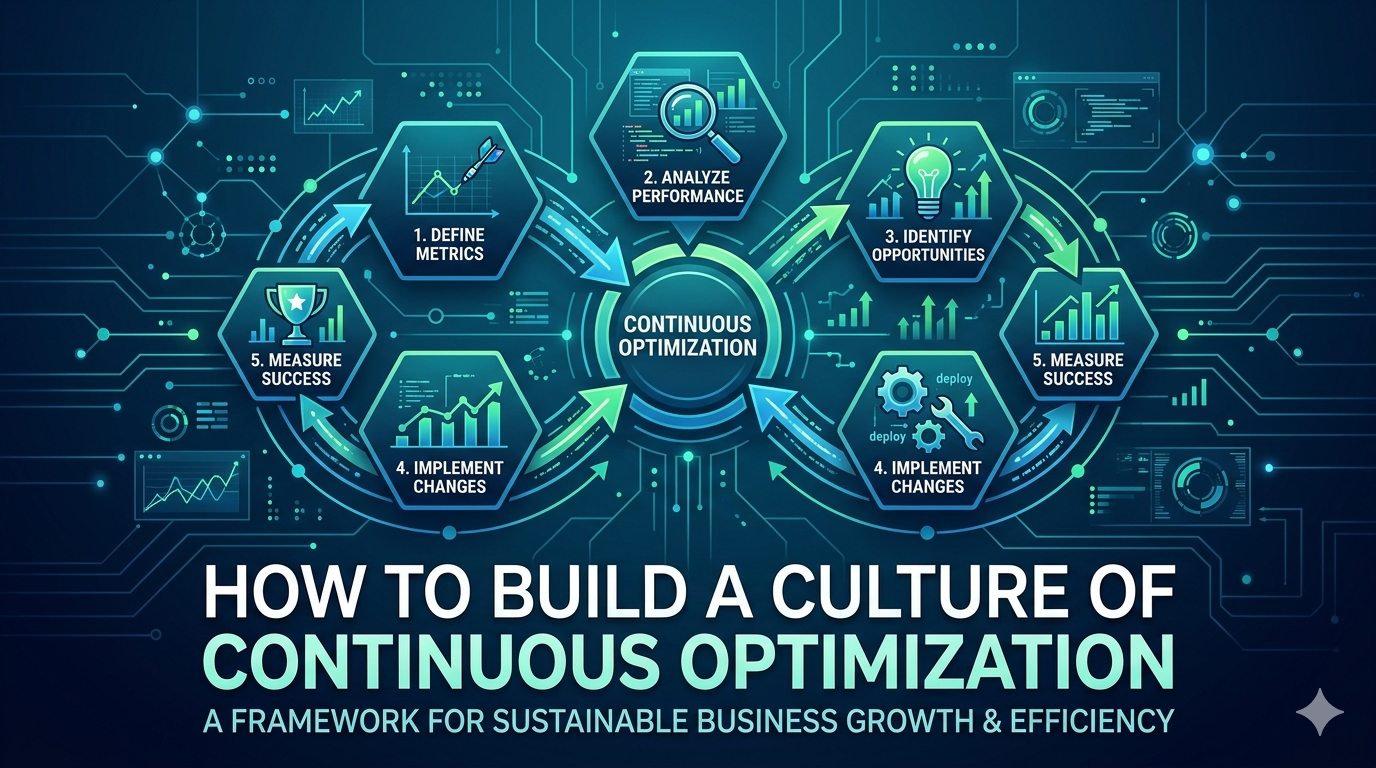
    How to Build a Culture of Continuous Optimization

    How to Build a Culture of Continuous Optimization

    The Genesis of Growth: Embracing the Optimization Mindset

    Picture this: a lone vessel, cresting the waves. Sails billow, then slacken as the captain, ever vigilant, tweaks the rigging. A metaphor, yes. This is the essence of weaving a culture where improvement never sleeps. Not a fixed point, but an endless dance of adaptation.

    Stillness spells ruin in the frantic theater of modern business. To nurture a mindset of constant betterment isn’t some trendy tactic; it’s oxygen. Our quest? A compass to weave this ethos into your organization’s very being, swapping fleeting attempts for fundamental instinct. Expect strategies with teeth, tales from the trenches, a beacon toward lasting expansion. First, the bedrock: mindset. An unyielding drive to question, to probe, to view every stumble as a lesson etched in fire. See challenges as they truly are: fuel for the forge.

    Laying the Foundation: Establishing Clear Goals and Metrics

    Hold fast! Before plunging into the gears of relentless refinement, plant your flag. Know what victory looks like. This means etching goals that are precise, quantifiable, attainable, resonant, and time-bound. Anchored to your grand strategy. What needs mending? What needs cutting? Where does the customer ache? These are the stars to navigate by.

    A team aiming to lift web conversions by 15% within a quarter, for example, or service reps slashing resolution times by 10% in half a year. The trick? Transmuting lofty dreams into concrete targets. Then, the compass: Key Performance Indicators (KPIs). These must relentlessly chart your trajectory. Crystal clear, objective measurements of progress against your ambitions. Our marketing crew? They’d watch traffic, bounce, conversion. Service? Resolution duration, delight scores, first-call fixes. Let data be your lodestar, driving every decision, illuminating every adjustment. Every change must be measured. Rigorously.

    The Power of Data: Harnessing Insights for Informed Decisions

    Data: the lifeblood. In this realm, it’s less map, more guiding star. To drift without it? A fool’s errand. Investment is non-negotiable: sturdy tools for collection and scrutiny. Unearth performance insights, spotlight areas ripe for upheaval. Mine every source, site breadcrumbs, customer whispers, sales tallies, and operational heartbeats. Once gathered, dissect. Seek patterns, connections, whispers hidden in the noise. Visualize! Dashboards, reports, turn raw numbers into vivid narratives. Picture a retailer, sifting sales to spotlight heroes and banish laggards. Armed with this truth, they sculpt their offerings, hone their pricing, sharpen their message. Or a factory, pinpointing bottlenecks, slaying waste, boosting output. Information births power. Decisions must echo this. Cultivate trials. Encourage experimentation. Accept setbacks. Then, learn. Always, refine.

    Embracing Experimentation: The Engine of Continuous Improvement

    Experimentation: the very pulse. A methodical probing of new concepts, a relentless search for “better.” Failure? Reframe it. A launchpad. Demand the status quo be challenged. A/B is the chant. Pit two versions against each other – web page, email, advert – and let the audience decide. Decisions then rooted in cold, hard numbers. Headlines clash, subject lines duel, all in pursuit of optimization. Though, experimentation blooms beyond A/B. New workflows, new tech, new structures – all fodder for the test. Nurture a safe haven where ideas can breathe, and mistakes become lessons. Such a spirit fuels improvement. Innovation thrives, and progress becomes inevitable.

    Empowering Employees: Fostering a Culture of Ownership and Accountability

    Optimization doesn’t trickle down; it erupts from within. Each soul must grasp ownership, be tethered to results. Engaged minds birth motivation, stoking the flames of betterment. These are the minds that conjure innovation, the hands that bring it to life. Arm them! Resources, training, unwavering support – the arsenal for success. Access to data, wieldable tools, cutting-edge technology, space to learn, to grow, to carve their own path. Weave a tapestry of feedback – ideas shared, critiques offered, voices amplified. The sum of minds eclipses any single genius. This collective might, unleashed through empowerment, forges the unbreakable chain of improvement.

    The Feedback Loop: Iterating Towards Excellence

    Not a sprint, but a marathon. The feedback loop: collect, dissect, adjust. KPIs under constant watch, whispers from customers and employees closely heeded, new paths fearlessly explored. Build a structure, a system. Guidelines for intake, analysis, action. A software team, agile in motion, sculpting their creation based on user cries. Marketers, deciphering surveys, reshaping campaigns. Key: a culture steeped in learning. Feedback, a gem, not a stone. Within the loop, insights become weapons, refining processes, elevating creations, and enchanting customers.

    Technology’s Role: Leveraging Tools for Efficiency and Insight

    Technology: the silent partner. From data whispers to automation’s hum, it lets you slash wasted effort, unlock buried insights, and make decisions forged in data. Data platforms gather, analyze, and reveal. Automation snips tedious tasks, freeing minds for grand strategy. Picture marketing campaigns on autopilot, results tracked with hawk-like precision, or chatbots answering customer needs. Choose tools with care, aligning them to your unique war. Ensure mastery; train your troops. Technology amplifies the drumbeat of optimization when wielded with purpose.

    Overcoming Challenges: Navigating Obstacles on the Optimization Path

    The path is rarely smooth. Resistance to change, scarce resources, data locked in silos – these are the dragons you’ll face. Clarity of vision, unshakeable leadership, a battle plan etched in steel are your weapons. Combat resistance by painting the vision, by inviting everyone to the table. Scarcity? Prioritize. Target areas ripe for the greatest change. Silos? Demolish them. Integrate. Centralize. Patience, too. Fortitude. It’s a long game. Cheer the small victories, learn from the stumbles. Forge a mindset of resilience. View every setback as a crucible for growth.

    Real-World Examples: Illuminating the Path to Success

    Countless warriors have carved this path, etching their names in the annals of success. Look to Amazon, obsessed with customer delight, wielding data as a scalpel, dissecting every facet of their empire. From product whispers to logistical ballet, they’re forever testing, forever tuning. Or Toyota, masters of “lean”, empowering every worker to hunt waste, to sculpt efficiency, to elevate quality. These tales prove the universality of constant betterment. The formula? A burning vision, a fierce leader, and the courage to experiment.

    Sustaining Momentum: Embedding Optimization into the Organizational DNA

    The final stone? To weave betterment into your organization’s very code. Make it a creed, an anthem, a thread woven into every operation. Forge systems that breathe improvement. Performance reviews that reward the pursuit of “better.” Cross-functional strike teams, dismantling problems with ruthless efficiency. Make it instinct, not agenda. When constant refinement becomes culture, it ceases to be a task. It becomes you.

    The Future of Optimization: Adapting to an Ever-Changing World

    The world shifts. Unceasingly. To endure, adapt. The future? Forged by new tech, evolving desires, relentless competition. Those who embrace this storm, who tirelessly sculpt processes and strategies, will claim victory. Dare to probe new tech, to heed customer cries, to tear down the old. It’s not just about today; it’s about tomorrow. Embrace a hunger for betterment, and you will be ready.

    Conclusion: A Journey, Not a Destination

    Not a place to arrive, but a road to travel. By embracing the principles, you’ll build a culture where improvement echoes through every corridor, fueling enduring expansion. Start small. Experiment often. Unleash your people. It’s not just smart; it’s the only path for those who crave lasting success. Embrace the journey, and reap the bounty.

  • How to Measure Statistical Significance in Conversion Tests

    How to Measure Statistical Significance in Conversion Tests

    How to Measure Statistical Significance in Conversion Tests

    The Anguish of the Unknown: Truly Grasping What Resonates

    Picture this: you’ve poured every ounce of creativity into perfecting a landing page, obsessing over each button, each carefully crafted phrase. Yet, a nagging question lingers: did any of it even matter? This is the tightrope walk that marketers and website gurus often face. Conversion rate optimization (CRO), while shimmering with promise, is also a minefield of ambiguities. Did those sign-up spikes happen by chance? Or did your tinkering genuinely move the needle? Here’s where statistical significance steps into the spotlight. What follows is an insightful exploration of measuring statistical significance within conversion experiments. Consider it your compass, guiding you to confidently discern whether your alterations truly impact success.

    Demystifying Statistical Significance in Conversion Experiments

    At its core, statistical significance serves as a barometer, gauging whether the outcomes of an experiment stem from genuine influence or sheer coincidence. When applied to conversion testing, it acts as a crucial lens, helping us decipher whether the variance in conversion rates between iterations (think A versus B) signifies a tangible boost, or is merely a trick of fate. It’s about securing the knowledge that your interventions are, without a doubt, the engine behind any observed upswing. For anyone navigating the realm of data-centric marketing or entrepreneurial ventures, statistical significance isn’t just advantageous, it’s indispensable. Otherwise, you risk wagering valuable resources, leaning on instincts instead of concrete proof. And what’s the fallout? Squandered effort, financial loss, and a digital strategy that falls short of its potential.

    Why Statistical Significance is the Bedrock of Conversion Optimization

    Here’s why statistical significance earns its keep within the conversion optimization arena:

    • Steering Clear of Illusions: Absent the rigor of statistics, you might mistakenly credit achievements to alterations that contributed little to outcomes.
    • Amplifying Return: By directing your energies toward statistically validated outcomes, you ensure your optimization strategy fuels true improvements in conversion efficacy, culminating in heightened investment gains.
    • Decisions Forged in Data: Statistical significance shifts your decision-making approach from the realm of hunch to one supported by evidence. Implement modifications confidently, grounded in the high probability of favorable results.
    • Assuredness in Achievements: It cultivates confidence in test results. Rather than second-guessing validity, showcase substantiated data to stakeholders, underscoring the advantages of optimized strategy.

    Key Pillars of Statistical Significance

    To wield statistical significance skillfully, you must anchor yourself in some foundational principles:

    A/B Showdowns

    The A/B duel (otherwise known as split testing) pits two versions of a digital entity, a webpage, app, or marketing piece, against each other to see which one wins. Version A is your control; Version B is the challenger, bearing the change you’re keen to test. Throughout this showdown, traffic is channeled randomly between both contenders, tracking how each version fares in terms of conversions. The victor? The version that demonstrates a statistically credible surge in conversions.

    The Null Assumption

    This hypothesis begins from a place of neutrality, presuming that the duelists are equally matched. In the context of A/B testing, it posits that there’s no detectable variance in conversion rates. The aim of significance testing is to amass enough evidence to potentially dismiss this initial assumption.

    The Alternative Scenario

    As its name suggests, this flips the script of the null assumption, declaring that a distinction exists between the pair being assessed. In A/B evaluations, it asserts that conversion rates differ between Version A and Version B. Should the significance test yield enough reason to cast aside the null scenario, this alternate view gains favor.

    Decoding the P-value

    Think of it as a probability yardstick that calculates the chance of witnessing the test’s findings (or more dramatic ones) assuming the null scenario is true. In simpler terms, it reveals how much the conversion rates owe to randomness. A shrinking p-value amplifies the case against the null scenario, bolstering confidence in the test’s significance.

    Significance Threshold (Alpha)

    This threshold, set in advance, acts as a referee, determining when to throw out the null scenario. It signifies the likelihood of mistakenly rejecting that scenario when it holds true. Typical levels include 0.05 (5%) and 0.01 (1%). Only when the p-value dips below this level can one confidently reject the null scenario, deeming the findings significant. A significance level of 0.05 suggests you’re accepting a 5% risk of spotting a fictional difference between the two versions.

    Statistical Muscle

    This represents the likelihood of correctly dismissing the null scenario when it doesn’t hold. Essentially, it’s your odds of detecting a real effect if it’s there. Influenced by sample size, the magnitude of the effect, and the significance threshold, a potent test is more likely to uncover genuine variances. An 80% benchmark is generally favored.

    Confidence Window

    Imagine a range within which the true measurement (the true difference in conversion rates, for example) probably resides. It’s often shown as a percentage, like a 95% confidence window. A broad window betrays greater ambiguity, while a narrower one boosts conviction. In conversion experiments, it throws light on the scope of progress to foresee from an adjustment.

    The Blueprint for Measuring Statistical Significance

    To gauge statistical significance, follow these steps:

    1. Frame Your Argument

    Articulate both the null and alternative scenarios. For example:

    • The Null: There is no distinction between the conversion success of the initial landing page (Version A) and its revised version (Version B).
    • The Alternative: The altered landing page (Version B) leads to greater conversion when compared with the initial landing page (Version A).

    A well-defined theory steers your evaluation.

    2. Select the Appropriate Significance Test

    Pick a test tailored to your data nuances and test setup. The Chi-Square or Z-test is often favored for A/B testing where conversion metrics are in play (binary data). They are designed to evaluate group rates and confirm significance.

    3. Gather Data

    Initiate your A/B test and accumulate information on visitor numbers and conversions across each version. Be sure to gather sufficient data to ensure sturdy statistical integrity. The sample figure you’ll need hinges on factors like baseline rates, smallest detectable effects, and preferred threshold. Use a sample dimension calculator to pinpoint required visitors per version.

    4. Compute the P-value

    Employ a statistical calculator to process your data and secure the p-value. Inputting your data (visitor number, conversions) will prompt an automatic calculation.

    5. Juxtapose the P-value with the Threshold

    Pit your calculated p-value against your predetermined threshold (alpha). Should it be less than or meet the threshold, reject the null scenario. For instance, a 0.03 p-value against a 0.05 threshold allows you to conclude the revised landing page boosts conversion significantly.

    6. Interpret Results

    Significant results bolster confidence that changes affected conversion. Insignificant results imply random variance, suggesting prolonged testing or more radical variations.

    The Toolkit for Measuring Statistical Significance

    Consider these resources when assessing significance in your tests:

    • Online Statistical Calculators: Many zero-cost online tools can perform statistical assessments. Simply input your metrics to generate the p-value.
    • A/B Testing Platforms: Platforms such as Optimizely, VWO, and Google Optimize include in-built statistical assessors, delivering insights regarding statistically valid differences.
    • Statistical Software: Software offerings like R and SPSS bring advanced analysis capabilities, enabling broad test ranges and custom configurations.

    Common Errors to Sidestep

    Avoid these pitfalls:

    • Premature Result Scrutiny: Fight the urge to peek at findings prematurely. Hastened conclusions can skew results.
    • Test Halting: Refrain from stopping tests upon reaching significance. Allow for sufficient running time to stabilize traffic variations.
    • Ignoring Statistical Muscle: Assure that your experiment has sufficient potency to identify real effects. Underpowered tests can lead to missed signals.
    • P-value Misinterpretation: Remember, the p-value doesn’t equal the certainty of the alternate scenario.
    • Exclusive Focus on Significance: Consider the practical importance alongside statistical significance. A statistically backed outcome might hold diminutive significance if it makes a trivial impact on conversion rates.

    Beyond Numbers: Real-World Relevance

    While statistical significance determines whether an outcome is likely attributable to chance, real-world relevance indicates whether it holds practical meaning. A test could be statistically significant yet yield negligible benefits. Weigh the magnitude of effect versus the expense and effort.

    Real-World Examples

    Here are practical scenarios illustrating how statistical significance functions:

    Scenario 1: Headline Tweaks

    Imagine testing two headlines for your landing page over two weeks. Here’s what you find:

    • Headline A: 1,000 viewers, 50 conversions (5%)
    • Headline B: 1,000 viewers, 70 conversions (7%)

    Via a Chi-Square evaluation, a p-value of 0.04 surfaces. Because this beats your 0.05 level, Headline B stands statistically taller than A.

    Scenario 2: Button Color Change

    Picture experimenting with call-to-action button hues for a week:

    • Button A: 500 visitors, 25 sign-ups (5%)
    • Button B: 500 visitors, 26 sign-ups (5.2%)

    A Chi-Square reveals a p-value of 0.8. Surpassing your 0.05 benchmark, no meaningful contrast separates the buttons.

    The Virtue of Ongoing Experimentation

    Conversion optimization is a marathon, not a sprint. By diligently measuring statistical significance, secure ongoing refinements in your conversion funnel. Foster a test-oriented ethos and maximize results.

    In Closing: Leverage Data Mastery

    Understanding, pursuing, and acting on statistical significance empowers knowledgeable choices and maximizes your return. Understanding central concepts, implementing logical approaches, and avoiding prevalent errors will support the detection of modifications that yield favorable results. Embrace data, with statistical significance lighting your path.

  • Why Most A/B Tests Fail (And How to Fix Them)

    Why Most A/B Tests Fail (And How to Fix Them)

    Why Most AB Tests Fail (And How to Fix Them)

    Why A/B Tests Often Go Wrong (And How We Can Right Them)

    Picture this: a spark of an idea, better conversions, you think! Two landing page versions crafted with care. An A/B test launched with anticipation. Then? Silence. Just…crickets. After weeks, results are hazy, impact? Nearly nonexistent. Too familiar, right? So many A/B tests stumble, leaving those of us in marketing wondering what the point even is. But hold on! It’s not the tests themselves at fault, but how we use them. Let’s uncover common mistakes and dodge them.

    This piece? Your guide. We’ll walk through why A/B tests fail so often and give you solid steps to make sure your experiments really do something. From precise goals and the right numbers, to digging into what “statistically significant” even means and watching out for bias. When done well, A/B tests? A goldmine. Websites, marketing, user happiness – all improved. Let’s jump in and turn your tests from a headache into a growth engine. Executing an A/B test? Can be tricky. It needs careful construction, you see.

    1. No Real Hypothesis

    Major slip-up? Diving into tests without a clear hypothesis. What’s a hypothesis? A statement you can test, predicting what will happen in your experiment. “I want better conversions”? Not enough. You must pin down what you’re changing, why you think it’ll work, and how you will measure victory. A great hypothesis? “If I tweak [this element] because [this reason], then [this metric] will [go up/down].”

    A weak example: “Button color change = better conversions.”

    A strong example: “If I switch the button from blue to orange, knowing orange grabs more eyeballs, then the button’s click-through rate will rise.”

    Without that clear hypothesis, you’re just guessing. You won’t know why a version shone (or didn’t), making it hard to repeat success or learn from flops. A well-defined hypothesis? The foundation.

    Without direction, your A/B test will fail. Make sure your A/B test is well-organized before you begin.

    2. Tiny, Unimportant Changes

    A lot of A/B tests? Focused on tiny tweaks unlikely to shift the big numbers. Changing a single word’s color, a slight font adjustment, nudging an element a few pixels? They seem worth it, but often? Negligible. That’s time wasted; time better spent on impactful stuff. Tests that matter involve more than tiny changes.

    Skip the minor stuff. Focus on bold moves that hit core user needs. Headlines? Value statements? Calls to action? Layouts? Test those. Such moves can seriously boost conversions, engagement, and other key metrics.

    A trivial change: Two nearly-identical shades for a background.

    A strategic change: Two totally different landing page designs, each flaunting unique value and calls to action.

    Remember: the aim? Discover changes that genuinely matter to your business. Don’t sweat the small stuff. Focus on impact. The A/B test will improve website metrics.

    3. Not Enough Data

    Statistical significance? Key. It’s the likelihood that the difference you’re seeing isn’t just random luck. It tells you how confident you can be that the winner is actually better. A/B test results should be statistically significant.

    Why A/B tests fail? Often, it’s not enough data. If you’re short on data, you can’t tell if the difference is real or just random noise. Before you launch, calculate the minimum data needed to hit statistical significance, based on your confidence level and the effect you anticipate. Online calculators? Plenty.

    Running an A/B test with too little data? Like flipping a coin a few times and claiming to know if it’s fair. You need enough flips! The A/B test needs sufficient participants.

    4. Running Tests Briefly

    Even with enough data, short tests can mislead. Website traffic? It bounces around by the day, week, and year. A few days of testing might catch a traffic spike or dip, skewing results. The A/B test should run long enough to gather data.

    Account for the bounces. Run tests for at least a week or two. Longer? Better. This ensures you grab a representative slice of your traffic, dodging conclusions based on short-term blips. Also? Consider outside influences. Major marketing push during your test? Factor it in. A/B test should factor in external forces.

    5. Not Splitting Up Your Data

    A/B results can be misleading if you don’t segment. Different users react differently. A change that helps mobile users might hurt desktop users. Segmentation reveals these differences, letting you tweak your site for specific groups.

    Common segments? Device, browser, location, traffic source, user behavior. Analyze A/B results for each segment. Understand what clicks and what doesn’t. Then? Personalize the experience. Maximize conversions. The A/B test provides data that can be segmented. An A/B test should be segmented to provide a more accurate picture.

    6. Ignoring What’s Happening Around You

    Outside stuff can mess with A/B tests. Seasonality, big events, marketing, competitors – all influential. Testing during the holidays? Results might be warped by increased traffic and different shopping habits. A/B test should exclude external factors.

    Minimize outside impact. Test during stable traffic. Avoid running tests alongside big marketing pushes. If you can’t avoid those factors? Account for them when you analyze. The A/B test needs to be carefully planned.

    7. Stopping Too Soon

    Tempting, right? Declare a winner the moment one version pulls ahead. But stopping too early? Risky. The apparent difference might be random. It might vanish if you let the test run longer. A/B test takes time. The A/B test requires patience.

    Avoid this. Wait for statistical significance. Let the test run long enough (at least a week or two) before calling it. Fight the urge to peek too often. It breeds bias and rash calls. The A/B test needs to run for a certain period of time.

    8. Not Writing Down and Sharing What You Learn

    A/B testing is a journey. Each test, win or lose, reveals user behavior. But those insights? They vanish if you don’t document and share with the team. The A/B test should be documented carefully.

    Create a central place for all A/B test results. Hypothesis, process, results, conclusions – everything. Share it with your team. Use it to guide future tests and site improvements. Build a culture of testing and constant improvement. The A/B test data should be shared throughout the company.

    9. Seeing What You Want to See

    Confirmation bias? We favor info that confirms what we already believe and ignore what contradicts it. In A/B testing, this can twist your view, making you think the results back your initial idea, even if they don’t. The A/B test may be subject to bias if not properly constructed.

    Dodge confirmation bias. Be objective. Accept that your initial idea might be wrong. Seek other explanations. Consider outside forces influencing the outcome. The A/B test should be objective.

    10. Forgetting About Phones

    Mobile-first world, right? Optimize your site for phones. Yet, many A/B tests ignore mobile, focusing solely on desktops. This skews results and misses chances. The A/B test should be optimized for mobile devices.

    When running A/B tests, segment by device. Optimize variations for phone users. Screen size, touch input, network speed – consider it all. An A/B test should factor in mobile users.

    Conclusion: Mastering the Test

    A/B testing? Powerful tool. But not magic. Dodge these common mistakes. Follow the steps here. You’ll boost your A/B test success and unlock the potential of testing. The A/B test is a powerful tool.

    Start with a clear idea. Test meaningful changes. Ensure enough data and time. Segment. Account for outside forces. Avoid rushing. Document and share. Stay objective. Disciplined, data-driven? You’ll transform your A/B testing into a growth machine. The A/B test provides a path for growth. Happy testing!

  • How to Run High-Impact Conversion Experiments

    How to Run High-Impact Conversion Experiments

    How to Run High-Impact Conversion Experiments

    Picture this: a tiny alteration to your website, and boom, sales double. Sounds like a pipe dream? Not with high-impact conversion experiments. We’ve all heard the tales, the perfect button color igniting a 20% surge in click-throughs, the headline so magnetic it banished bounce rates. Yet, enduring growth? It’s not about mimicry. It springs from a relentless, data-fueled quest to truly know your audience. To grok their desires. This? Your roadmap. Craft, execute, dissect experiments. Watch the numbers dance. This isn’t mere A/B testing. We plunge deep into the art, the science, the very soul of user behavior. Each touchpoint? Optimized. Impact? Sky-high. Envision your website, your marketing, a finely tuned engine, churning out conversions.

    Understanding the Foundation: What Are Conversion Experiments?

    First, definitions. “Conversion experiments”? Structured probes. The mission: to boost the percentage of visitors who act on your site or app. A purchase. A newsletter sign-up. A demo request. A resource downloaded. High-impact? Think seismic shifts. Achieved via strategy and finesse. The scientific method, reborn for marketing. Hypothesis in place (“A new landing page headline? Sign-ups will soar!”). A variant battles the original. The experiment unfolds. Data speaks. Was your hunch right? Here, rigor is king. Not guesswork. Data-driven. Assumptions? Validated.

    Step 1: Define Your Goals and Identify Key Metrics

    Begin here: clarity. What’s the Everest you’re climbing? Sales spike? Leads gush? Engagement ignite? Fix your gaze. Now, metrics. Your measuring sticks. Think SMART: Specific. Measurable. Achievable. Relevant. Time-bound. Forget “increase sales.” Embrace “15% online sales surge within Q3.” Common metrics? Conversion rate. Bounce rate. Time on site. Order value. Choose wisely. These guide your design. These reveal the truth.

    Step 2: Conduct Thorough Research and Analysis

    Before ideas erupt? Know the terrain. Dive into analytics. Which pages repel visitors? Where do they abandon the funnel? What paths do they tread? Arm yourself: Google Analytics. Hotjar. Crazy Egg. Glimpse user behavior. Heatmaps. Scrollmaps. Session recordings. Seek stories, not just stats. User surveys. Interviews. Usability tests. What do customers whisper? What delights, what frustrates? Listen. Their words? Gold for your designs.

    Step 3: Formulate Hypotheses Based on Data and Insights

    Data in hand? Time for hypotheses. A testable claim. Linking elements. Metrics. “Headline change? From ‘Start Now’ to ‘Double Sales in 30 Days’? Sign-ups rise 10%.” Anchor your claims in evidence. Shun mere hunches. Specific. Measurable. Achievable. Relevant. Time-bound. What change? What outcome?

    Step 4: Prioritize Experiments Based on Potential Impact and Effort

    Hypotheses amassed? Prioritize. Not all are equal. Some promise bigger booms. Some are simpler to launch. Weigh the potential. Against the grind. The ICE score? A lens. Impact. Confidence. Ease. Score each, 1-10. Impact? The ripple effect on your metrics. Confidence? Your certainty of success. Ease? The sweat equity required. Multiply. Highest ICE? Front of the line. Maximize results. Minimize fuss.

    Step 5: Design Your Experiments with Statistical Significance in Mind

    Design? Consider statistical significance. How likely are results real? Or mere chance? Significance = confidence. Changes caused the effect. Power matters. The probability of spotting a real effect. Factors? Sample size. Baseline conversion. Detectable effect. A significance calculator? Essential. Time? Account for traffic tides. User quirks. One to two weeks minimum. Longer? Better.

    Step 6: Implement and Run Your Experiments Carefully

    Design locked? Implementation time. Arm yourself. Google Optimize. Optimizely. VWO. A/B testing powerhouses. Create variants. Track performance. Implement flawlessly. Avoid bias. Avoid errors. Variations configured? Displayed correctly? Segmentation? Key. Right variations. Right users. Geography matters. Traffic sources too. Monitor. Closely. No glitches. No broken links. Fix fast.

    Step 7: Analyze Your Results and Draw Meaningful Conclusions

    Experiments complete? Results await. A/B testing tool? Your oracle. Which variant reigned supreme? Statistical significance? Did changes truly cause the surge? Don’t be blinded by stats alone. Practical significance counts. A tiny conversion bump? Insignificant, despite the stats. Business goals? The ultimate context. Dig deep. Why did one variant win? Patterns? Trends? User surveys? Interviews? Illuminate the numbers.

    Step 8: Iterate and Optimize Based on Your Learnings

    Experimentation? Not a sprint. A marathon. Continuous refinement. Results analyzed? Lessons learned? Fuel the next round. Success? Implement. Test anew. Failure? Don’t despair. Understand. Adjust. Keep probing. Keep learning. Challenge assumptions. Unexpected places? The wellspring of breakthroughs. Document. Share. Build a knowledge fortress. Successes. Failures. Avoid repetition. Amplify triumphs. Continuous iteration? The engine.

    Step 9: Document and Share Your Findings

    Meticulous records? Non-negotiable. A central hub. Hypotheses. Designs. Implementation. Results. Conclusions. Accessible to all. Documentation? Tracks progress. Learns from stumbles. Sparks collaboration. Fuels knowledge sharing. Share findings widely. Cultivate a culture of experimentation. Host discussions. Brainstorm. Collaboration? Accelerates learning. Drives breakthroughs.

    Step 10: Embrace a Culture of Experimentation

    The bedrock? A culture of relentless experimentation. Question everything. Challenge norms. Relentlessly seek improvement. Safe to fail? Absolutely. Failure is fertilizer for growth. Empower your team. Resources. Support. Celebrate wins. Recognize contributions. Experimentation? Second nature. Unlock the potential. The website. The marketing. A natural rhythm.

    Tools and Technologies for Conversion Experiments

    Tools? Abundant. Essential categories:

    • A/B Testing Platforms: Google Optimize, Optimizely, VWO, AB Tasty. The arena for A/B tests, multivariate showdowns, personalization blitzes.
    • Analytics Platforms: Google Analytics, Adobe Analytics, Mixpanel. Data streams: traffic, behavior, conversions.
    • Heatmap and Session Recording Tools: Hotjar, Crazy Egg, FullStory. Visualize user interactions: heatmaps, scrollmaps, session replays.
    • User Feedback Tools: Qualtrics, SurveyMonkey, Typeform. Voices of users. Surveys. Interviews. Feedback forms.
    • Project Management Tools: Asana, Trello, Jira. Orchestrate the process. Track tasks. Unite the team.

    Right tools? Streamline. Maximize. Evaluate. Choose wisely.

    Common Pitfalls to Avoid in Conversion Experiments

    The path seems clear. Yet pitfalls lurk:

    • Testing Too Many Elements at Once: Isolate changes. One element at a time. Clarity reigns.
    • Ignoring Statistical Significance: False positives? Avert them. Calculate significance. Always.
    • Stopping Experiments Too Early: Insufficient data? Misleading conclusions. Run long enough. Account for variations.
    • Failing to Segment Your Audience: Masked differences? Segmentation reveals. Right variations. Right users.
    • Making Assumptions Without Data: Hunches? Dangerous. Anchor in research. Analysis.

    Avoid these. Amplify effectiveness. Achieve more.

    Conclusion: The Power of Continuous Optimization

    More than tweaks. A data-fueled quest. Know your audience. Optimize every touch. Transform your website. Your marketing. A conversion engine. Goals clear. Research thorough. Hypotheses testable. Experiments prioritized. Designs statistically sound. Implementation flawless. Analysis rigorous. Iteration constant. Documentation meticulous. A culture of experimentation embraced. Sustainable growth. Success achieved.

  • What to A/B Test First on Your Website

    What to A/B Test First on Your Website

    What to AB Test First on Your Website

    The A/B Testing Odyssey: A Tale of Two Buttons

    Picture this: a vibrant marketplace. Merchants clamor, each booth vying for attention. Your website? That’s the marketplace. Every visitor, a potential buyer. How, in this digital hubbub, do you make your spot, your website, the most magnetic, turning browsers into buyers? Enter A/B testing. An age-old technique, spruced up for the digital era. Let’s venture into the realm of A/B testing. Where to begin? How to truly make an impact? Consider this your map through the complex world of site improvement.

    We’re diving deep into a hands-on A/B testing approach. Revealing those key website areas begging for a little experiment. We’ll explore the art of formulating ideas, nailing down crystal-clear targets, and deciphering the outcomes. You’ll leave equipped to prioritize your A/B efforts, honing in on the elements that truly matter. Get set to turn your website from static brochure into a conversion-optimized dynamo. The adventure starts now!

    Laying the Groundwork: Understanding A/B Testing Fundamentals

    Before we get granular, let’s get the basics down. At its heart, A/B testing is simple. Show two versions (A and B) of a webpage element to different groups of visitors. Then, watch which one does better, based on what you want to achieve. That “achievement” could be anything. Higher click-throughs, more sales, fewer bounces. Here’s the thing: A/B testing isn’t guesswork. It’s decisions backed by data. Every test needs a guiding idea. A clear statement of what you think will happen, and why. That idea? Your North Star. Without it, you’re just fumbling. Instead of blindly changing a button color, think: “Switching the button from blue to orange will boost clicks because orange grabs attention more effectively.” That’s solid reasoning. You learn, even if the test flops.

    Also crucial? Setting your key indicators before you start. How will you judge the winner? Typical ones? Conversion rates, bounce rates, time spent on the page, click-throughs. Pick the right ones, and you measure what truly counts for your goals. Remember, it’s not just about finding a winner. It’s about understanding how your audience thinks and acts. Every test, win or lose, is a treasure trove of data. Use it to fine-tune your site. Think of each experiment as a chance to learn and refine what you know about your visitors. Better experience for them, better results for you.

    The Prime Suspects: High-Impact Elements Ripe for A/B Testing

    With the basics down, let’s zero in on the high-impact zones. The areas where even the smallest change can trigger big improvements. These are your prime suspects. The elements that are prime for A/B testing include:

    1. Headlines: The Siren’s Call

    Your headline? The first impression. Sometimes, the only one. It’s the siren song that draws them into your site. A captivating headline can skyrocket engagement, time on page, conversions. Try testing different styles: questions, benefits, teasers, lists. Mix up the tone and length. Infuse words that stir emotion, create urgency. Generic “Learn About Our Services”? Try something like “Unlock Your Potential: The Secret to [Desired Outcome].” Your headline is the hook. Make it irresistible. Attracting that perfect audience may depend on it.

    2. Calls to Action (CTAs): Guiding the User’s Journey

    CTAs? Those are the signposts guiding users toward action. Optimize them, and watch your conversion rates soar. A/B test the wording, colors, sizes, placement. Experiment with action verbs: “Start Now,” “Download Instantly,” “Find Out More,” “Grab Your Deal.” Use colors that pop against the backdrop. Keep them clear, concise, compelling. Wording and placement? A/B test that. See what gets users moving. Instead of just “Submit,” how about “Get Your Free Guide Now!” Make it crystal clear what they gain by clicking. Getting conversions requires a CTA.

    3. Images and Videos: Visual Storytelling

    Visuals speak volumes. Often louder than text. They convey emotion, information, all in a glance. Test different images, videos. See what clicks with your audience. High-quality visuals, relevant to your content? Yes. Experiment with styles: product shots, lifestyle scenes, explainer videos. Faces often work wonders. They grab attention. Storytelling can be improved through styles. Make sure they load fast. Big files kill user experience. Remember, a picture says a thousand words. Choose wisely. Attention can be gained using videos.

    4. Form Length and Fields: Striking the Right Balance

    Forms are key for leads, data. But they can also be a hurdle. Test the length, the fields. Find the sweet spot between enough data and minimal drop-off. Try ditching unnecessary fields. Break long forms into steps. Clear labels for each field are a must. Show progress. A progress bar works. Generation of leads can be improved. Easy to use, simple to grasp. Fewer fields often equals higher conversion. More conversions are possible by length.

    5. Pricing Pages: Optimizing for Conversions

    The pricing page? Where decisions happen. Purchase or pass. Test different structures, plan names, feature highlights. Highlight the most popular plan, or offer a free taste. Use language that’s clear, concise, benefit-driven. Comparison tables can be very effective. Increase of sales may be done by pricing pages. Make sure that the most crucial feature is visible and understandable. Competitive pricing is a must. It has to match the value you deliver. Pricing pages greatly help conversions.

    Crafting the Perfect Hypothesis: A Detective’s Approach

    Every test starts with a solid idea. A hypothesis. It’s a statement you can test. It predicts the outcome. Not just a guess, but an educated prediction. Based on what you know about your audience, your site. A good one is specific, measurable, achievable, relevant, and time-bound. Hypothesis are a must for A/B testing. It has to be clear what you’re testing, why, and what you expect. You can either confirm or deny using A/B tests. Instead of a vague “Changing the button will boost conversions,” try “Switching the button from blue to green will raise click-throughs by 10% within a week because green is more appealing.” That’s a clear target. You can actually measure success.

    To build a winning hypothesis, start by spotting a problem or chance on your site. Dig into the numbers. Where are users dropping off? Where are they not engaging? Look for trends. Talk to your customers. Get their thoughts on the site. Use that info to shape your hypothesis. Solve a problem, seize an opportunity. Your hypothesis is your roadmap. Make it clear, concise, ready for action. This relies on a solid hypothesis.

    Tools of the Trade: Selecting the Right A/B Testing Platform

    The right platform is crucial for effective tests. Options abound, each with pros and cons. Some names? Google Optimize, Optimizely, VWO (Visual Website Optimizer), AB Tasty. When choosing, consider ease of use, features, fees, how well it plays with your analytics. Find a platform that lets you create and handle tests easily, track key stats, and divide up your audience. It should offer good reporting, so you can understand the outcomes. Platforms are useful. Some even offer extras like personalization. The champion platform? The one that fits your needs and your budget. Most offer free trials. Try a few before you decide. Right tool for A/B testing is key.

    Avoiding Common Pitfalls: Ensuring Valid Results

    A/B testing? Powerful, yes. But it can go wrong. To get real results, steer clear of common mistakes. Testing too many things at once. Running tests for too short a time. Ignoring statistical significance. Test one thing at a time. Find out what’s really driving the results. Run your tests long enough to collect enough data to be valid. Statistical significance shows that your results aren’t just random luck. Testing audiences leads to statically significant results. Aim for 95% confidence. Divide up your audience. See how different groups react. Testing audiences individually is a must.

    The Iterative Process: Continuous Optimization

    Testing isn’t a one-off thing. It’s a loop. Continuous improvement. Once you’ve got a winner, don’t stop. Use what you learned to come up with new ideas, run more tests. The aim? To constantly sharpen your website, boost its performance. Embrace a culture of trying new things. Encourage your team to seek ways to improve user experience. Even small gains add up over time. An iterative process that leads to more user engagement. Treat your site like it’s alive. Always changing, always adapting to your audience. Continuous, never-ending testing allows you to remain successful.

    The A/B Testing Success Story: A Tale of Increased Conversions

    A real-world example? An online jewelry business. Sales were lagging. They turned to A/B testing. First up? Product page headlines. Their thinking? A benefit-driven headline would lift click-throughs, boost conversions. They created two versions: Version A: “Handmade Jewelry” Version B: “Unique, Handcrafted Jewelry That Makes You Shine” The test ran for two weeks. Version B crushed it. Click-throughs jumped 20%. Conversions rose 15%. A conversion rate improvement was made possible with A/B tests. They made Version B permanent. Sales skyrocketed. This shows the impact of A/B testing on real business results. An increase in sales can be achieved using A/B tests.

    Beyond the Basics: Advanced A/B Testing Techniques

    Once you know the fundamentals, explore advanced techniques to optimize your site. Multivariate testing. Personalization. Behavioral targeting. Test multiple elements at once to find the perfect combination. Tailor the site to individual users, based on their behavior. Target users with tailored messages, rewards, etc. A/B testing is a great place to start. These can be complex, but also rewarding. Experiment as you become more skilled with A/B testing. Success using A/B testing is possible.

    The Future of A/B Testing: Embracing Artificial Intelligence

    AI is changing A/B testing. AI-powered tools can automate many of the steps: creating ideas, setting up tests, analyzing results. AI can also personalize the website, in real-time, based on how users act. A user improvement can be done through A/B testing. These tools are growing and becoming more easily accessible. As AI evolves, expect even more innovative uses for A/B testing. A/B testing can be enhanced by AI. The use of AI for future testing is extremely exciting.

    Conclusion: Your A/B Testing Journey Begins Now

    A/B testing is a potent tool for site optimization. But it’s not magic. You need a plan, a deep understanding of your audience, and dedication to constant improvement. Focus on the high-impact elements, craft solid hypotheses, dodge common mistakes, and you’ll unlock the power of A/B testing. Optimizing the process through testing is the goal. So, take that first step today. Experiment. Learn. Optimize your website for success. This process can lead to great things. Every click, conversion, interaction? A chance to learn and improve. Embrace the power of A/B testing. Transform your website into a lean, mean, conversion machine. A journey starts now!

  • How to Build a Conversion Experimentation Framework

    How to Build a Conversion Experimentation Framework

    How to Build a Conversion Experimentation Framework

    Picture this: every tweak to your website or app, fortified by concrete data. No more guessing games about what resonates; instead, knowing. That’s the raw force of a well-oiled conversion experimentation framework. Forget blindly chasing trends. We’re talking about methodical hypothesis testing, insights gleaned from results, and constant refinement leading to better user experiences and, the ultimate prize, soaring conversion rates.

    In this guide, we’re mapping out the terrain for constructing your bespoke conversion experimentation framework, notch by notch. We’ll traverse from pinpointing your aims to dissecting your outcomes. By journey’s end, you’ll wield a lucid strategy for orchestrating potent trials and sparking tangible leaps in your enterprise.

    Why You Need a Conversion Experimentation Framework

    Before we get into the nuts and bolts, let’s tackle the core question: Why pour time and resources into forging a conversion experimentation framework? Bluntly, to banish guesswork and embrace choices sculpted by data.

    Too many outfits lean on instinct or the flavor-of-the-month when tweaking their digital spaces. While a hunch has its place, it’s a shaky substitute for hard numbers. A conversion experimentation framework hands you the reins to examine your notions, validate your bright ideas, and pinpoint what genuinely clicks with your audience.

    Consider a chef pursuing culinary perfection. They could toss in ingredients at random, praying for a miracle. Or, they could meticulously test variations, one at a time, to unveil the keys to unlocking the ultimate flavor profile. A conversion experimentation framework? Your definitive blueprint for conquest in the arena of digital fine-tuning.

    Step 1: Define Your Goals and Objectives

    Each triumphant test springs from a crystallized goal. What’s the summit you’re scaling? Aiming to pump up sign-ups? Supercharge sales? Plug the leaks of bounce rates? Or electrify user engagement? The sharper your aim, the smoother sailing in designing and decoding your experiments. Here lies a keystone of your conversion experimentation framework.

    For instance, instead of a fuzzy “Boost conversions,” try something laser-focused, such as “Amplify free trial sign-ups by 15% this quarter.” This delivers a tangible benchmark to shadow and assess.

    Zero in on the key gauges that matter most to your domain. These might encompass:

    • Conversion Rate: The fraction of voyagers who seal the deal.
    • Click-Through Rate (CTR): The cut of eyeballs that engage a designated link or button.
    • Bounce Rate: The tally of those who bolt after a fleeting glance at a single page.
    • Average Order Value (AOV): The median spend per swipe of the card.
    • Customer Lifetime Value (CLTV): The cumulative bounty a patron is tipped to yield across their tenure.

    Once you’ve plotted your goals and pinpointed your KPIs, document them precisely. Let this be your lodestar across the conversion experimentation framework, forging unity and shared ambition. These aims must be Specific, Measurable, Achievable, Relevant, and Time-bound (SMART).

    Step 2: Conduct Thorough Research and Analysis

    Before you unleash a torrent of experiment ideas, get acquainted with your users. Who are they, really? What cravings and frustrations fuel them? What milestones are they striving to conquer on your turf? The richer your grasp, the more impactful your experiments will be. This is a linchpin in any staunch conversion experimentation framework.

    Multiple paths lead to user insights:

    • Website Analytics: Harness tools like Google Analytics to trace user footsteps across your site. Zero in on metrics such as page views, bounce rates, time spent, and the channels that lead to triumph.
    • User Surveys: Pose questions directly to your audience. Employ digital surveys to harvest feedback on your site, app, or specific prowess.
    • User Interviews: Spark one-on-one dialogues with patrons to dig deep into their motivations, irritations, and grand plans.
    • Heatmaps and Session Recordings: Tools like Hotjar or Crazy Egg allow you to witness user action. Spot where attention clusters, where scrolling halts, and where time stretches.
    • Competitor Analysis: Scrutinize your rivals’ digital estates to glean winning tactics and uncover prime areas for distinction.

    Once your research trove is brimming, seek patterns and flashes of revelation to fuel your experiment blueprints. Spot those pressure points, drop-off zones, and sources of friction. Here is where a conversion experimentation framework can unleash its mightiest force.

    Step 3: Formulate Hypotheses

    A hypothesis? A testable assertion tying together variables. Think of it as an educated gamble about the ripples a change will create. A solid hypothesis is clear, tight, and ready to be measured. It’s the engine of any conversion experimentation framework.

    A seasoned hypothesis often looks like this: “If we [inject this change], then [this outcome] will unfold because [of this rationale].”

    For instance:

    • “If we transplant a glowing customer testimonial onto our landing page, then sign-ups will surge, fueled by trust and the sway of social proof.”
    • “If we streamline the checkout dance by trimming unnecessary steps, then cart abandonment will plummet, smoothing the path to purchase.”
    • “If we morph the call-to-action button from serene blue to vibrant green, then clicks will erupt, capturing eyes with its visual punch.”

    When brewing your hypotheses, anchor them to your bedrock research. Avoid stray guesses; let data be your compass. This ups the odds of experiment triumphs and insights that truly matter.

    Step 4: Prioritize Your Experiments

    Likely, you’ll face a flood of experiment notions, more than time or resources allow. Thus, prioritizing experiments based on their potential boom and practicality is essential. Zone in on those prime movers and execute with zeal as part of your conversion experimentation framework.

    A popular method for ranking experiments is the ICE scoring system (Impact, Confidence, Ease). Assign each experiment a score from 1 to 10 on each front:

    • Impact: How seismic could this test be on your pivotal metrics?
    • Confidence: How bullish are you that this experiment will bear fruit, given your groundwork?
    • Ease: How nimble is this experiment to enact, in terms of clock ticks, resources, and tech hurdles?

    After scoring, blend the factors (multiply them) to secure an ICE total for each. The highest ICE scores? These are your top-tier candidates.

    Another tack is a prioritization matrix: chart experiments by their potential windfall versus the elbow grease needed. Hone in on high-impact, low-effort plays.

    Step 5: Design and Implement Your Experiments

    Time to breathe life into your experiment visions. This involves shaping the variations you’ll pit against each other, embedding them on your digital terrain, and establishing mechanisms to gauge their impact. A critical chapter in the saga of your conversion experimentation framework.

    Experiment styles abound:

    • A/B Testing: The clash of two versions, vying for supremacy.
    • Multivariate Testing: A medley of elements and variations, seeking the ultimate harmony.
    • Personalization: Tailoring the digital canvas to different viewers, based on their profile and past moves.

    As you sculpt experiment variations, lock onto the hypothesis under the microscope. Shun sweeping changes, as this blurs the individual impact of each twist. Strive for variations that are sleek and sharply focused.

    Leverage A/B testing tools. Ensure laser-accurate data collection, the lifeblood of a robust conversion experimentation framework.

    Step 6: Analyze Your Results

    Once your experiment has roamed the digital wilds for a spell (think a week or two), dissect the findings. Does the data bolster your hunch? Did your variations spark a statistically significant jolt in your critical metrics? Data: the cornerstone of your conversion experimentation framework.

    Employ statistical significance calculators to gauge if the disparities between variations are genuine. A statistically significant result signals the change stems from your alterations, not mere chance.

    Even if your experiment misses statistical fireworks, it can still illuminate hidden truths. Hunt for trends and patterns that fuel future endeavors. Embrace missteps; they’re gold mines of knowledge.

    Step 7: Document and Share Your Learnings

    The final verse in the conversion experimentation framework? Immortalize and spread your discoveries. Forge a log of your tests, noting goals, hunches, variations, outcomes, and pivotal insights. Document everything as part of the conversion experimentation framework.

    Share your treasure with teammates, gatekeepers, and even the broader digital fraternity. This ignites a culture of testing within your sphere, where lessons are shared and progress is collective.

    Consider establishing a central haven for experiment chronicles, like a wiki or shared archive. This empowers others to tap into your wisdom and fuel their experiments.

    Recall: constructing a conversion experimentation framework is a perpetual voyage, not a fleeting pit stop. Refine your framework ceaselessly, honing your methods and amplifying your triumphs. By clasping a data-charged path to refinement, you unlock colossal growth for your enterprise.

    Essential Tools for Your Conversion Experimentation Framework

    To wield your conversion experimentation framework with finesse, you’ll crave a suite of tools, from research to roll-out. Here are some to ponder:

    • Website Analytics: Google Analytics, Adobe Analytics
    • A/B Testing Platforms: Optimizely, VWO, Google Optimize
    • Heatmaps and Session Recordings: Hotjar, Crazy Egg
    • User Survey Tools: SurveyMonkey, Qualtrics, Google Forms
    • Statistical Significance Calculators: Various online calculators
    • Project Management Tools: Asana, Trello, Jira

    The right arsenal hinges on your distinctive desires and coffers. Begin with the bedrock tools, then gradually scale as your conversion experimentation framework matures.

    Building a Culture of Experimentation

    Forging a triumphant conversion experimentation framework transcends mere mechanics; it demands cultivating a test-and-learn ethos within your organization. This entails championing a data-inspired mindset, challenging norms, and relentlessly seeking avenues for advancement.

    Here’s how to kindle a culture of relentless testing:

    • Secure command endorsement: Guarantee your leaders grasp the worth of experimentation and pledge to fuel it.
    • Empower your squad: Grant your crew the freedom to orchestrate and steer their own trials.
    • Celebrate victories and stumbles: Acknowledge and cheer both the triumphant and the thwarted tests.
    • Broadcast your insights: Certify everyone gains access to the findings of your voyages.
    • Perpetually refine: Dare to test the very framework that governs your experiments.

    By architecting a culture of ceaseless testing, you birth a learning juggernaut, ever-evolving to mirror the shifting tides of your customer’s desires. This gifts you a steep edge in today’s hyper-kinetic digital arena. A sturdy conversion experimentation framework sets the stage for enduring victory.

    Conclusion: Embrace the Power of Experimentation

    Fashioning a conversion experimentation framework? It’s an investment ripe with reward. Systematically probe your concepts, extract wisdom from outcomes, and sculpt a finer user journey. This spurs progress in key metrics and aligns with your ambitions. The conversion experimentation framework? It’s a perpetual cycle of refinement.

    Embark with a clear compass, charting your aims and ambitions. Plunge into research, decoding your users’ needs and pressure points. Articulate crisp, testable hypotheses. Rank experiments by clout and pragmatism. Steer your experiments with precision. Scrutinize results with rigor. And lastly, record and relay your wisdom to your crew and the wider landscape.

    Seize the might of experimentation, and you’ll stride confidently toward unlocking unparalleled prospects for your business. The conversion experimentation framework? Your gateway to zenith.