Author: Jayashree

  • Search Intent Explained: How to Match Content to Queries

    Search Intent Explained: How to Match Content to Queries

    Search Intent Explained How to Match Content to Queries

    Introduction: The Quest to Understand What Searchers Really Want

    Imagine this: You’re a digital Sherlock Holmes. Forget criminal masterminds; your target? The elusive minds of online searchers. What propels them when those words hit the search bar? This, is the very essence of search intent. It’s deeper than mere words; it’s the underlying why. Crack this code, and you unlock superior SEO, captivating content, and ecstatic users. Consider this article your compass, guiding you toward the understanding of search intent and molding your content to resonate with user queries.

    The Four Pillars of Search Intent: Navigational, Informational, Transactional, and Commercial Investigation

    Think of a skyscraper. Without solid footings, it crumbles. Similarly, comprehending search intent demands familiarity with its foundational types. We generally categorize it into four essential cornerstones:

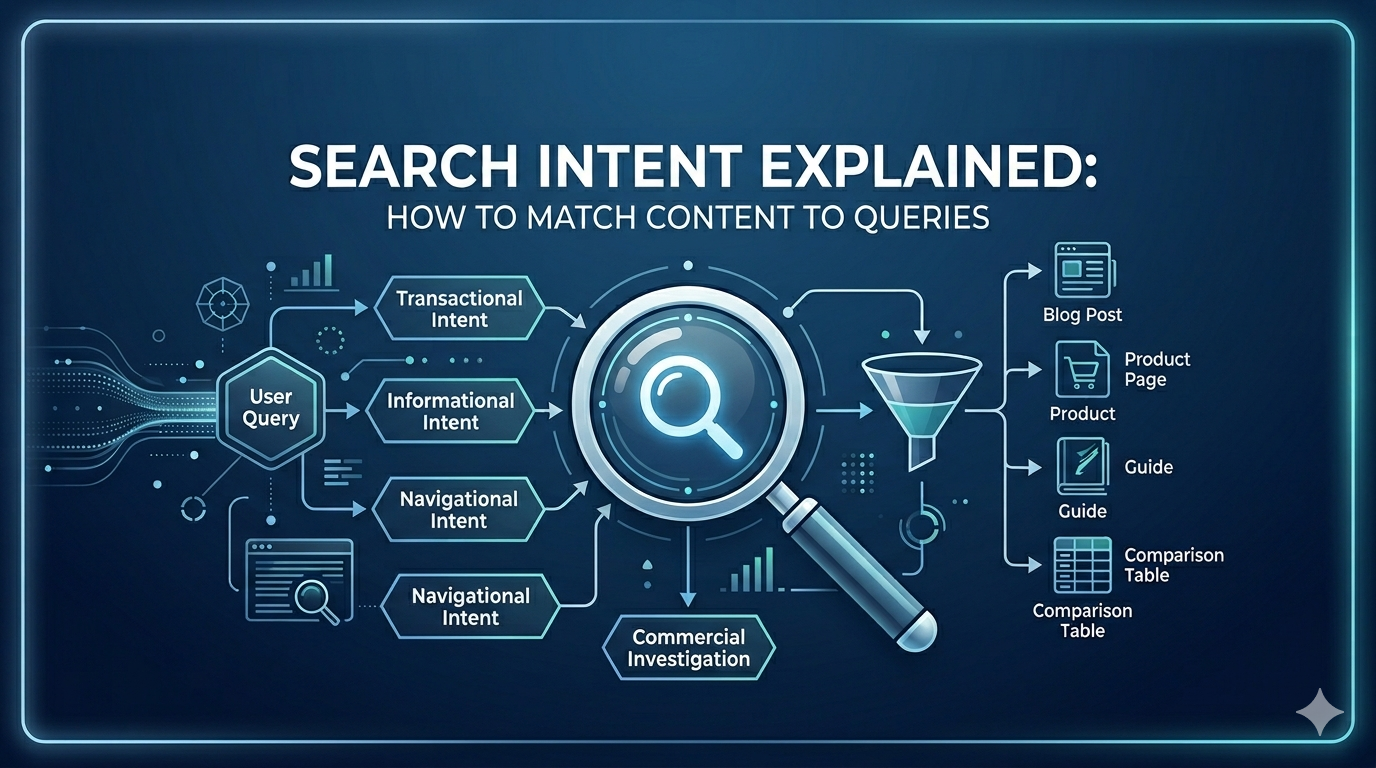
    • Navigational Intent: The user has a destination in mind – a specific website. They’re not wandering; they know where they want to land. It’s akin to knowing a store’s address. The query “Facebook login,” for instance? The user is already aware of Facebook; they simply seek the entry point.
    • Informational Intent: A quest for knowledge. The user poses a question and seeks an answer. The spectrum is vast, spanning inquiries like “how to bake a cake” to “capital of France?”
    • Transactional Intent: The user is primed to purchase. Wallet in hand, they’re ready for a transaction. Examples? “Buy running shoes” or “order pizza online.”
    • Commercial Investigation Intent: Research precedes the purchase. The user meticulously weighs options, devouring reviews. Contemplate searches like “best laptops 2024” or the classic showdown: “Samsung S24 vs iPhone 15.”

    Acknowledging these categories is the initial stride toward grasping search intent. Each demands a tailored content approach.

    Decoding the User: Tools and Techniques for Unveiling Search Intent

    So, how does one discern the search intent concealed within a query? It’s not a guessing game, but an analytical pursuit. Here are some indispensable tools:

    • Analyze the SERP (Search Engine Results Page): Observe the landscape. What reigns supreme? Blog posts? Product showcases? Videos? Search engines possess an uncanny knack for deciphering search intent. The SERP itself whispers clues. For “best coffee makers,” if the zenith is occupied by reviews, consider that the intent is commercial investigation.
    • Keyword Research Tools: They unearth user vocabulary and their corresponding search intent. Often, keywords are neatly categorized, easing the task.
    • Google Trends: A pulse on trending topics and related queries. Contextual understanding blooms, and emerging search intent is revealed.
    • Step Into the User’s Shoes: This is paramount. Inquire: “What would I seek?” Contemplate their perspective, their aspirations.

    Command of these techniques is essential for truly understanding search intent.

    Content Formats: Matching the Medium to the Message

    With search intent illuminated, select the fitting content format. Harmony between expectation and need is the goal. Behold some illustrations:

    • Navigational Intent: A streamlined landing page, a direct conduit to the desired destination. Navigation must be effortless.
    • Informational Intent: A blog post, article, insightful guide, or video – the oracle that answers the user’s burning question. Clarity and precision are paramount.
    • Transactional Intent: A product page adorned with stunning imagery, exhaustive descriptions, and persuasive calls to action. The purchase? It must be frictionless.
    • Commercial Investigation Intent: A comparison, an exhaustive review, a curated list – tools for evaluation. Impartiality reigns. Illuminate the advantages and disadvantages.

    Content and query must align to achieve SEO success.

    Keyword Modifiers: Fine-Tuning Your Understanding of Search Intent

    Keywords offer subtle signals. These words act as beacons, clarifying the search intent. The usual suspects include:

    • “How to”: Signals informational intent. A step-by-step guide is craved.
    • “Best”: Commercial investigation emerges. Recommendations are the quarry.
    • “Buy”: Transaction is imminent.
    • “Review”: The hunt for opinions and feedback.
    • “Near me”: A local yearning. Proximity matters.

    They unlock meaning and better search intent.

    On-Page Optimization: Delivering on the Promise of Search Intent

    Craft content with search intent in mind. Then, optimize for search engines. The steps include:

    • Title Tag: Encompass the primary keyword. A compelling reason to click is essential. Accuracy matters.
    • Meta Description: Concisely summarize, entice, and mirror the content.
    • Header Tags (H1, H2, H3): Structure your content and spotlight keywords. Your H1 tag? It must feature the primary keyword.
    • Body Content: Weave keywords naturally. Prioritize valuable, enlightening content.
    • Image Alt Text: Descriptive alt text is crucial.
    • Internal Linking: Enhance user experience with additional information.

    When content is readily found and grasped, you flourish. By aligning your content with search intent, higher rankings are within reach, attracting the traffic you seek.

    The Mobile Factor: Adapting to Shifting Search Intent

    Mobile reigns supreme. Mobile searches crave immediacy and locality. Optimize your content, considering:

    • Mobile-Friendly Website: Responsive design is non-negotiable.
    • Local Search Optimization: If locality matters, target local keywords. A Google Business Profile is a must.
    • Concise, Scannable Content: Mobile users demand efficiency.
    • Mobile-Friendly Formats: Page speed matters.

    Understanding mobile nuances broadens reach and drives conversions.

    Long-Tail Keywords: Unlocking Niche Search Intent

    Targeted specificity can lead to higher conversion rates. Consider the phrase “best organic fair trade coffee beans for French press.” Match your content. A sound strategy boosts your search intent strategy.

    Measuring Success: Tracking Your Search Intent Performance

    Metrics reveal the efficacy of your search intent optimization:

    • Rankings: Are your pages ascending?
    • Organic Traffic: Are you gaining traction?
    • Bounce Rate: Is it diminishing?
    • Conversion Rate: Are conversions increasing?
    • Time on Page: Are users lingering?

    Analytics tools like Google Analytics are invaluable. Data-driven decisions are the most insightful ones.

    The Ever-Evolving Landscape of Search Intent

    Algorithms shift. User behavior morphs. Adapt. Constant vigilance is essential.

    Conclusion: Mastering Search Intent for SEO Success

    Catering to search intent is no longer optional. Align content and queries to boost rankings. Staying adaptable will keep you ahead. Embrace search intent.

  • What Are AI Agents and How They Change Search Behavior

    What Are AI Agents and How They Change Search Behavior

    What Are AI Agents and How They Change Search Behavior

    The Day Search Changed Forever

    The old way: punching keywords into a search box. Dull. Now, imagine this: an internet that knows you. An assistant predicting your every informational whim. Delivering answers before you even ask the question. That future? It’s not science fiction. It’s here. AI agents. Not just tweaking search; they’re rewriting the rules.

    This story? It’s about diving deep into those AI agents. What are they? How do they think? Most importantly, how are they messing with our search habits? Businesses, users, the very soul of the internet… everything’s changing. Buckle up. Information is about to hunt you.

    What Exactly Are AI Agents?

    Think of the core: computer programs, eyes on the world, brains figuring it out, and hands taking action. Goal-getters. They learn. They adapt. They decide… all without needing a human breathing down their digital necks. Traditional algorithms? Rigid. Obeying pre-set rules. Not these guys. AI agents? They thrive on machine learning, getting smarter with every tick of the clock.

    Digital butlers. That’s the vibe. Always learning your quirks. Anticipating needs. Calendar watching. Travel tracking. Article suggesting based on your late-night reading binges. The kicker? They don’t just react. They foresee.

    The Anatomy of an AI Agent

    Every AI agent has its own unique blueprint, but generally, they have some universal key components:

    • Sensors: Eyes and ears on their world. Text inputs, camera feeds – the raw data stream.
    • Actuators: How they do things. Displaying info, firing off emails, even controlling physical stuff.
    • Knowledge Base: The encyclopedia of everything. Facts, rules, relationships… all filed away.
    • Reasoning Engine: The brain. Making sense of the knowledge base, drawing conclusions, making choices.
    • Learning Module: The upgrade center. Sharpening performance with every experience, constantly evolving.

    All working in lockstep. Planning. Problem-solving. Deciding. The better these components? The better the agent conquers its objectives.

    How AI Agents are Reshaping Search

    AI agents have stormed the search engine castle, and nothing is the same. Keyword matching? Link analysis? Old news. Now it’s about context. It’s about intent. Relevant results? Personalized results? That’s the new game. Here’s how AI agents are rewriting the search playbook:

    • Semantic Understanding: Words aren’t just words. AI agents grasp the meaning, the nuance. Complex questions? They get it. Accurate answers? You got it.
    • Personalization: They stalk… err, learn your habits. Tailored results? Absolutely. A search experience that feels… personal? Bingo.
    • Proactive Information Retrieval: Need something? They already know. Relevant content delivered before you even type a thing. Spooky? Maybe. Convenient? Definitely.
    • Conversational Search: Talk to the search engine. Like a human. Natural language. It’s intuitive. It’s easy.
    • Multimodal Search: Text. Images. Audio. All mashed together. Comprehensive results. The whole picture, not just fragments.

    A seismic shift. Keywords are fading. Natural interaction is rising.

    The Impact on User Search Behavior

    Users are changing. Because AI agents are changing everything. As AI agents level up, so do user expectations:

    • Asking more complex questions: Simple keywords are for chumps. Now? Nuance. Subtlety. Expecting real answers, not just links.
    • Expecting personalized results: Generic is garbage. Tailored is king. They want search engines that get them.
    • Relying on proactive information delivery: Forget searching. They expect information to find them. A constant stream of relevant goodness.
    • Engaging in conversational search: Typing? So last century. Voice search is booming. Conversational interfaces are taking over.
    • Demanding multimodal search experiences: Images. Audio. Video. They want it all. Search isn’t just text anymore.

    Businesses? They better adapt. SEO is no longer just about keywords. It’s about understanding, personalization, and conversation.

    SEO in the Age of AI Agents

    Keyword stuffing? Link building? Medieval tactics. AI agents laugh at your antiquated ways. Here’s the new SEO gospel:

    • Creating high-quality, informative content: Write well. Be accurate. Be relevant. Give the user what they need.
    • Optimizing for semantic understanding: Natural language. Semantic keywords. Help AI agents understand your message.
    • Personalizing the user experience: Tailor your website. Cater to individual tastes. Make it personal.
    • Developing conversational content: Voice search is here. Adapt. Create content that speaks its language.
    • Building a strong brand reputation: Trust matters. Authority matters. AI agents are watching.

    It’s not just about ranking. It’s about giving users a reason to stick around. User satisfaction? The new gold standard.

    Examples of AI Agents in Search Today

    Here are some search enhancements leveraging AI agents:

    • Google’s BERT: BERT is a neural network-based natural language processing pre-training technique. Helps Google understand the context of words in a search query and deliver more relevant results.
    • Microsoft’s Bing AI: Bing AI incorporates AI agents to provide more personalized and intelligent search experiences, including image recognition and question answering.
    • Apple’s Siri: Siri leverages AI agents to understand voice commands and make recommendations. It can be used to search the web, make calls, send texts, and more.
    • Amazon’s Alexa: Alexa is a voice-controlled virtual assistant using AI agents to answer questions, play music, control smart home devices, and conduct searches through voice commands.

    Just a glimpse. Expect more innovations as AI agents continue their evolution.

    The Future of Search with AI Agents

    AI agents and search? Inseparable. Expect these shifts:

    • Increased personalization: Hyper-personalized. Tailored to your DNA.
    • More proactive information delivery: They’ll know what you need before you do.
    • Seamless integration with other devices: Your phone. Your home. Everything connected. A unified search experience.
    • More sophisticated conversational interfaces: Talking to your search engine will feel… human.
    • Greater emphasis on trust and transparency: No more black boxes. Accountability will be key.

    The rise of AI agents? Not a tweak. A revolution. Information finding us. Efficient. Personalized. Intuitive.

    The Ethical Considerations

    AI agents are on the rise. So are ethical concerns. Algorithmic bias looms large. Biased data in, biased results out. Fairness? Transparency? Non-negotiable. Filter bubbles are another threat. Too much personalization? Exposure to different ideas disappears. Informed decisions require diverse viewpoints.

    Data privacy is paramount. AI agents vacuum up user data. Protection is crucial. Regulations are needed. Accountability matters. Who’s to blame when an AI agent screws up? Clear lines of responsibility are a must.

    Preparing for the AI-Driven Search Revolution

    The future is now. Embrace it. Businesses? Master semantic search. Create content that understands user intent. AI-powered tools? A competitive edge. Stay informed. Stay ahead.

    Individuals? Sharpen your critical thinking. Evaluate sources. Seek diverse perspectives. Learn to use AI. Embrace lifelong learning.

    Conclusion: Embracing the AI-Powered Future of Search

    AI agents are not just tech. They’re a new way of thinking about information. Reactive search is dead. Proactive experiences are here. They anticipate. They personalize. The future is being written now.

    Key takeaways:

    • AI agents are intelligent systems. They understand context. They understand intent.
    • They personalize. They anticipate.
    • SEO must adapt. Understanding. Experience.
    • Ethics matter. Responsible development is key.
    • Lifelong learning is essential.

    The age of AI agents has arrived. Understand them. Harness them. Unlock new possibilities. Build a more informed world.

  • Pillar Pages vs Cluster Content: Which Works Better?

    Pillar Pages vs Cluster Content: Which Works Better?

    Pillar Pages vs Cluster Content Which Works Better

    The Tale of Two Content Kingdoms: Pillar Pages and Content Clusters

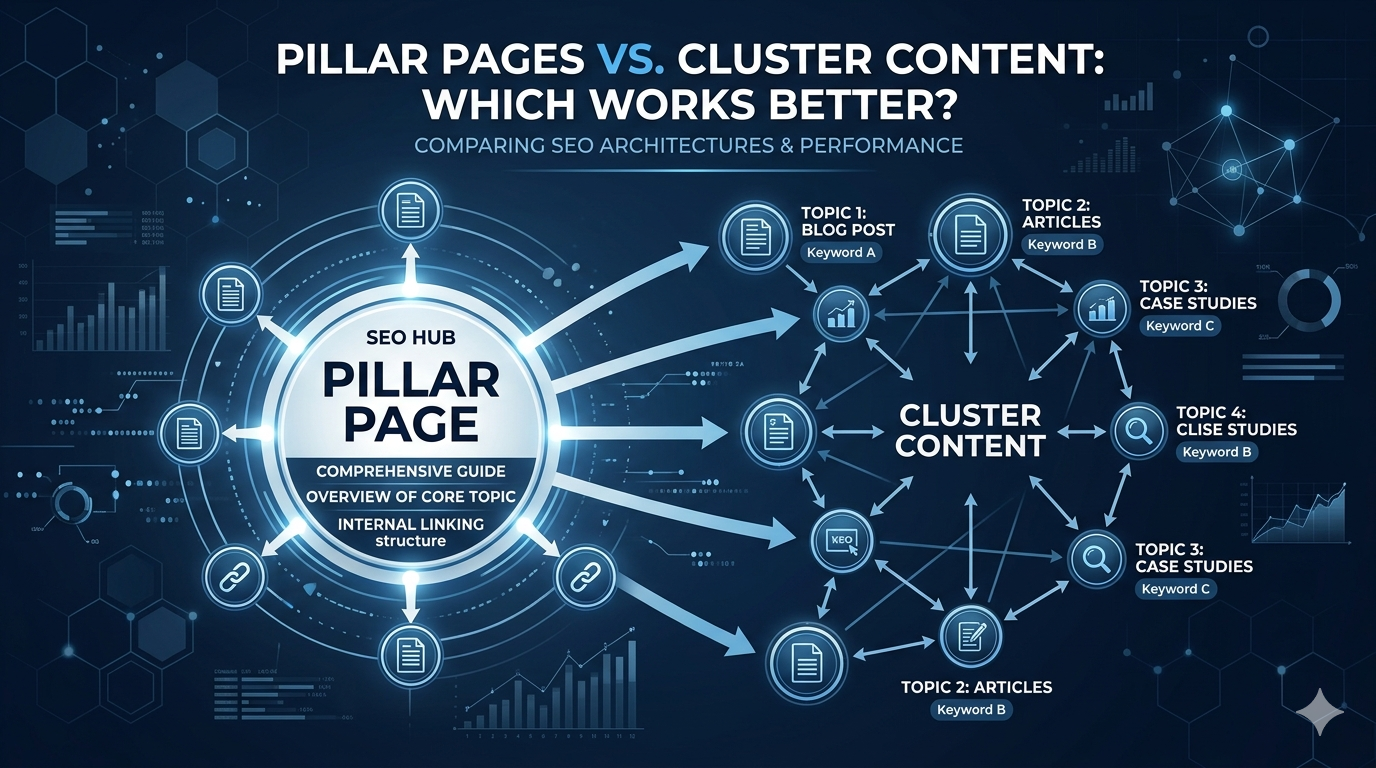
    Envision two realms locked in a silent struggle for digital supremacy. One, a colossal pillar, unyielding and grand, embodying a full-spectrum guide to a sprawling subject. The other? A constellation of interconnected hamlets, each probing a distinct angle of the same overarching narrative. These, friends, are our pillar pages and content clusters. Content strategies, yes, but also subtle gladiators vying for dominance in the arenas of SEO and user attention. The question at hand isn’t about declaring a victor. Rather, it’s about discerning which champion aligns flawlessly with your aspirations and the soul of your audience. Prepare to journey into the very heart of these strategies, dissecting their virtues, vulnerabilities, and the arenas where they truly shine. This guide? Your armory. Equipping you with the insight to enthrone the content strategy destined to rule your brand’s digital kingdom.

    What Exactly is a Pillar Page?

    Picture a definitive trove. A single source illuminating a central theme in its glorious totality. It’s the ‘101’ course, the ultimate compendium, the port of entry where a newcomer finds complete orientation. Forged to be commanding and profound, these pages often grapple with expansive keywords, laying down a rock-solid bedrock of knowledge. The north star? To ascend in rankings for a broad keyword and serve as the epicenter for all related content. A pillar page, wrought with care, is a landmark. A beacon calling visitors and cementing your stature as a true authority. Pillar pages? The very keystones of a robust content strategy. The essence of a pillar page: comprehensive command over a core subject.

    Deconstructing the Content Cluster Model

    Now, conjure a vibrant web. A tapestry of interconnected content pieces, each twirling around a central axis. That’s the content cluster model for you. Forget monolithic pages; embrace a symphony of focused articles, each delving into a pinpointed subtopic. These, in turn, connect back to the central ‘pillar,’ weaving a rich tapestry of related content, bolstering the overall weight of the cluster. Depth and nuance define the content cluster model. Unlock the power to target those elusive long-tail keywords and address your audience’s specific yearnings with laser-precise content. Cultivate a user experience that’s not just navigable, but inviting. Readers glide effortlessly, uncovering different facets of the topic. Strategic interlinking? The secret sauce, amplifying the SEO resonance of the entire cluster. The content cluster model? It harnesses the raw, untamed might of interconnected content.

    Pillar Page Power: Strengths and Advantages

    Pillar pages boast some serious advantages. First, their all-encompassing nature. They’re built to seize broad keywords and beckon a vast audience. Consider them supreme lead magnets. Offering invaluable insight in exchange for a simple introduction – contact details. Pillar pages? Incredibly potent for solidifying your authority and thought leadership. By painting a complete portrait of a topic, you rise as a trusted sage in the field. What’s more, a meticulously crafted pillar page can ignite user engagement. Watch visitors linger longer, bounce rates plummet. A boon, indeed. Content, sculpted with precision, is an undeniable asset. The expansive embrace of a pillar page? A treasure in itself.

    Content Cluster Capabilities: Strengths and Advantages

    Content clusters, in contrast, reign supreme in their mastery of long-tail keywords, catering to the nuances of user intent. This refined approach lets you lure a laser-focused audience, actively hunting specific knowledge. Think engaged and eager. The interwoven nature of content clusters? It cultivates an experience, allowing readers to move seamlessly. They uncover interconnected topics, enriching their comprehension. Plus, the artful dance of internal linking within a content cluster supercharges SEO performance. Search engines take note of your content’s relevance and authority. Content clusters? They serve specific needs with pinpoint accuracy. Internal linking within? It amplifies SEO benefits. These strategies? They craft a rich digital tapestry.

    Pillar Page Pitfalls: Disadvantages to Consider

    For all their might, pillar pages are not without their shadows. The forging of a comprehensive pillar page? It demands time and resources. Research, the art of writing, and the craft of design – these take their toll. Maintenance? A relentless task. Information must be vigilantly updated, ensuring accuracy and relevance. Moreover, pillar pages can overwhelm. Particularly for those new to the topic. The sheer volume? Daunting. It can lead to information overload, extinguishing engagement. Weigh the costs: the resources required for creation and upkeep. Balancing breadth with user-friendliness? The key to unlocking their true potential.

    Content Cluster Challenges: Disadvantages to Consider

    Content clusters, while potent, also harbor their own trials. The creation of a cohesive content cluster? It calls for meticulous orchestration. Each content piece must be a strategic note, harmonizing with the theme and linking to the pillar page with grace. Managing a sprawling content cluster can be a Gordian knot. It demands a robust content management system and a clear understanding of the intricate threads connecting each piece. The keystone? The quality of each individual article. One poorly crafted or irrelevant piece can unravel the entire cluster. Careful planning? The bedrock of success. Content quality? Paramount.

    Keyword Strategy: Pillar Pages vs. Cluster Content

    The keyword strategy for a pillar page dances around a broad, high-volume keyword. The embodiment of the core theme. The goal? To ascend in rankings for this term, beckoning an audience drawn to the subject. Pillar pages are sculpted for broad visibility. The keyword strategy for a content cluster? A more refined pursuit. While the pillar page still aims for a broad keyword, the articles within the cluster lock onto long-tail keywords, intertwined with the main topic. This allows you to snare a more targeted audience, addressing specific yearnings. Content clusters? They excel at capturing long-tail searches. A pillar page? The keystone upon which long-tail keywords find their strength. A delicate balance, critical for both strategies.

    SEO Impact: Pillar Pages and Content Clusters

    Both pillar pages and content clusters can unleash significant SEO impact, albeit through different paths. Pillar pages elevate SEO by solidifying authority and relevance for a sweeping topic. The comprehensive nature signals to search engines that you are a fount of knowledge. Content clusters ignite SEO by forging a web of interconnected content. This reinforces the relevance and authority of the pillar page. Internal linking? The secret weapon. It empowers search engines to crawl and index your content more efficiently. Both strategies? They bolster SEO by establishing topical mastery. Internal linking? It greases the wheels of search engine crawling. The strategic deployment of these tactics? It can supercharge overall SEO performance.

    User Experience: Which Strategy Delivers?

    The user experience offered by pillar pages and content clusters presents a fascinating contrast. A deftly designed pillar page unfurls a structured vista, granting users rapid comprehension and seamless navigation to specific points of interest. Content clusters? They offer a granular and exploratory adventure, inviting users to plunge into subtopics and uncover related content at their own pace. The ideal path? It depends on the user. Some crave the panoramic view of a pillar page, while others relish the depth and adaptability of a content cluster. Consider your audience. Their preferences matter. Options cater to a symphony of user styles.

    Content Marketing Applications: Where Each Strategy Shines

    Pillar pages find their true calling in content initiatives crafted to educate and enlighten a broad audience. They are the darlings of comprehensive guides, ebooks, and white papers. Resources that transform into lead magnets or invaluable assets. Content clusters? They shine in campaigns designed to address specific user needs and interests. They are the masters of blog series, tutorials, and case studies. Tools to conquer pain points and deliver solutions. Align your content strategy with your marketing dreams. Weigh your audience’s desires when sculpting your content. Both pillar pages and content clusters? They play a symphony in content marketing. Their dance? A delicate balance.

    Measuring Success: Key Metrics for Each Approach

    Gauging the resonance of a pillar page involves charting metrics like organic traffic, time spent, bounce rate, and lead conversion. These reveal the effectiveness in drawing and engaging visitors. Assessing the success of a content cluster entails tracking organic traffic to the pillar page and its constituent articles. Also, the count of internal clicks. These metrics illuminate the cluster’s power in driving traffic and engagement. Track the compass points. Analyze the data. Refine your strategy. Data-driven insights? The bedrock of continuous progress. The artful application of metrics and analytics? It elevates your content strategy to new heights.

    Pillar Pages vs. Cluster Content: A Head-to-Head Comparison

    The choice? It hinges on your aspirations and resources. Are you aiming to seize a broad audience and solidify authority for a core theme? A pillar page might be your champion. Do you seek to target specific yearnings with laser-focused content? A content cluster could be your weapon. In some scenarios, a fusion approach – weaving together elements of both – might be the most potent solution. Weigh your resources. Define your dreams. A hybrid approach? It might unlock maximum impact. Their fusion? It can elevate both strategies to new heights.

    Real-World Examples: Pillar Pages in Action

    Many have harnessed the might of pillar page strategies to ignite traffic, generate leads, and cement authority. HubSpot, a shining example, sculpted a pillar page on inbound marketing. It has since drawn waves of organic traffic and countless leads. Neil Patel, too, wields pillar pages with deftness, educating his audience on the intricacies of SEO and content marketing. These tales speak volumes of the power of pillar pages. Study these victories. Glean wisdom from the tactics employed by industry titans. Their application? Crucial in these real-world sagas.

    Real-World Examples: Content Clusters in Action

    Similarly, countless companies have woven content cluster strategies to target specific user desires and bolster SEO. Backlinko, a name whispered with reverence, crafted a content cluster around link building. Each article? A deep dive into a particular technique. NerdWallet, another luminary, utilizes content clusters to deliver profound insight on personal finance. These stories? They showcase the potency of content clusters in capturing niche audiences. Learn from these triumphs. Adapt their blueprints to your own efforts. The strategic touch? It amplifies their effectiveness.

    The Future of Content Strategy: Beyond Pillar Pages and Clusters

    The horizon of content strategy hints at a tapestry woven from pillar pages, content clusters, and a constellation of fresh approaches. As search algorithms evolve, the call for content that is both comprehensive and keenly relevant to user needs will only intensify. This demands a deep understanding of your audience and a willingness to experiment. Embrace the new. Adapt to the changing tides. Continuously hone your strategy based on data and insight. The artful touch? It will remain a compass point in the future.

    Conclusion: Mastering the Art of Content Strategy

    In summation, both pillar pages and content clusters stand as invaluable tools in your content marketing arsenal. Your mission? To understand their strengths and shadows, choosing the path that best fits your needs and resources. By meticulous planning, execution, and measurement, you can sculpt a content ecosystem. One that beckons, engages, and converts your target audience. Embrace the power. Continuously learn. Stay ahead. The astute application? It will be the bedrock of enduring triumph.

  • How to Optimize Content for AI Answers (ChatGPT, Gemini, etc.)

    How to Optimize Content for AI Answers (ChatGPT, Gemini, etc.)

    How to Optimize Content for AI Answers (ChatGPT, Gemini, etc.)

    Imagine: Your content isn’t merely read. It’s understood. Synthesized. Presented as the answer by AI. We’re nearly there. Optimizing for AI responses? Not a sci-fi dream. It’s survival. Consider it teaching a star pupil, but the prize isn’t a grade. It’s prime digital land in an AI’s reply. This article? A deep dive into optimizing content for AI answers. Specific strategies await. Strategies to boost your content’s odds of appearing in AI summaries, insights, and responses. ChatGPT and Gemini are our North Stars.

    The AI Revolution: Why Optimize Content for AI Answers?

    ChatGPT. Gemini. Sophisticated AI. They’ve shaken information consumption to its core. Forget endless scrolling. Users crave immediate, all-encompassing answers. AI? It sifts mountains of data, pinpointing authoritative sources to craft concise, smart responses. Your content, if unoptimized, risks vanishing. Quality be damned. To optimize content for AI answers guarantees your effort pays off. Structure is key. Information presented in an AI-friendly way. Clear, sharp, truthful answers to common questions. Becoming the source in this AI age. To optimize content for AI answers? It’s not a fad. It’s the future of the game.

    Understanding How AI Processes Information

    Techniques first. Grasping AI’s information dance is vital. AI models – especially those hefty language models (LLMs) – lean on NLP, ML, and semantic analysis. NLP deciphers language’s code. ML learns from floods of data. Identifying patterns, relationships. Semantic analysis? Context. Intent. When AI faces a query, these techniques spring to life. Analysis. Keyword pinpointing. Content searching. Evaluation follows. Relevance. Truth. Authority. Readability. Finally, synthesis. Information distilled into a sharp answer. To truly optimize content for AI answers, mirror this process. Clarity. Logic. Authoritative information. Understanding NLP and semantic analysis? Non-negotiable. AI must grasp your content.

    Keyword Research: The Foundation of AI Optimization

    Keywords remain king in SEO. AI optimization demands it too. The shift? Away from mere high-volume keywords. Toward question-based queries. Toward long-tail phrases. These are the words users punch into AI-powered tools. Brainstorm questions. Your audience. Your niche. Use keyword tools to unearth related terms. Volume and competition matter. Scrutinize the top search results. What’s already soaring? Aim to create content that’s richer, more accurate, more current. Once keywords are locked, weave them naturally. Title. Headings. Body. Keyword stuffing? Avoid it. Genuine value? Prioritize it. A naturally embedded keyword elevates chances to optimize content for AI answers.

    Structuring Your Content for AI Comprehension

    Structure dictates AI understanding. AI models hunt for patterns, for connections. Logical, organized content is paramount. Headings, subheadings? Use them. Breaking content into digestible pieces. AI can scan. Key points identified. Bullet points. Numbered lists. Structured information. Facts extracted. Tables, charts? Visuals speak volumes. Complex data clarified. Short paragraphs improve the experience. Humans and AI alike can follow the thread. Think structured database. Clearer the information? Easier for AI to extract. To synthesize.

    Creating Concise and Informative Content

    Concise answers are AI’s bread and butter. Clarity. Directness. Jargon? Slang? Ditch them. Simple language reigns. Get to the point. Shun fluff. Truth matters. Currency matters. Build trust. Credibility. Back claims with proof. Cite. Examples. Case studies. Bring it to life. Relatability. Summary first. More effective the message? More likely AI will feature your content. If you truly want to optimize content for AI answers, focus on clarity.

    Leveraging Schema Markup for Enhanced Understanding

    Schema markup. Structured data. Added to HTML. Search engines gain deeper content insight. Context. Meaning. Ranking boost. Many schema types exist. Articles. Blogs. Products. Events. Use a schema generator. Or add the code manually. Validate it with Google’s Rich Results Test. Schema shines in AI optimization. Clear. Concise. AI models understand the content. Schema leveraged? AI-generated responses become likelier. A subtle, powerful step to optimize content for AI answers. To optimize content for AI answers includes implementing schema.

    Optimizing for Featured Snippets: A Gateway to AI Answers

    Featured snippets appear atop Google’s results. Direct answers to user questions. AI models use these answers. Optimization is crucial. Find the questions your audience asks. Create content that answers them sharply. Structure with headings matching user questions. Bullet points. Numbered lists. Structure matters. Clear, concise answer within the opening paragraph. Schema markup identifies question and answer. Monitor rankings. Track progress. Experiment. Content formats. Optimization tweaks. To optimize content for AI answers, ensure you optimize for featured snippets, including direct answers to common questions.

    Mobile-First Optimization: Catering to the AI User

    Mobile reigns. Optimize for mobile-first indexing. Mobile-friendly site? Content accessible on smaller screens? Essential. Responsive design adapts to screen size. Optimize images. Reduce load times. Clear writing style. Readable on mobile. Headings break up the text. Fast website. Slow sites frustrate. Ranking suffers. It’s about humans and AI. AI models use mobile-first indexing. Ensure mobile optimization. To optimize content for AI answers means ensuring your website is mobile-friendly.

    Building Authority and Trust: E-A-T for AI

    E-A-T (Expertise, Authoritativeness, Trustworthiness). Google’s quality yardstick. Sensitive topics demand it (health, finance, legal). Demonstrate field expertise. Be a trusted source. Content accurate. Reliable. High-quality content. Genuine value. Cite sources. Back claims. Connect with other experts. Get published on respected sites. Google verification boosts reputation. Trust is paramount. Not just for users. AI uses E-A-T signals. Optimize content for AI answers, you must build authority and trust.

    Monitoring and Adapting Your AI Optimization Strategy

    Ongoing. Not a one-off task. Track rankings. Monitor progress. Analytics reveal traffic, engagement, conversions. Keyword rankings. Search results analyzed. Opportunities identified. Experiment. Content formats. AI shifts constantly. Stay informed. Adjust. The goal? Organic visibility. Continuously optimize content for AI answers to stay ahead.

    The Future of AI-Powered Content

    Content’s future? AI. AI models grow smarter. They’ll reshape information discovery. Optimization is no longer optional. Understanding AI. Structuring content. Building trust. Boosts your chances of being featured. Embrace the AI surge. Position content for success. Continue to optimize content for AI answers and the future is bright.

    Conclusion: Embracing the AI-First Content Strategy

    AI optimization? Critical for digital success. Focus: question-based keywords. Structure: AI comprehension with clear headings. Schema markup unlocks understanding. Authority. E-A-T. Consistent monitoring is also vital. An AI-first content game plan? Content resonates with humans and AI. To optimize content for AI answers is to future-proof your content strategy.

  • Content Refresh Strategy: How to Update Old Blogs for Traffic

    Content Refresh Strategy: How to Update Old Blogs for Traffic

    Content Refresh Strategy How to Update Old Blogs for Traffic

    Introduction: The Forgotten Art of the Content Refresh Strategy

    I still recall the day our first blog post went live. The thrill! The anticipation! We’d labored over every single word. It felt like a ship christened and set to sea. But what becomes of that vessel after its initial journey? Does it continue its voyage indefinitely, or does it eventually languish, forgotten in some quiet harbor? Too often, our blog posts suffer the latter. Released, shared…then, silence. But, imagine if I told you there’s a way to reclaim those forgotten treasures, to breathe vitality back into them, transforming them into veritable traffic dynamos? That’s the potential unlocked by a robust content revival plan. In the following, we will investigate how to breathe life into those posts of yesteryear, evolving them from static web detritus into lead-attracting magnets. We will explore implementing a content revival plan and time-tested techniques to achieve content resurgance.

    The Stale Content Problem: Why Refreshing Matters

    Envision a grocery store; half the shelves lined with expired goods. Not exactly inspiring, is it? That’s akin to how search engines perceive aged content. Even the most dazzling blog post can fade. Facts morph, figures shift, fresh contenders appear. The result? A slide in search engine visibility, a trickle of visitors, and an opportunity squandered to genuinely connect with your audience. A content revival plan isn’t solely about revision; it telegraphs to search engines that your material remains pertinent, of value, and deserving of prominence. A content revival plan is a critical search engine optimization approach.

    Step 1: The Content Audit – Finding Your Hidden Gems

    Before commencing revitalization, you must first inventory your assets. Enter: the content audit. Think of it as a treasure hunt, but the quarry is blog posts bubbling with untapped potential. Begin by cataloging all your existing entries. Next, dissect each one using metrics such as organic traffic volume, bounce rate observed, dwell time, and shares via social media. Zero in on those posts that previously enjoyed success but have since witnessed waning traffic. These represent the best candidates for a content revival plan. Platforms like Google Analytics, coupled with Google Search Console, prove indispensable here. The aim, remember, is spotting those posts, that, given a little care, can gleam anew. A well-conceived content revival plan starts with an awareness of your content portfolio.

    Step 2: Keyword Research – Updating for Relevance

    The digital domain: always in flux, and keywords mirror this. What was trendy last year? Perhaps completely irrelevant now. This is why keyword exploration forms a pivotal piece of any content revival plan. Employ tools like SEMrush, Ahrefs, or even Google’s Keyword Planner to pinpoint contemporary search terms tied to your existing subjects. Seek terms marked by substantial search interest yet minimal competition. Then, weave these terms thoughtfully into your blog posts: title, headings, text, and meta descriptions included. Steer clear of keyword overload. The objective remains two-fold: boost search engine visibility while delivering a fluid, captivating experience for your audience. A sound content revival plan consistently revises keywords.

    Step 3: Content Updates – Adding Value and Freshness

    Here’s where the transformation occurs. Prepare to dive in and revamp your content. But, what precisely should this include? Consider these areas:

    • Update Information: Swap antiquated data, facts, and statistics with present-day equivalents. Vet all sources ensuring precision and recency. This constitutes the very essence of a content revival plan.
    • Add New Sections: Expand your existing work by introducing fresh sections touching on tangential subjects or offering enhanced insights. Think about weaving in novel research, case studies, or expert perspectives. Adding is critical to a thriving content revival plan.
    • Improve Readability: Enhance content clarity, making it easier to digest by thoughtfully employing headings, subheadings, bulleted lists, and images. Segment lengthy paragraphs into shorter, more approachable pieces. Easily read content makes a critical ingredient of a phenomenal content revival plan.
    • Add Visuals: Integrate pertinent images, videos, infographics—anything that enhances engagement and seizes your audience’s interest. Images are important in a contemporary content revival plan.
    • Optimize for Featured Snippets: Structure your piece to facilitate easy information extraction and display as a featured snippet. Employ explicit headings, lists, and tables to highlight essential details. Snippets represent an outstanding avenue to elevate your content revival plan.

    Keep in mind, the goal extends beyond merely lengthening content; it’s about enhancing its quality. Prioritize delivering maximum value, granting your audience the most exhaustive, current knowledge attainable. This should form a bedrock when putting into motion a content revival plan.

    Step 4: Optimizing On-Page SEO – Fine-Tuning for Search Engines

    Content modernization comprises only half the undertaking. Fine-tune on-page search engine optimization to ensure effortless comprehension and ranking. Consider these elements:

    • Title Tag: Fashion an attention-grabbing title incorporating your principal term, accurately reflecting the page’s subject. A meticulously crafted title tag stands as a vital facet of an efficient content revival plan.
    • Meta Description: Compose a succinct, persuasive summary to entice searchers to select your link. The meta description proves pivotal within your content revival plan.
    • Header Tags: Implement header tags (H1, H2, H3, etc.) to scaffold your content, underscoring salient points. Implemented header tags form a cornerstone of an effective content revival plan.
    • Image Alt Text: Apply descriptive alt text to all images, enabling search engines to decipher their context. The alt text proves essential to putting into motion a content revival plan.
    • Internal Linking: Connect to other relevant pages on your domain. It amplifies overall search engine optimization. Plus, furnish users with further resources. Interlinking is critical to a properly executed content revival plan.
    • URL Structure: Confirm that your URLs remain concise, illustrative, and incorporate your primary term. Concise URLs are vital for a streamlined content revival plan.

    Appropriate search engine optimization is a core tenet of a content revival plan.

    Step 5: Promoting Your Refreshed Content – Getting the Word Out

    Content modernized? Check. On-page search engine optimization? Perfected. It’s time to publicize! Refrain from passivity, awaiting traffic. Instead, aggressively champion your revamped creation. Examine these promotional techniques:

    • Social Media: Disseminate your creation across all platforms. Draft gripping updates highlighting essential takeaways. Also, encourage viewers to explore your blog post. Sharing proves important to any worthwhile content revival plan.
    • Email Marketing: Alert your subscribers to your fresh content. Underscore novel insights. Additionally, elucidate incentives for exploration. Email marketing forms an integral piece of any thriving content revival plan.
    • Guest Blogging: Contact fellow bloggers within your niche. Extend an offer to craft a guest piece incorporating links back to your revitalized content. Guest blogging forms a cornerstone of a successful content revival plan.
    • Online Communities: Broadcast your piece within pertinent digital communities; forums, groups, Q&A sites. Contribute meaningfully to conversations, imparting valuable observations. Communicating your output represents a potent strategy to put into motion a content revival plan.
    • Paid Advertising: Weigh running paid ad campaigns across platforms like Google Ads or social media avenues. This broadens audience reach. Paid advertising symbolizes an exceptional method to maximize your content revival plan.

    Recall: promotion powers traffic toward your refreshed content. Feel emboldened to assess varied tactics. Discover what resonates most with your viewers. Promotion constitutes a superlative approach to executing a content revival plan.

    Step 6: Measuring and Analyzing Results – Tracking Your Success

    The ultimate phase? Quantify and dissect the fruit of your labor. This dictates whether your endeavors yield dividends. Plus, it pinpoints areas ripe for refinement. Monitor metrics such as organic traffic volume, bounce rate observed, dwell time, and conversion rates. Employ platforms like Google Analytics and Google Search Console to trace your advancement. Scrutinize shifts in your rankings over time. Did your revitalized content ascend within results? Did you register gains in organic traffic? Did your bounce rate diminish? By examining these benchmarks, glean critical perspectives regarding the potency of your content revival plan. And, implement adjustments as necessary. This proves indispensable to any thriving content revival plan.

    Real-World Examples: Content Refresh Strategy in Action

    Let’s examine how organizations have successfully executed a content revival plan:

    • HubSpot: HubSpot frequently updates its blog entries with the latest marketing patterns and best practices. This has assisted them in upholding their stature as a commanding font of knowledge within the marketing sphere.
    • Neil Patel: Neil Patel excels at content promotion. He routinely revitalizes aged blog pieces. His aim? To sustain relevance. The result? Millions generated from his blog.
    • Backlinko: Brian Dean of Backlinko is celebrated for his insightful, actionable content. He consistently revises his blog pieces. New data and case studies are included. Consequently, he has cultivated a substantial, devoted following.

    These stand as but a few illustrations of entities leveraging a content revival plan to amplify traffic flow and search engine optimization. By emulating their methodologies, similar outcomes remain attainable. Drawing insights from tangible instances forms a key step when embracing a content revival plan.

    The Future of Content Refresh Strategy

    As search engine algorithms evolve, the need for a content revival plan only escalates. Expect to witness amplified emphasis on content currency and relevance. Organizations must proactively update their legacy blog entries. Also, align them with emerging movements and optimal techniques. Emerging tools and technologies will empower organizations to automate and refine their content revival plans. From content refinement powered by artificial intelligence, to keyword investigation fueled by machine learning, the horizon for content revitalization gleams brightly. Weigh future ramifications when commencing a content revival plan.

    Conclusion: Embrace the Content Refresh Strategy

    A content revival plan transcends optionality; it embodies an essential. It is necessary for any entity intent on remaining competitive in the online arena. By routinely modernizing your legacy blog entries, amplify traffic flow, elevate search engine optimization, and furnish your audience with unparalleled, current insights. Therefore, welcome the content revival plan. Prepare to invest effort. Begin infusing fresh life into your neglected creations. Your website shall express its gratitude. In summary, consistently adopt a content revival plan.

  • How to Write Blog Posts That AI Picks as Answers

    How to Write Blog Posts That AI Picks as Answers

    How to Write Blog Posts That AI Picks as Answers

    Introduction: The Quest for AI Endorsement

    Picture this: Your blog posts aren’t just seen by human eyes. Instead, they are singled out by artificial intelligence. Selected to field questions, dissect problems, and spread knowledge. A far-off dream? Nope. It’s the playing field today for anyone crafting content. Search engines? They’re leaning hard on AI, striving to grasp and serve up the cream of the crop in answer form. Knowing how to write blog posts that AI picks as answers? That’s not a nice-to-have anymore. It’s survival for creators aiming to lead the charge.

    Consider this article your treasure map to mastering content that hums in harmony with AI. We’ll dissect the methods, the clever moves, the golden rules that will send your chances soaring when it comes to seeing your blog posts spotlighted as answers, chosen by cold, calculating machines. Newbie or veteran? Doesn’t matter. Here, you’ll arm yourself with the insights to win in the age of AI-powered content.

    Understanding How AI Selects Answers

    Hold up! Before we dive into creation mode, let’s peek under the hood. How do these AI systems even pick answers? AI, especially the stuff search engines use, tries to think like us. It aims to deliver responses that are spot-on, truthful, and thorough. Content gets judged on a few key things:

    • Relevance: Does it hit the nail on the head when it comes to what the user’s asking?
    • Authority: Is the source someone you can trust? Are they legit?
    • Comprehensiveness: Does it leave any stones unturned in its quest to answer?
    • Structure: Is it a hot mess, or neatly organized and easy to follow?
    • Engagement: Does it grab you and keep you hooked? Does it bring something worthwhile to the table?

    Want AI to pick your content? Then you’ve got to ace each of these areas. That means deep dives into research. Logical bones to your content. Writing that’s sharp and clear. Plus, offering up juicy insights that go way beyond the obvious.

    Keyword Research: The Foundation of AI-Optimized Content

    Keywords? They’re the rock-solid base of any SEO success story. And they’re just as vital when you’re trying to woo AI. But there’s a twist. Keyword hunting for AI is a bit different. Forget just chasing the big numbers. You’ll want to zero in on long-tail keywords and those question-based searches, too.

    Long-tail keywords? Think longer, super-specific phrases. The kind users type when they’re hunting for the nitty-gritty. Question-based searches? Those start with words like “how”, “what”, “why”, and “where”. AI is way more likely to use these to sniff out the best answers.

    Want to do keyword research like a pro for AI? Grab tools like Google Keyword Planner, Ahrefs, and SEMrush. Hunt down those long-tail keywords and question phrases that orbit your topic. Most importantly, figure out what users really want when they type those words. Then, make your content sing to that tune.

    Structuring Content for AI Readability

    AI? It’s all about logic. Structure. Order. So, if you want to befriend these algorithms, you’ve got to present your content in a way that makes sense to them. Here’s the playbook for structuring content that AI will pick every time:

    • Use clear and descriptive headings and subheadings: These are like road signs for AI. They point out the main ideas and where to find them.
    • Use bullet points and numbered lists: Big walls of text? AI hates them. Lists break things up, making it easy to spot the important stuff.
    • Use tables and charts: Got data? Stats? Charts and tables make them shine. They turn boring numbers into eye candy that’s easy to digest.
    • Use short paragraphs: Aim for three to four sentences, max. Short and sweet keeps everyone happy—humans and AI alike.
    • Use a clear and concise writing style: Ditch the fancy words and the head-scratching sentences. Simple is king.

    Follow these rules and you’ll craft content that’s not only organized but a downright delight for AI to consume.

    Creating Comprehensive and Authoritative Content

    AI? It’s on the hunt for substance. Authority. Trust. So, your mission? Create content that digs deep. Content that spills secrets readers won’t find anywhere else. How do you do it? Try these:

    • Conduct thorough research: Before you type a single word, become an expert on your topic.
    • Provide evidence to support your claims: Don’t just say it, prove it. Back up your words with facts, figures, and studies.
    • Cite your sources: Give credit where it’s due. Show that you’ve done your homework.
    • Provide unique insights: Don’t just parrot what everyone else is saying. Add your own spin. Your own “aha!” moments.
    • Update your content regularly: Keep it fresh. Keep it current. The world changes fast, and your content should too.

    Do these things, and you won’t just inform, you’ll impress. You’ll build trust. And you’ll dramatically boost your odds of having AI spotlight your blog posts as the ultimate answers.

    Optimizing for Semantic Search

    Semantic search? It’s search that gets the meaning behind the words. It’s not just matching keywords. It’s trying to understand what the user really wants. To win here, you’ve got to create content that’s dripping with context and relevance.

    One trick? Latent semantic indexing (LSI) keywords. Think of these as sidekick words. Phrases that relate to your main keyword and add extra color to your content. “Chocolate cake recipe”? LSI keywords might be “baking tips”, “chocolate frosting”, or “dessert ideas”.

    Tools like LSI Graph and Google Correlate can help you unearth these gems. Sprinkle them naturally into your writing to pump up the semantic richness.

    Leveraging Schema Markup

    Schema markup? It’s like adding secret labels to your website. Labels that help search engines decode what’s on your pages. It feeds them extra info. The type of content. Who wrote it. When it went live. The main topics covered.

    Add schema markup and you’re making life easier for AI. You’re boosting your chances of getting picked as an answer. There are tons of schema types. Pick the ones that fit your content:

    • Article schema: For your blog posts
    • Recipe schema: For those mouth-watering recipes
    • Product schema: For product pages
    • FAQ schema: For those burning questions
    • How-to schema: For those step-by-step guides

    Want to add schema? Tools like Google’s Structured Data Markup Helper or a WordPress plugin like Yoast SEO can help. Test your work with Google’s Rich Results Test to be sure it’s all working right.

    Writing Engaging and User-Friendly Content

    AI is important, no doubt. But don’t forget the humans! You need content that grabs them, that keeps them reading. After all, AI is trying to think like us. It wants to deliver what we find useful.

    So, how do you create content that sizzles?

    • Write in a conversational tone: Skip the jargon. Talk like a real person.
    • Use visuals: Break up the text with pictures, videos, anything that catches the eye.
    • Use storytelling: Weave in stories. Share personal experiences. Make it memorable.
    • Ask questions: Get your readers thinking. Get them involved.
    • Provide actionable advice: Give them tips they can use now.

    Marry AI smarts with human appeal and watch your chances of AI success skyrocket.

    Promoting Your Content

    Great content? Check. AI-optimized? Check. Now, you’ve got to shout it from the rooftops. You need to get it in front of eyeballs. Here’s your promotion playbook:

    • Share your content on social media: Facebook, Twitter, LinkedIn, Instagram—hit them all.
    • Email marketing: Send newsletters with links to your latest posts.
    • Guest blogging: Write for other blogs in your world.
    • Participate in online communities: Share your wisdom where it fits.
    • Link building: Get other sites to link to you. It’s like a vote of confidence.

    Get out there and hustle. The more visible you are, the better your chances with AI.

    Analyzing and Iterating

    This isn’t a one-and-done deal. Crafting content that AI loves is a marathon, not a sprint. You need to watch the numbers. See what’s working. Adjust. Tweak. Repeat.

    Google Analytics and Google Search Console are your friends. Track your traffic. See where your keywords rank. Find out what’s hot and what’s not.

    Then, get to work. Refine your content. Sharpen your keyword strategy. Revamp your promotion. Keep testing. Keep learning. The game is always changing.

    Conclusion: The Future of Content Creation

    To sum it all up, how to write blog posts that AI picks as answers is complex. It’s a mix of AI understanding, sharp keyword skills, smart content structure, semantic savvy, schema secrets, user engagement, and promotion power. Master these and you’ll be well on your way to AI stardom.

    AI is only going to get bigger. It will play a huge role in search and discovery. Creators must adapt. Those who embrace this new world will be the ones who thrive.

    Remember: Do your research. Be authoritative. Be user-friendly. Experiment. Learn. Adapt. The road to AI approval is a long one, but the rewards are worth it.

    Write those blog posts. Stay plugged into the world of AI. Master structured data, semantic search, and engaging content. Unlock new doors for your blog and your business. The future is intelligent. It’s waiting for you.

    Craft blog posts with purpose. With a voice. With a passion for giving value. Harness the power of AI to amplify your message and reach new heights. The world of content is changing. It’s time to adapt and win in the age of AI.

  • Long-Tail Keywords vs Short-Tail: Which Wins in 2026?

    Long-Tail Keywords vs Short-Tail: Which Wins in 2026?

    Long-Tail Keywords vs Short-Tail Which Wins in 2026

    The Keyword Prophecy: 2026 and Beyond

    Late December, 2025. The digital marketing world? Electric. Not just for New Year’s musings, but something bigger. The unveiling of the 2026 search algorithm. Whispers traveled like wildfire. Would the short-tail keyword reign endure, or would hyper-specific long-tail searches finally ascend the throne? The skirmish between long-tail keywords and their concise cousins? It had been a long, drawn-out affair. But 2026? It promised resolution. A victor declared. This narrative? It’s about that clash. And how grasping its subtleties reshapes your SEO game.

    Think of this as a voyage. A cruise through the ever-shifting SEO terrain. We’ll pull apart the strengths, the soft spots, of both long-tail keywords and those snappy, shorter terms. Expect real-world stories. Algorithm autopsies. And, most critically, the know-how to forge an SEO master plan primed for 2026 and beyond. So, brace yourself. Which approach wins? long-tail keywords or short-tail? The answer unlocks SEO glory.

    Short-Tail Keywords: The Old Guard

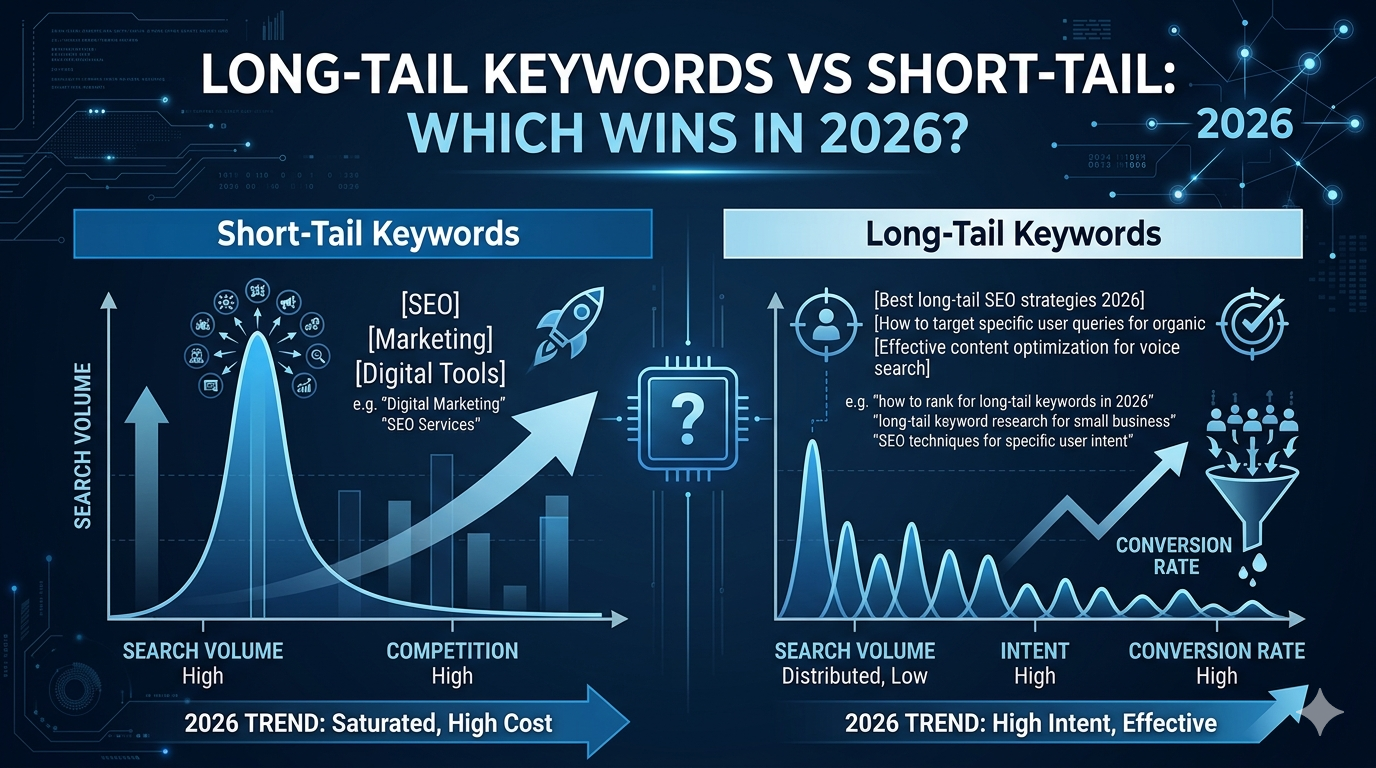
    Ah, short-tail keywords. SEO’s grizzled veterans. These are expansive, universal terms. Usually one to three words. “Cars.” “Running shoes.” “Digital marketing.” Get the picture? Their allure? Sheer search volume. Think millions hunting these terms each month. That’s immense traffic potential. The flip side? Blistering competition. Everyone’s clawing for that coveted top spot.

    A teeming bazaar. That’s the short-tail keyword arena. A cacophony of voices, hawking similar wares, all vying for the same eyeballs. To cut through? It demands serious SEO muscle. Link fortresses. Epic content. Technical wizardry. If you’re an established titan, short-tail keywords? A golden goose. But for the small fry, the startups? The entry fee might be too steep.

    Take “coffee.” A caffeinated colossus might pursue this term, casting a wide net for anyone, anywhere, with a coffee craving. They’ve got the resources to wage war for that top ranking. The spoils? Branding power. A tidal wave of generic traffic. But the road is long. Treacherous. And many smaller contenders? They’ll never reach the summit. That’s precisely why many see long-tail keywords as a vital weapon.

    Long-Tail Keywords: The Rising Tide

    Long-tail keywords? They’re different. Lengthier. Sharper. They echo a user’s precise yearning. Forget “coffee.” Now think, “best organic fair trade coffee beans online.” Search volume dips, yes. But competition? It practically vanishes. Rising in the ranks becomes easier. Much easier. Result? Laser-focused traffic, pouring straight to your digital doorstep.

    Picture this: Long-tail keywords as secret streams, feeding a mighty river. Individually? Modest. But together? They unleash a torrent. Similarly, each long-tail keyword might only lure a handful of visitors monthly. Yet, collectively? They orchestrate a surge in traffic. Long-tail keywords are about specificity. Zeroing in to capture those hyper-targeted searches. They’re also about clarity. Giving customers the detailed intel they crave about your offerings.

    Plus, here’s the kicker. Long-tail keywords often signal a buyer on the brink. The person hunting for “best organic fair trade coffee beans online”? They’re way further down the sales funnel than someone just typing “coffee.” They know exactly what they want. They’re on the hunt for that specific product, that perfect fix. By wielding long-tail keywords, you snag premium leads. Prospects primed to become paying customers. Long-tail keywords? They fuel smarter sales. Long-tail keywords? They’re marketing essentials.

    The Algorithm’s Whisper: How Search Engines are Evolving

    The march of search engine algorithms? It’s the heartbeat of the long-tail keywords versus short-tail debate. Back in the primordial soup of search, algorithms were simple creatures. Keyword matching ruled. Your website echoed the searcher’s exact words? Bingo! High ranking. But these early systems? Easily gamed. Cue the keyword stuffing. The content wasteland.

    Today’s algorithms? They’re sophisticated beasts. Machine learning. Natural language processing. They dissect the intent lurking behind the search. Context. Location. Past searches. Even sentiment. They factor it all in. The result? Search engines now deliver relevant results, even if your website doesn’t parrot the searcher’s every word.

    This spells big changes for SEO. Simply chasing short-tail keywords? Not enough. Not anymore. To thrive, you must craft content that speaks to the user’s deepest needs, that offers genuine value. This is where long-tail keywords shine. By answering specific questions, soothing specific anxieties, you broadcast your expertise. You forge trust. Long-tail keywords? More crucial than ever.

    Data Dive: Analyzing the Numbers

    Let’s crack open some real-world data. Let the numbers tell the tale of long-tail keywords‘ might. A study by Ahrefs, sifting through over 1.9 billion keywords, revealed that a staggering 92% attract ten searches or less each month. This spotlights the untapped potential of long-tail keywords. Each keyword might seem small, insignificant. But their sheer volume? That’s a traffic goldmine.

    Another study, this one from Moz, discovered that 70% of all searches are long-tail keywords. People are increasingly specific in their hunts. Credit voice search. Credit smarter algorithms. As voice search becomes second nature, users speak in full sentences, posing detailed questions. Long-tail keywords? They’re gaining traction.

    The picture is clear. Long-tail keywords aren’t a niche tactic. They’re foundational to SEO. Ignore them? You’re turning your back on a massive slice of potential traffic, potential customers. Long-tail keywords are paramount.

    Case Studies: Long-Tail in Action

    Time for some real-world stories. How long-tail keywords translate to tangible results.

    Case Study 1: The Boutique Fitness Studio

    A small studio, specializing in yoga and Pilates, struggled to wrestle market share from the big-box gyms. Short-tail keywords like “yoga” and “Pilates”? A losing battle. They pivoted. They embraced long-tail keywords. Think “yoga classes for beginners in [city name]” and “Pilates for back pain relief.” The outcome? A surge in website traffic. A flood of new client inquiries. By homing in on specific needs, specific desires, they reeled in a premium audience.

    Case Study 2: The Online Pet Supply Store

    An online store, selling pet supplies, faced a similar challenge. Amazon. Petco. Giants dominating the short-tail keyword landscape. “Dog food.” “Cat toys.” The store shifted gears. They doubled down on long-tail keywords. “Best grain-free dog food for sensitive stomachs.” “Interactive cat toys for indoor cats.” The result? Higher rankings for specific products. Customers finding exactly what they sought. The sales funnel? Streamlined. By embracing long-tail keywords, the store witnessed a dramatic upswing in sales.

    Tools of the Trade: Finding the Right Long-Tail Keywords

    Unearthing the perfect long-tail keywords? It’s part art, part science. A blend of research, analysis, and a dash of inspiration. Here are some weapons for your arsenal:

    • Google Keyword Planner: Google’s free keyword playground. Research. Analyze. Uncover related terms.
    • AnswerThePublic: A question generator. It spits out a treasure trove of questions people are asking. Pure long-tail keyword gold.
    • SEMrush and Ahrefs: The SEO powerhouses. Keyword research. Competitor spying. Rank tracking. They do it all.
    • Google Search Suggestions: Start typing. Watch Google’s suggestions appear. These are based on real searches, real needs.
    • Forum and Blog Research: Dive into online communities. Scour blogs. What questions are people asking? What topics spark debate?

    Remember, the best long-tail keywords? They resonate with your business. They address a specific need. They possess a pulse, a reasonable amount of search volume. Long-tail keywords? They’re the future of SEO.

    The 2026 Forecast: A Hybrid Approach

    So, the million-dollar question. Who triumphs in 2026? long-tail keywords or short-tail? The savvy SEO strategy will likely be a fusion. Short-tail keywords? They forge brand recognition, casting a wide net. Long-tail keywords? They reel in targeted traffic, generating qualified leads. The trick? Knowing when to deploy each weapon.

    Think of a balanced investment strategy. You wouldn’t gamble everything on a single stock. Similarly, don’t pin all your hopes on short-tail or long-tail keywords alone. Diversify. Maximize your potential. Diversification? It’s SEO’s secret ingredient. Long-tail keywords? A crucial element.

    In 2026, SEO glory hinges on grasping user intent and crafting content that delivers tangible value. Focus on both short-tail and long-tail keywords, yes. But prioritize the user above all else. Long-tail keywords? They amplify the user experience.

    Beyond Keywords: The Holistic SEO Strategy

    Keywords matter. But they’re one piece of a larger puzzle. To truly conquer SEO in 2026, embrace a holistic strategy. One that weaves together these essential strands:

    • High-Quality Content: Informative. Engaging. Valuable. Content that resonates.
    • Technical SEO: A website that’s technically sound. Easy for search engines to crawl, to index.
    • Link Building: Backlinks from reputable sources. They boost your website’s authority.
    • User Experience: A website designed for delight. Speed. Mobile-friendliness. Intuitive navigation.
    • Mobile Optimization: A mobile-first mindset. More people are browsing on phones and tablets.
    • Local SEO: For local businesses, optimize for local search. Attract nearby customers.

    By focusing on these core pillars, you’ll forge an SEO strategy built to last. Long-tail keywords? A vital component.

    The Future is Now: Implementing Your Strategy

    The future of SEO isn’t some distant dream. It’s unfolding now. Grasp the shifting tides of search. Master the art of long-tail keywords. And you’ll position your business for triumph in 2026 and beyond. Long-tail keywords? More pivotal than ever.

    Don’t wait for algorithm updates to drop. Start crafting your long-tail keyword strategy today. Know your audience. Understand their needs. Create content that soothes their anxieties. Provide value. Build trust. That’s the SEO secret sauce. Long-tail keywords? They help you stir it.

    The skirmish between long-tail keywords and short-tail? It might rage on forever. But by understanding their strengths, their limitations, you can forge an SEO strategy that drives traffic, snags leads, and grows your business. Start wielding long-tail keywords now.

    Key Takeaways for 2026 SEO

    As we peer into 2026, some key insights about long-tail keywords surface:

    • Intent is Paramount: Search engines are intent-obsessed. Long-tail keywords align your content with specific user desires.
    • Specificity Wins: In the crowded digital arena, specificity carves a path. Long-tail keywords target niche audiences with laser precision.
    • Hybrid is Best: A balanced attack. Short-tail and long-tail keywords working in harmony. That’s the winning formula.
    • Quality Content is King: Regardless of your keyword tactics, high-caliber, valuable content reigns supreme.
    • Adapt and Evolve: The SEO landscape is a living, breathing entity. Stay informed. Stay agile.

    By embracing these principles, you’ll navigate the SEO maze and secure lasting success in 2026 and beyond. Master long-tail keywords, and you might just claim that top spot. Prepare now. The future of long-tail keywords awaits.

  • Keyword Research in the Age of AI: What Changed?

    Keyword Research in the Age of AI: What Changed?

    Keyword Research in the Age of AI: What Changed?

    Picture this: you’re a mapmaker, but the world’s being reshaped as you watch. Fast. Your maps? Antiquated. New lands popping up overnight. Your trusty tools? Suddenly… insufficient. That’s keyword research today. Artificial intelligence didn’t just tweak things; it detonated the old order. The painstaking, manual quest for search terms? Now a vibrant, AI-assisted deep dive into what users really want, content voids, and what’s trending. The shift? Seismic.

    The Pre-AI Landscape: A World of Manual Labor

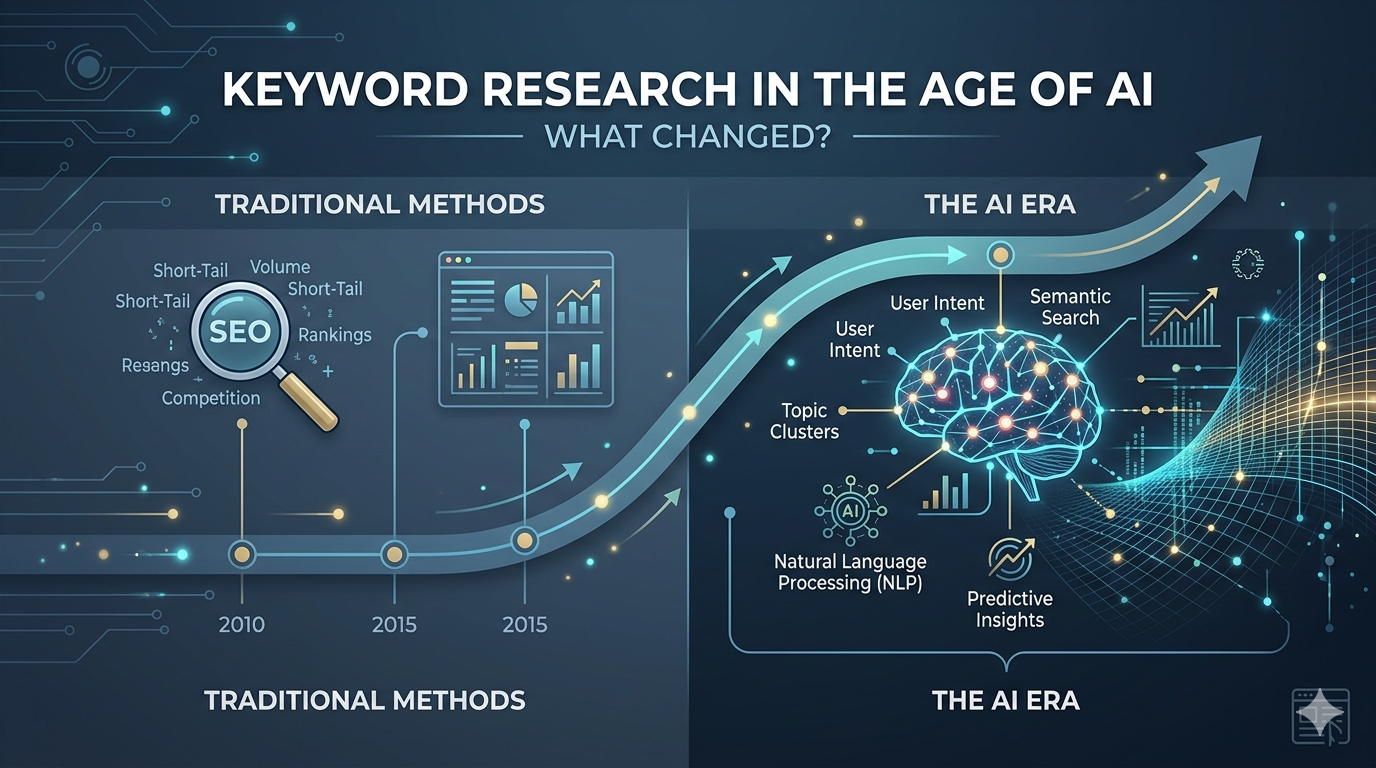
    Before AI took over, keyword research meant work. Endless hours squinting at keyword tools, crunching search numbers, then grouping keywords. By hand. SEO folks clung to Google Keyword Planner, SEMrush, Ahrefs. Prospecting for gold, basically: tons of dirt, tiny payoff. We’d burn weeks building lists, sizing up the competition, guessing which keywords would bring the flood. Tedious? Oh yes. Frustrating? Absolutely. You needed serious SEO chops and a saint’s patience. All that? So slow. So… narrow.

    The old way had serious flaws. Time. Oh, the time it devoured! Hundreds, thousands of keywords? Days. Weeks. And mistakes? Human nature. We’d miss key terms, or totally misread what searchers were after. Plus, search changed fast. New keywords, new trends… impossible to keep pace by hand. Keyword research? Needed a serious upgrade.

    AI Enters the Scene: A Paradigm Shift

    AI tools? They rewrote the book. Now, algorithms sift data faster than we can blink. They see connections that would be invisible to us. And they morph as search itself evolves. AI? Indispensable. Think of it: a tireless research team, digging for opportunities, 24/7. That’s AI’s impact on keyword research.

    The biggest change? Focus. Not just keywords, but the why behind the search. AI looks at search queries, website text, and deciphers user intent. SEO now targets keywords that match that intent. Better content, better engagement. Take “coffee maker.” AI doesn’t stop there. “Best coffee maker for home use?” “Coffee maker with grinder?” “Easy to clean coffee maker?” Now we’re talking! Content that actually helps people. Keyword research advanced by leaps and bounds.

    AI-Powered Tools: A New Arsenal for SEO Professionals

    A whole ecosystem sprung up. AI tools for every stage of keyword research. Discovery, competition analysis, content refinement, tracking results.

    • AI-powered keyword suggestion tools: Machine learning at work. Feed it keywords, your site’s text, what’s trending. Boom: keyword suggestions. Long-tail keywords, related phrases, hidden gems that old tools miss.
    • AI-driven content optimization tools: These dissect your site’s content, then tell you how to make it better. Where to slip in keywords naturally, how to rephrase for impact, overall content polish.
    • AI-based competitive analysis tools: Spying, but ethical. These tools analyze competitors, revealing their top keywords, content tricks, backlinks. Steal… er, borrow those insights for your own keyword research.
    • AI-powered performance tracking tools: Watching your keywords, watching your content. Rankings, traffic, conversions. Know what’s working, what’s not. Tweak your strategy.

    AI spots trending topics, real-time. AI finds content gaps in search results, so you can fill them with something better. AI tailors keyword research to your industry, your audience, your goals. It’s a constantly growing toolkit. Better options. Better optimization. For everyone.

    The Evolving Role of the SEO Professional

    AI didn’t kill the SEO pro. It transformed them. No more endless grunt work. Now, strategy takes center stage. Understanding intent. Crafting content plans. Mining data for trends. An SEO pro? Now needs AI smarts, machine learning knowledge, the skills to translate AI insights into action.

    The new SEO? Less data entry, more strategist. They think critically about what AI spits out. They use their expertise to guide keyword research and content creation. They communicate. With clients. With stakeholders. Explaining the why behind the SEO moves, proving the value of their work. The SEO pro? A conductor now, orchestrating AI tools and human skills to get the best possible outcome. The change to keyword research has been revolutionary.

    The Importance of Human Insight Remains

    AI automates, yes. But it can’t replace human intuition, human creativity. Algorithms are only as good as their training data. Sometimes, they’re biased. Sometimes, flat-out wrong. SEO pros? They must validate what AI finds. They must spot opportunities that algorithms miss. AI might flag a popular keyword. A human might realize that keyword is irrelevant to the target audience, or that the search intent doesn’t align with the business. AI might suggest a content idea. A human might know that topic is already played out, or that the audience wouldn’t care.

    Content needs soul. AI optimizes, but humans captivate. A catchy headline. A compelling story. Visuals that pop. SEO pros use their creativity to grab attention, to cut through the noise. Human oversight? Still crucial for keyword research.

    Adapting to the New Landscape: Essential Strategies

    SEO pros must adapt. New strategies. Embrace AI. Here’s how to thrive in this new world:

    • Focus on user intent: Let AI reveal what users truly need. Target keywords that align with that intent. Create content that truly delivers.
    • Embrace long-tail keywords: Longer phrases. Lower search volume. Higher conversion rates. AI finds those hidden gems, specific to your niche, specific to your audience.
    • Prioritize content quality: Compelling. Engaging. Valuable. Answer questions. Solve problems. Create a great user experience.
    • Monitor performance and adapt: Track keywords. Track content. Tweak as needed. Data-driven decisions.
    • Stay up-to-date: AI evolves fast. Conferences. Blogs. Experimentation. Stay ahead of the curve.

    The Future of Keyword Research: A Symbiotic Relationship

    AI and human expertise? Inseparable. AI will keep automating the tedious stuff. SEO pros can focus on the big picture. Human insight? Always vital. Validating AI’s findings. Crafting amazing content. Adapting to a constantly shifting landscape.

    Expect even smarter AI tools. Bigger datasets. Subtler patterns. Personalized recommendations. But the human touch? Never gone. SEO pros will always need judgment, expertise, creativity. To make smart calls about keyword research and content creation.

    Success in keyword research? Embrace AI. But never forget the human element. Combine AI’s power with human skills. Unlock traffic. Engage audiences. Achieve real goals.

    Conclusion: Navigating the AI-Driven SEO Revolution

    To sum it up: keyword research? Radically changed. Thanks to AI. From endless manual labor to AI-powered automation. SEO pros now approach keyword research in a whole new way. AI’s data skills are mind-blowing. Pattern recognition? Unmatched. Trend identification? Spot on. But don’t forget human insight. And creativity. The best strategies? Blend AI tools with human expertise. A balanced approach to keyword research. As AI keeps evolving, SEO pros must evolve too. Embrace the symbiosis: tech and human ingenuity. To stay relevant. To stay effective. In the ever-shifting world of SEO. Ultimately, keyword research‘s future lies with those who wield AI’s power. And who also possess the critical thinking and creative vision to connect with people. And drive results.

  • Zero-Click Searches: How to Still Get Traffic

    Zero-Click Searches: How to Still Get Traffic

    Zero-Click Searches How to Still Get Traffic

    The Rise of the Invisible Click: Navigating the Zero-Click Search Landscape

    Imagine this: people locating answers without a single click. Sounds futuristic, right? It’s the here and now. We all do it. That quick weather check? Currency conversion? A speedy fact lookup? All right there, inside the search results. But what does it all suggest for businesses, for content creators dependent on that lovely flow of organic traffic? Is it the end of days? Or an opportunity…waiting?

    Forget mourning the switch. This? This is about arming you. Equipping you with plans. Strategies to prosper. In the world of these so-called “zero-click” searches. Time to see how to adjust your SEO. How to wield featured snippets. And yes, still get those clicks. Even if they aren’t, well, direct. The core? To prove that, armed with the correct moves, you don’t just survive. You flourish.

    Understanding Zero-Click Searches: What’s Really Happening?

    Before solutions, a problem. A good look at what’s actually unfolding. Zero-click searches? They’re those queries where the answer leaps out on the search results page (SERP), no website visit required. It’s all about that “best user experience”, right? Direct answers. Featured snippets. Knowledge panels. Tools to satisfy, without needing a click. Examining the underbelly of these searches? Crucial. How people behave is changing.

    The numbers? Don’t lie. Study after study shows it: a huge chunk of searches? Zero clicks. Several factors feed this:

    • Mobile-First Indexing: Small screens. Quick answers. That click? Less likely.
    • Rich Results: Recipes swirling in carousels. Products gleaming in listings. Details, right up front.
    • Featured Snippets: Concise answers. Perched atop the SERP. The immediate satisfaction.
    • Knowledge Panels: People. Places. Things. Facts pulled from the depths.

    Understanding? The first step. Adapting? The second. The rise of the zero-click? Not bad, not good. It’s just…different. Information now, is consumed in a new way. Don’t fight it. Work with it.

    Strategy 1: Optimize for Featured Snippets and Position Zero

    No clicks? Fine. Be the answer. Those snippets. Position zero. Top of the heap. Direct answers. Nab that snippet? It’s prime territory. How do you make it happen? Consider this:

    • Answer Specific Questions: What’s your audience asking? Answer. Concisely. Directly. Use those question-based phrases.
    • Use Structured Data Markup: Schema markup? Implement it. Help those engines. Give them context. Spot those snippet answers.
    • Create High-Quality Content: Accurate. Full. Well-structured. Value? Pour it on.
    • Optimize for Mobile: Mobile-friendly. Loads like lightning. Featured snippets demand it.
    • Use Lists and Tables: Google favors them. Use them.

    The snippet? Not a guarantee. But…authority. Visibility. It’s about enough info to satisfy. But still, that little enticement. That urge to click for more. Zero-click? Embrace it. Become the source.

    Strategy 2: Dominate Long-Tail Keywords and Voice Search

    Broad keywords? Maybe zero-click city. But longer, more specific phrases? Another path. These long-tail phrases? Users type them. They’re specific. Intent is higher. Less likely to be sniped by a SERP answer. The world of zero-click? Navigated with those longer tails.

    Voice search? Related. Siri. Alexa. The rise of the assistants! People using natural language. So optimize, and do it together.

    • Identify Long-Tail Keywords: Research tools. Niche-relevant questions. Dig deep.
    • Create Detailed Content: In-depth answers. Pour it all out.
    • Optimize for Voice Search: Conversational content. Natural answers. Schema markup. Use it.
    • Focus on Local SEO: Google My Business? Optimize it. Make it local.

    Focus. Specific info. Higher chance of a click. Diversify those phrases. Combat the zero-click.

    Strategy 3: Build Brand Authority and Trust

    Brand? It matters, now more than ever. Seeing your name in snippets? Panels? Association. Expertise. Credibility. A strong brand presence? It can drive traffic. Drive action. Even sans click. Brand recognition? Key.

    How to build it?

    • Create High-Quality Content Consistently: Informative. Engaging. Valuable. Regular.
    • Earn Backlinks from Authoritative Websites: Ranking factor. Credibility signal.
    • Engage on Social Media: Build that presence. Talk to your audience.
    • Get Reviews and Testimonials: Trust. Social proof.
    • Participate in Industry Communities: Establish yourself. Online forums.

    Time. Effort. Worth it. A strong brand? Stand out. Attract those looking for reliability. Your brand? Invest.

    Strategy 4: Optimize for Google Discover and News

    Google Discover? A personalized feed. Phones light up. Based on interests. Browsing history. Featured content? Traffic boost! Another area, when maneuvering the zero-click world.

    Google News? A news source aggregator. Content? News-related? Increase visibility. More traffic.

    Here’s how:

    • Create High-Quality Visual Content: Appealing visuals. Resolution high.
    • Write Compelling Headlines: Attention-grabbing. Accurate reflection.
    • Follow Google’s Content Policies: Adhere to the guidelines.
    • Use AMP (Accelerated Mobile Pages): Load fast. Google loves it.
    • Focus on Timeliness: Relevant. Now.

    A great way to reach a crowd. Even with the zero-click looming. Diversify those sources. Lessen the impact.

    Strategy 5: Think Beyond Clicks: Focus on Conversions

    Clicks? Not the only game. Conversions. Leads. Sales. Bottom line impact. Users find the info. Contact you. Still a win.

    Here’s how:

    • Optimize Your Website for Conversions: Make contact easy. Quotes easy. Buying easy.
    • Track Your Conversions: Analytics. Identify. Improve.
    • Focus on Lead Generation: Valuable resources. Contact info. Exchange.
    • Use Call Tracking: Measure. Impact.

    Demonstrate the value. Even without all those clicks. Perspective shift. What matters most?

    Conclusion: Embracing the Evolution of Search

    Here. Real. Not a threat. Adapt. Focus. Build authority. Thrive. Value. Sustainable presence. Not just clicks. Provide value. To your audience. Zero-click? Not the end. Adapt. Evolve. Embrace. Experiment. Innovate. Connect. Navigate. Succeed. Don’t fear it. Embrace it.

  • Content That Ranks vs Content That Converts (Key Differences)

    Content That Ranks vs Content That Converts (Key Differences)

    Content That Ranks vs Content That Converts (Key Differences)

    Picture a lively marketplace. A stall, piled high with gorgeous fruits and vegetables, draws a huge crowd, yet hardly anyone buys anything. Then there’s another, smaller, less showy stall. It has a steady stream of customers, each one making a purchase. That’s the heart of the content ranking versus content conversion question. Simply drawing eyeballs isn’t enough; you need to transform them into dedicated patrons.

    Online, your website? That’s the marketplace. And your content? The produce you’re trying to move. Content that ranks is built to pull in a big crowd, using savvy search engine optimization (SEO). It’s all about being seen, hitting the top spots on search engine results pages (SERPs), and driving traffic directly to you. Content that converts, now, that’s about getting those visitors to do something: buy, sign up for your newsletter, ask for a demo. The trick is knowing what makes each one tick, and then mixing them together just so.

    Understanding Content That Ranks

    Content that ranks? It lives and breathes SEO. It’s about zeroing in on what folks are actually hunting for, then crafting content that answers those questions, thoroughly and like an authority. Think of it as raising a lighthouse, steering searchers toward your shores. But a lighthouse alone? Doesn’t guarantee anyone will drop anchor.

    Keyword Research: The Compass

    Keyword research. Absolutely essential. Tools – the Google Keyword Planner, SEMrush, Ahrefs – these help you spot keywords that have high search volume and low competition, keywords that fit what you do. Those keywords? They become the bedrock of your content plan, shaping what you write about and how you say it. What about long-tail keywords? These longer, super-specific phrases often face less competition and can lure in highly targeted traffic. Selling coffee makers? Instead of aiming for the super-general “coffee maker,” try “best automatic coffee maker with grinder.” That’ll snag folks practically ready to buy.

    On-Page Optimization: Polishing the Gem

    Keywords in hand? Time to refine your content. Skillfully slip those keywords into your title tags, meta descriptions, headings, and even the main text. Careful, though. Overdoing it – “keyword stuffing” – can actually hurt your rankings. Strive for natural usage, making the keywords enhance, not detract from, the writing. Also: ensure your website plays nice on phones, loads fast, and has an easy-to-follow layout. Search engines love websites that offer a great user experience.

    Off-Page Optimization: Building Authority

    Off-page optimization? That’s what you do away from your site to boost your rankings. It’s mainly about earning backlinks from other credible websites. Think of backlinks as votes of confidence, showing search engines your content is worth something, worth trusting. Guest blogging, contacting influencers, hanging out in industry forums? Good ways to build those backlinks. And remember: quality trumps quantity here. A single backlink from a respected website beats dozens from junky ones.

    The Role of Technical SEO

    Technical SEO? This ensures search engines can easily explore and understand your website. It’s about fine-tuning your website’s structure, creating a sitemap, adding schema markup, and fixing any broken links. A well-oiled website provides a stable platform for your content to climb the ranks. Ignore it? You’re hamstringing your ranking efforts, no matter how dazzling your content.

    Understanding Content That Converts

    Content that converts? It’s about the art of persuasion. It’s about diving into what your audience truly needs, what they crave, what frustrates them… and then crafting content that speaks directly to those emotions. It’s about earning their trust, proving your worth, and gently guiding them toward the action you want. Think of it as being a fantastic salesperson, masterfully leading the customer toward a decision.

    Knowing Your Audience: Empathy is Key

    Before writing a single word, get to know your target audience inside and out. Develop detailed “buyer personas” – profiles outlining their demographics, their inner motivations, their challenges. Trace their buying journey: what questions do they ask at each stage? What info do they need to feel confident in their choice? The deeper you dig into understanding them, the better you can tailor your content to their specific needs.

    Compelling Copywriting: Words That Sell

    The words you choose? They matter. Use persuasive copywriting techniques to grab attention, hammer home the benefits, and inject a little urgency. Highlight the value you offer, not just the list of features. Sprinkle in strong calls to action (CTAs), clearly telling visitors what you’d like them to do. “Get a Free Quote,” “Download Our Ebook,” “Start Your Free Trial” – those are good examples. Make sure the CTA stands out and is easy to spot.

    Visual Storytelling: Engage and Persuade

    Visuals can be absolute powerhouses for driving conversions. Deploy high-quality images, videos, and infographics to illustrate your points, flaunt your product, and tell your brand’s unique story. Video, especially, is great at grabbing attention and can be used to show off how a product works, share glowing customer reviews, or foster a sense of belonging. Make sure your visuals are mobile-friendly and load quickly.

    Building Trust: Credibility is King

    Visitors? They’re more likely to convert if they trust you. Build that trust by showcasing what others say: customer testimonials, case studies, reviews. Display security badges and guarantees, reassuring folks that their info is safe with you. Be upfront about pricing, policies, and how you operate. Maybe you sell accounting software? Publish case studies of businesses that used it successfully, highlighting how it positively impacted their finances.

    Optimizing the User Experience (UX)

    A smooth user experience is vital for driving conversions. Ensure your website is easy to navigate, has a clean, uncluttered layout, and is free of distractions. Optimize your landing pages, stripping away anything unnecessary and focusing on the core message. Run A/B tests, experimenting with different designs, headlines, and CTAs to see what resonates best. A seamless, intuitive experience encourages visitors to stick around and, ultimately, convert.

    Key Differences Between Content That Ranks vs. Content That Converts

    Here’s a breakdown of the core differences between content that ranks and content that converts, clarifying their unique goals and how they work. Knowing this? Essential for building a well-rounded content strategy.

    Blending Ranking and Conversion: The Sweet Spot

    The best content plans mix ranking and conversion strategies. You want to draw a crowd, sure, but you also need to nudge those visitors to act. So, how do you strike that perfect balance?

    Create Content That Addresses the Entire Buyer Journey

    Cater to visitors no matter where they are in their buying process – from just becoming aware of your product to seriously considering it, all the way to making a decision. Create content for the top of the funnel, drawing a wide audience and introducing them to your brand. Then, create content for the middle of the funnel, nurturing those leads and educating them about what you offer. And finally, bottom-of-the-funnel content to seal the deal, turning leads into buyers. Top-of-funnel? Blog posts tackling common problems. Bottom-of-funnel? Detailed product comparisons or case studies.

    Use Data to Inform Your Strategy

    Track how your content performs with tools like Google Analytics. Monitor rankings, traffic, engagement, and those all-important conversion rates. See what’s working, what’s not. Then, use that data to tweak your strategy and optimize your content for both ranking and conversion. Blog post ranking high but converting poorly? Time to sharpen the call to action or refine the landing page.

    Focus on Quality Over Quantity

    Don’t just pump out content for the sake of it. Pour your energy into crafting valuable content that truly resonates with your audience, content that offers real solutions to their issues. This kind of content is more likely to rank well, attract backlinks, and drive conversions. One fantastic, well-researched blog post? Worth far more than ten hastily written articles.

    Promote Your Content Strategically

    Don’t just hit publish and hope for the best. Actively promote your content via social media, email marketing, and other channels. Reach out to influencers, asking them to share with their followers. The more eyes on your content, the higher the chance it’ll rank well and spark conversions. Share that new blog post across all social channels, email it to subscribers, and boost it with some paid advertising.

    Examples of Content That Ranks and Converts

    Let’s peek at some real-world examples of content that expertly juggles ranking and conversion.

    Product Review Articles

    These can target keywords like “best [product category] review” or “[product] vs [product] comparison.” Content that ranks will dig deep, comparing products objectively. Content that converts will include those all-important affiliate links or clear calls to action, steering readers toward a purchase. A tech blog reviewing noise-canceling headphones? It might link to purchase them on Amazon, earning a little something on each sale.

    Landing Pages with Optimized Content

    Optimize a landing page to target specific keywords related to your product or service. That page should also feature persuasive writing, eye-catching visuals, and a crystal-clear call to action. Content that ranks makes sure the page loads fast, works great on phones, and uses relevant keywords in headings and descriptions. Content that converts? It shines a spotlight on the benefits and makes it ridiculously easy for visitors to sign up or buy.

    Blog Posts Addressing Customer Pain Points

    Tackle common customer frustrations in blog posts, offering real solutions. Target keywords related to those pain points, and you’ll draw the right crowd. Be sure to include a call to action, like downloading a free ebook or trying a free trial. Content that ranks will dive deep into the problem and offer actionable steps. Content that converts will position your product or service as the perfect fix.

    The Future of Content: A Holistic Approach

    The future of content marketing is all about balance – seamlessly blending ranking and conversion. Zero in on crafting valuable content that draws a big audience and motivates them to act. Use data to guide your strategy, always tweaking and improving your content for both ranking and conversion. Put the user first, striving to create the best possible experience. Adopt this strategy, and you’ll create content that not only ranks well but also drives real, tangible results for your business.

    Content That Ranks versus Content That Converts: Conclusion

    In the always-changing world of content, the dance between content that ranks and content that converts is key. Ranking content lays the groundwork, getting you seen and attracting visitors. Conversion content? That seals the deal, turning those visitors into loyal fans. Know the differences, mix the two skillfully, and you’ll unlock explosive growth. It takes constant learning, data-smarts, and a relentless focus on delivering value. Master this balance, and you’ll thrive. Visibility fuels engagement. Engagement drives conversions. It’s a beautiful cycle, resulting in a content strategy that’s both powerful and effective. A lighthouse is only good if ships actually head toward it. A sales pitch? Only works if someone’s listening.