Author: Jerryton Surya

  • Automating Content Briefs with AI: Save Hours Every Week

    Automating Content Briefs with AI: Save Hours Every Week

    AI content brief generator

    The Day the Content Briefs Wrote Themselves

    I still picture that day. Our content team was underwater. Overwhelmed. Content requests? Avalanche. Faster than we could possibly manage. Each project? It kicked off with the same soul-crushing chore: wrestling together excruciatingly detailed content briefs. Hours…poof. Gone. Vanished as we dug for keywords, dissected competitors, and painstakingly designed the perfect outline. Surely, surely, there had to be a smarter play. That’s when we began seriously eyeing the promise of an AI content brief generator. The need? To automate the drudgery. To liberate us to actually create. This is the saga of how an AI content brief generator didn’t just smooth out the wrinkles, it utterly reinvented our process.

    The Content Brief Bottleneck: A Familiar Story

    For many a content squadron, the content brief plays the role of unsung champion. Or, perhaps, the overlooked underling. Executed masterfully, it stages the whole affair for triumph. It makes certain every soul is locked on the same goals, the correct audience, precisely targeted keywords, and the overarching scheme. But let’s be brutally frank. Hand-crafting these briefs? A slog. A black hole where research vanishes without a trace. Data amassing turns into a Sisyphean task. And the endless formatting? We might hemorrhage hours upon a solitary brief. Hours that could be far more wisely spent writing, sharpening, and juicing up our content. The waste? You could taste it in the air. The ultimate sting? Too often, even with every ounce of effort expended, the briefs were still misconstrued. Or simply ignored. Harsh, yes. But this was reality before an AI content brief generator stepped onto the scene.

    Enter the AI Content Brief Generator: A Ray of Hope

    The core pitch for an AI content brief generator? Elegant in its simplicity: take the dull stuff off our plates, let us actually think, let us actually be imaginative. We put several contenders through their paces, each flashing its own strengths, each concealing its own shortcomings. The grail we sought? An AI content brief generator astute enough to grasp our particular quirks, mold itself to a spectrum of content flavors, and unfailingly cough up top-tier, use-them-now insights. Not just a keyword vending machine. We demanded a strategic ally. A big ask? Without question. Did it take time to unearth the perfect partner? Absolutely. The payoff? Unmissable. Almost instantly. The realization dawned: an AI content brief generator could blossom into an absolutely vital cog in our content machine.

    From Chaos to Clarity: How AI Streamlined Our Workflow

    Now, transplanting an AI content brief generator into our ecosystem wasn’t all rainbows and unicorns. The beast needed taming. Training. We had to imbue it with the nuances of our brand voice. The profiles of our cherished audience. The very DNA of our content aims. It necessitated some upfront investment. Time, sure. A few resources, naturally. But the ultimate bounty? Massive. Here’s how it reshaped our game:

    • Automated Research: The AI content brief generator? Instantly dissects top-performing content. Sniffs out relevant keywords. Whispers sweet insights about what your audience truly craves.
    • Structured Outlines: No more wrestling outlines into existence! The AI conjures structured frameworks. Born from the marriage of top-performing content and laser-focused keyword sleuthing.
    • Data-Driven Insights: Forget gut feelings. The AI content brief generator showers you with cold, hard facts. Optimal content length? Readability scores? Keyword density? All laid bare. Giving us the edge to supercharge our search engine mojo.
    • Competitive Analysis: The AI tears down competitor content, exposing their strengths, pinpointing their vulnerabilities, and suggesting battle plans to seize the high ground.

    The outcome? A streamlined operation. Less grunt work. More bandwidth devoted to crafting content that actually grips. The AI content brief generator morphed into our secret weapon. Empowering us to unleash superior content, faster, smarter, and more efficiently.

    The ROI of Automation: More Than Just Time Savings

    The goodies reaped from embracing an AI content brief generator? They cascade far beyond simply clawing back hours in the day. This is about birthing superior content. Content that echoes in the hearts of your audience. Content that sparks action. A glimpse at the prime gains we harvested:

    • Improved Content Quality: The AI? It’s a fountain of data-backed enlightenment. Guiding us to sculpt content that truly matters, content that truly connects.
    • Increased Organic Traffic: By fine-tuning our creations for the all-seeing eyes of search engines, we witnessed a tidal surge in organic traffic.
    • Higher Conversion Rates: Content that captivates? Content that resonates? It unlocks higher rates of conversion. Simple.
    • Enhanced Team Collaboration: The AI-forged briefs? They act as crystal-clear roadmaps for the entire content brotherhood. Promoting harmony. Guaranteeing everyone marches to the same drum.

    The AI content brief generator? More than just another tool in the shed. It was an investment in the very soul of our content philosophy. We unlocked the ability to craft superior content, lure greater traffic, and realize our wildest business dreams. An AI content brief generator? Worth more than its weight in digital gold.

    Choosing the Right AI Content Brief Generator: A Buyer’s Guide

    Don’t be fooled: not all AI content brief generators are forged from the same metal. You must pinpoint a tool that harmonizes with your singular demands and your fiscal realities. A checklist of crucial considerations:

    • Features: Hunt for functionalities like keyword excavation, competitor autopsies, content blueprinting, and juicy, data-driven intel.
    • Ease of Use: The tool should feel intuitive. A natural extension of your existing dance. Not a clumsy intrusion.
    • Pricing: Scrutinize the cost structure. Snag a plan that snugly fits your budgetary constraints.
    • Customer Support: Assurance. Demand ironclad customer support, ready to ride to your rescue when hiccups arise.
    • Integration: Does this AI content brief generator play nice with your other beloved toys? Your CMS? Your SEO platform?

    Before you commit, exploit free trials. Take test drives. Get your hands dirty with demos. See which contender truly tickles your fancy. Pore over user reviews. Compare features like a hawk. Arm yourself with information. The goal? To secure an AI content brief generator that genuinely vaporizes your content creation demons.

    Beyond the Basics: Advanced AI Content Brief Strategies

    Once you’ve mastered the ABCs of wielding an AI content brief generator, prepare to delve into advanced maneuvers. Tactics to further supercharge your content forge. A glimpse at insider secrets:

    • Customize Your Briefs: Don’t be a robot! Mold those AI-born briefs to your precise hunger. Infuse them with your own insights. Sprinkle in proprietary data. Weave in the threads of your unique brand tapestry.
    • Use AI for Ideation: Unleash the AI as your personal muse. Spark fresh content ideas. Expose hidden trending topics.
    • Optimize for Voice Search: Inject long-tail keywords into the mix. Embrace conversational phrasing. Speak the language of voice search.
    • Monitor Performance: Keep a watchful eye on your AI-enhanced content. Tweak. Adjust. Refine. Never stop optimizing for peak performance.
    • Combine AI with Human Expertise: Never forget! AI? A tool. Not a replacement for the messy, beautiful brilliance of human creativity. Use it to elevate your skills. To unlock even more astonishing content.

    The raw might of an AI content brief generator? It dwells in its capacity to eradicate tedious tasks. To vomit forth data-driven insights. Yet, you must fuse this raw power with human ingenuity. It’s the blend that births truly unforgettable content.

    The Future of Content Creation: AI and the Human Touch

    The ascent of AI content brief generators heralds nothing less than a seismic upheaval in the content cosmos. Forget science fiction. AI is now a pragmatic ally. A tool empowering content teams to sculpt superior content. Faster. Smarter. More efficiently. The human element, however, remains non-negotiable. AI can automate the drudgery of research. Conjure skeletal outlines. Unleash torrents of data-fueled enlightenment. But it cannot replicate the spark of creativity. The empathy that kindles connection. The narrative sorcery that transforms mere words into unforgettable experiences. The destiny of content creation? It rests in the harmonious marriage of AI and human genius. We must embrace AI as a weapon to augment our skills. To liberate us to explore the wild frontiers of imagination. The AI content brief generator? A force to be reckoned with. But only as potent as the humans who command it.

    Real-World Examples: Success Stories with AI Content Briefs

    To truly illuminate the transformative prowess of AI content brief generators, let’s dissect some real-world chronicles. Tales of companies that have successfully integrated these tools into their very DNA:

    • Marketing Agency: One agency harnessed an AI content brief generator to fuel content creation for its clientele. The result? A staggering 40% surge in organic traffic. A 25% leap in qualified leads.
    • E-commerce Company: An e-commerce titan deployed an AI-powered engine to optimize its product descriptions. The reward? A jaw-dropping 30% boost in sales.
    • B2B Software Company: A B2B software player wielded an AI content brief generator to unleash a torrent of blog posts and white papers. The outcome? A 50% explosion in website traffic. A 20% elevation in qualified leads.

    These glimpses offer just a taste of the transformative potential AI content brief generators can unleash. The secret? Selecting the perfect tool. Implementing it flawlessly. Marrying it with the irreplaceable might of human expertise.

    Addressing Common Concerns: AI and Content Quality

    Doubt lingers. Whispers circulate. Can we truly trust AI with our content’s soul? Some fret that AI-authored content will be bland. Uninspired. Devoid of that crucial spark of originality. It’s a valid concern. AI cannot fully replicate human creativity. However, it can furnish invaluable insights. Data-driven wisdom that elevates content to dizzying new heights. A survival guide to quash those AI-fueled anxieties:

    • Review and Edit: Never blindly trust the machine! Scrutinize every AI-generated morsel. Mold it to resonate with your brand’s unique voice.
    • Add Original Insights: Infuse your content with your own unique genius. Share your hard-earned wisdom. Offer perspectives that only you can.
    • Focus on Storytelling: AI? A tool to help you weave captivating narratives. Stories that grip the heart. Stories that echo in the mind long after the final word.
    • Don’t Rely Solely on AI: The mantra? AI plus human ingenuity. A symbiotic dance that births truly exceptional content.

    AI? A powerful weapon. But never a substitute for human brilliance. By forging this alliance, you unlock content that is both supremely effective and utterly unforgettable.

    The Future is Now: Embracing AI in Your Content Strategy

    The hourglass has run dry. The time to embrace AI within your content symphony? It is now. AI content brief generators have shed their futuristic skin. They stand ready as pragmatic allies. Tools primed to slash wasted time. Elevate content quality. And propel you toward your loftiest business aspirations. By automating the soul-crushing drudgery, by showering you with data-illuminated insights, by unshackling you to unleash your creative beast, AI promises to revolutionize your content forge. Leap. Explore. Plunge headfirst into the tantalizing universe of AI content brief generators. Prepare to be astonished. Armed with the ideal AI content brief generator, content creation will never be the same. You have been warned.

    Conclusion: Reclaim Your Time with an AI Content Brief Generator

    From drowning in a sea of content requests to gliding serenely, guided by the steady hand of an AI content brief generator… This odyssey has been transformative. We learned a profound truth: automation, when wielded with intelligence, does not stifle creativity. It ignites it. By freeing ourselves from the suffocating grip of tedious brief creation, we could finally zero in on what truly mattered: crafting narratives that resonate. Delivering value that transforms. The lessons echo with crystal clarity: an AI content brief generator? A shrewd investment. Offering a trifecta of benefits: time reclaimed, quality amplified, and team unity solidified. If you yearn to reclaim your stolen hours. If you burn to elevate your content strategy to soaring new heights… The moment has arrived. Embrace the awesome force of the AI content brief generator. You shall not regret it.
  • AI-Powered Keyword Clustering: A Complete Guide

    AI-Powered Keyword Clustering: A Complete Guide

    AI keyword clustering

    The Dawn of AI in SEO: A Keyword Clustering Story

    It feels like yesterday, doesn’t it? SEO, a guessing game. Keywords crammed everywhere. Everywhere. Hoping Google noticed. A bygone era. We’re on a precipice. AI reigns. AI keyword clustering? Not just changing SEO. Revolutionizing it. Scattershot? Gone. Laser focus now. Remarkable results.

    This guide? More than telling. A journey. What is it? How does it function? Crucially, how do you wield its might? Unlock explosive growth. The old is dead. Intelligence has arrived.

    What Exactly is AI Keyword Clustering?

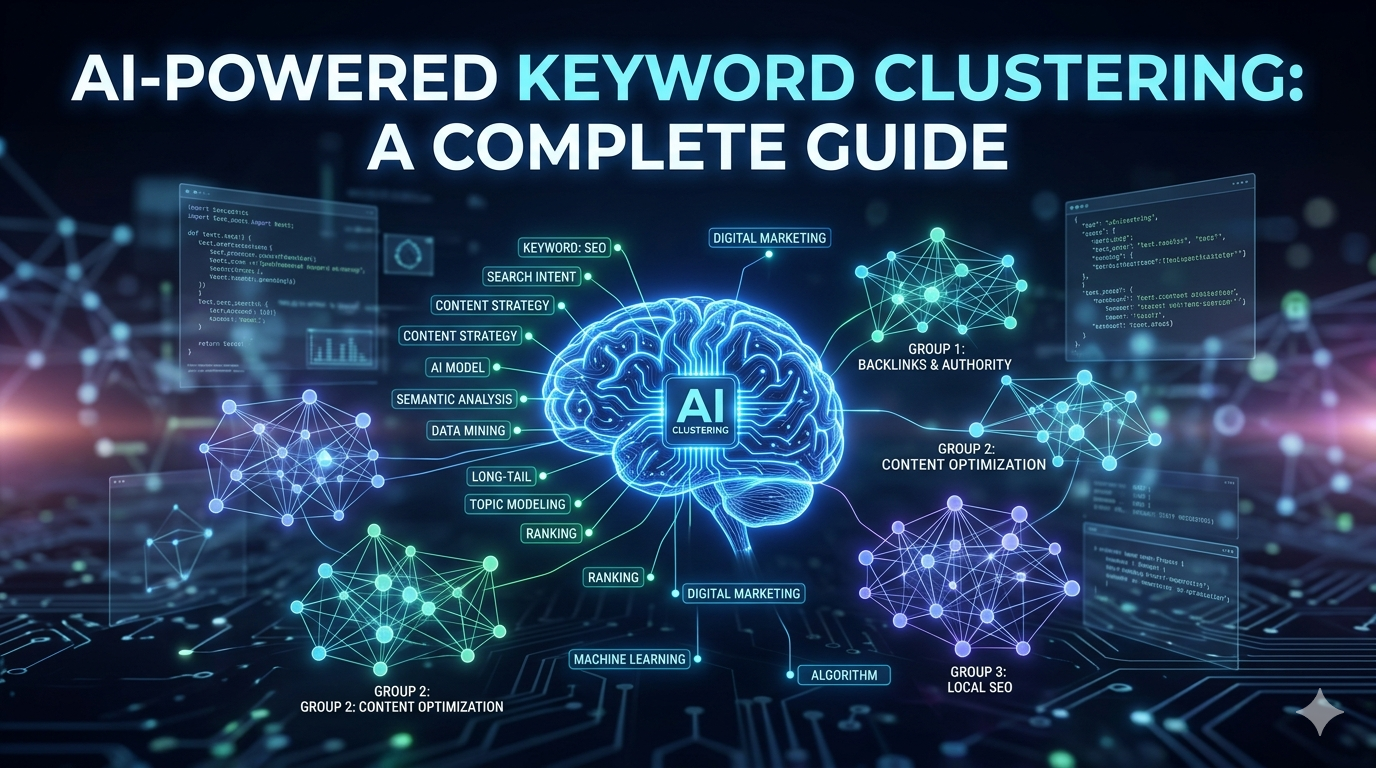
    Picture this: A colossal archive. Not books. Keywords. Thousands upon thousands. Now, untangle that manually. Overwhelming? Here comes AI keyword clustering. AI groups keywords. Semantic ties, search intent, the works. An AI librarian. Painstakingly organizing keywords. Logical clusters. No more lone-wolf keywords. Entire clusters targeted. Content comprehensively covering a topic.

    Old keyword exploration? Long, disjointed lists. AI keyword clustering? Transforms that. Actionable insights appear. Hidden keyword connections unveiled. Content that’s optimized and audience-relevant.

    Why Should You Care About AI Keyword Clustering?

    Face it: SEO, a war zone. Every edge is critical. AI keyword clustering? More than an edge. It reshapes everything. Here’s the breakdown:

    • Enhanced Relevance: Target keyword clusters. Content comprehensively covering a topic. User intent satisfied. Google sees authority.
    • Improved Rankings: Target entire clusters. Rank for many related keywords. Organic traffic floods in.
    • Increased Efficiency: One comprehensive piece, not separate articles. Time and resources reclaimed.
    • Better User Experience: Comprehensive, informative content. Better experience. Engagement soars.
    • Competitive Advantage: AI keyword clustering unearths opportunities. Rivals outranked. Content that resonates.

    In summation, AI keyword clustering: Work smarter. Unlock explosive gains.

    The Science Behind the Magic: How AI Keyword Clustering Works

    So, how does it do it? Science, not fairy dust. The steps:

    1. Data Collection: The AI slurps data. SERPs, keyword tools, your website analytics.
    2. Semantic Analysis: AI dissects the meaning. Underlying concepts, relationships emerge.
    3. Intent Recognition: AI grasps intent. What are users hunting for?
    4. Clustering: AI groups keywords. Clusters form. Each representing a topic. A subtopic.
    5. Refinement: AI hones clusters. Search volume, competition factored in. Maximum impact assured.

    The beauty? Automation. Time-consuming tasks vanish. Focus on content. AI handles the heavy lifting.

    Choosing the Right AI Keyword Clustering Tool

    Tools abound! Not all are equal. What to seek?

    • Accuracy: Precise grouping. Semantic similarity is key.
    • Scalability: Handles large datasets. Performance intact.
    • Customization: Tailor parameters. Your specific needs met.
    • Integration: Seamlessly connects. Existing tools enhanced.
    • Reporting: Detailed reports provided. Search volume, competition revealed.

    Some names:

    • SEMrush
    • Ahrefs
    • Surfer SEO
    • MarketMuse
    • TopicMojo

    Investigate. Read opinions. Choose wisely. It can make a world of difference.

    A Step-by-Step Guide to Implementing AI Keyword Clustering

    Ready for action? Here’s how:

    1. Define Your Goals: What’s the aim? Improve rankings? Boost traffic? Define it. Measure success.
    2. Gather Your Keywords: Keyword tools at the ready. Generate a comprehensive list.
    3. Choose an AI Keyword Clustering Tool: Select carefully. Budget-friendly.
    4. Upload Your Keywords: Feed the beast. Upload your list.
    5. Analyze the Clusters: Review. Semantic similarity matters.
    6. Create Content: Content that resonates. Comprehensive and engaging.
    7. Optimize Your Content: Keywords naturally integrated. SEO enhanced.
    8. Track Your Results: Monitor progress. See the payoff.

    Iterate. Always analyze. Refine the strategy.

    Content Creation Strategies for AI-Powered Keyword Clusters

    Clusters in hand? Now, creation. Some strategies:

    • Pillar Content: In-depth articles. Covering core topics. The foundation of your strategy.
    • Supporting Content: Dive deeper. Subtopics explored. Linking back to the pillar. A cohesive web.
    • Listicles: Valuable information in lists. Engaging and shareable. Attract new eyes.
    • How-To Guides: Step-by-step guidance. Solving problems. Achieving goals.
    • Case Studies: Real-world wins. Highlight your service.

    Key? Value and engagement. Solutions. Answers. Pain points addressed.

    Optimizing Existing Content with AI Keyword Clustering

    Not just for new content. Existing content can be reborn. Here’s the path:

    1. Identify Underperforming Content: Find the laggards. Website analytics reveal them.
    2. Analyze the Keywords: An AI keyword clustering tool assesses.
    3. Identify Missing Keywords: What’s absent? Find the gaps.
    4. Update Your Content: Fill the void. Keywords naturally integrated.
    5. Re-optimize Your Content: SEO refreshed. Title tags, meta descriptions enhanced.

    Breathe life into old content. Boost rankings.

    Measuring the Success of Your AI Keyword Clustering Efforts

    Is it working? Metrics to monitor:

    • Rankings: Track positions. Keyword clusters in focus.
    • Traffic: Organic surge? Pages targeting clusters scrutinized.
    • Engagement: Bounce rate, time on page, shares examined.
    • Conversions: Leads, sales, sign-ups counted.
    • Return on Investment (ROI): Cost versus benefit. The bottom line.

    Regular checks. Adjustments made.

    Common Pitfalls to Avoid with AI Keyword Clustering

    Powerful, yes. Flawless, no. Common errors:

    • Over-Optimization: Don’t stuff. Natural content wins.
    • Ignoring User Intent: It’s not just keywords. Understand the user.
    • Neglecting Content Quality: Quality reigns supreme. Well-written content essential.
    • Failing to Track Results: Monitor. Adapt. Maximize impact.
    • Relying Solely on AI: AI is a tool. Not a crutch. Your judgment matters.

    Avoid these traps. Success and sustainability ensured.

    The Future of AI and Keyword Research

    SEO’s future? Entwined with AI. Even tools and techniques will emerge. A glimpse:

    • More Accurate Semantic Analysis: AI gets smarter. Relationships clarified.
    • Improved Intent Recognition: Deeper understanding. Targeted content created.
    • Automated Content Creation: AI writes content? Time reclaimed.
    • Personalized SEO: Individual preferences honored.
    • Predictive SEO: Trends foreseen. An advantage gained.

    Stay informed. Embrace AI’s potential.

    Conclusion: Embracing the AI Revolution in SEO

    AI keyword clustering? A shift. Not a fad. AI unlocks organic growth. Improves rankings. Enhances the user journey. Work smarter. The future is now. A journey, not a sprint. Learning is constant. Adapt and refine. With the right approach, results will be remarkable.

    The takeaways are conclusive. Relevance, rankings, efficiency, and a better user experience. Don’t lag. Embrace it. Unleash the strategy. Now is the moment. Seize it!

    Experiment! See the SEO transform. Dedication plus the right methods equal a website to get high visibility and the organic traffic. The epoch of AI keyword clustering is upon us, and the possibilities are boundless. AI keyword clustering becomes the keystone of the SEO strategy. Plunge into the world of AI keyword clustering, and redefine the approach to SEO triumph. Unlock the complete scope of the online presence with the strength of AI keyword clustering, and walk head high into the future of SEO. Now is the time to find out the opportunities that AI keyword clustering has to offer and revolutionize the SEO effort. With the plan of action of AI keyword clustering, transform the website into a magnet. Embrace AI keyword clustering and unlock the secrets to dominating search engine rankings and driving sustainable growth. Make AI keyword clustering a necessary part of the SEO strategy, and see the website ascend to new heights of visibility. Join the ranks of SEO innovators that are leveraging the strength of AI keyword clustering to achieve noteworthy results. Discover the metamorphic potential of AI keyword clustering and revolutionize the method to SEO, unlocking unprecedented opportunities for expansion and triumph. With AI keyword clustering, control the power and achieve success in the ever-changing world of SEO.

  • How to Use ChatGPT for SEO Automation (Real Workflows)

    How to Use ChatGPT for SEO Automation (Real Workflows)

    how to use ChatGPT for SEO

    I recall the first whispers of ChatGPT. A machine conjuring text, almost human? A scene ripped from sci-fi. Skepticism, naturally, reigned, especially in the SEO sphere. Could AI really grasp the subtleties of search engine optimization? A resounding yes, as it turned out. It’s not about replacing the human spark, but supercharging it. Let’s dive into how to use ChatGPT for SEO automation. I’ll share concrete workflows you can put into practice today. Transform your SEO strategy now! Prepare to learn how to use ChatGPT for SEO and elevate content creation, refine data analysis, and, crucially, climb those rankings.

    The SEO Revolution: Why ChatGPT is a Game Changer

    The digital world never stands still. SEO pros are always on the hunt for an edge. ChatGPT, a language model, unlocks automation possibilities. Keyword research, content creation, technical audits… these tasks eat up time and resources. ChatGPT? It can streamline. Allowing specialists to focus on the bigger picture and think creatively. Learning how to use ChatGPT for SEO isn’t just keeping up; it’s about leveraging tech to dominate.

    Keyword Research: Mining for Gold with ChatGPT

    Keywords: the foundation of SEO success. Nail the right ones, and watch the traffic flow. ChatGPT steps in, generating ideas, dissecting search intent, and unearthing those long-tail gems. How to use ChatGPT for SEO for keyword hunting? Let’s dig in:

    • Generating Keyword Ideas: Feed ChatGPT a topic from your corner of the market. Ask it to brainstorm related keywords. Fitness industry? Try: “Keywords around weight loss for women over 40?”
    • Analyzing Search Intent: Decode the ‘why’ behind a keyword. Tailor your content to meet user expectations. Copy and paste a list into ChatGPT. Have it categorize search intent (informational, navigational, etc.). This ensures alignment with user needs.
    • Uncovering Long-Tail Keywords: These longer, more specific phrases often boast lower search volume, but higher conversion rates. Ask ChatGPT to conjure long-tail variations from your core keywords. Seed keyword: “running shoes”? Ask: “Long-tail keywords related to running shoes for marathon runners?”

    With ChatGPT, you can pinpoint keywords and craft content that speaks directly to your audience. Mastering how to use ChatGPT for SEO in this area? It’s your launchpad to triumph.

    Content Creation: From Idea to Article with AI Assistance

    Content rules. That’s SEO 101. But consistently churning out killer content? A big ask. ChatGPT can help at every step. From sparking article ideas to drafting the articles themselves. How to use ChatGPT for SEO for content? Here’s how:

    • Generating Article Ideas: Brain blank? Give ChatGPT your audience profile and niche. Ask it to generate potential topics. Small business owners? Try: “Blog post ideas for small business owners on social media marketing?”
    • Creating Outlines: Structure is key. Give ChatGPT a topic. Have it craft an outline with headings. Save time, ensure comprehensive coverage.
    • Drafting Articles: Don’t let ChatGPT write solo. But it’s great for initial drafts. Feed it an outline, request a first draft. Review and refine: accuracy, clarity, originality are paramount.
    • Optimizing Existing Content: Revamp old posts! Paste the article into ChatGPT. Ask for improvements to title, meta description, headings, and text. Spot keyword opportunities, too.

    When you’re thinking about how to use ChatGPT for SEO, think content creation. It’s a powerhouse. Just remember the human touch. Always review, always edit. Quality matters.

    Technical SEO: Automating Audits and Identifying Issues

    Technical SEO means optimizing the nuts and bolts of your site. Boost crawlability, indexability, and overall search engine appeal. Site speed, broken links, sitemaps: all in the mix. ChatGPT can assist with audits and issue spotting. It won’t implement fixes, but it delivers actionable intel.

    • Analyzing Website Structure: Give ChatGPT a rundown of your site’s architecture. Ask it to flag potential issues. For instance: “I have a blog, a product catalog, and a contact page. Any structural issues hindering my SEO?”
    • Identifying Broken Links: Paste a list of URLs. Ask ChatGPT to hunt for broken links. Not as slick as dedicated tools, but a quick way to catch errors.
    • Generating Robots.txt Files: ChatGPT can whip up basic robots.txt files. Control which sections of your site get crawled. List the directories you want to disallow. Request a robots.txt file.

    Remember: ChatGPT’s technical SEO skills are limited. Use specialized tools for comprehensive audits. Consult experts for complex problems. Grasping how to use ChatGPT for SEO in this area? It’s about enhancement, not replacement.

    Link Building: Finding Opportunities and Crafting Outreach Emails

    Link building: earning backlinks to boost authority and rankings. Tough, but vital. ChatGPT helps find prospects and personalize outreach.

    • Identifying Link Prospects: Provide your niche and target keywords. Ask ChatGPT to list websites that might link to your content. Pet food industry? Try: “Websites interested in linking to content about healthy dog food?”
    • Crafting Outreach Emails: Personalized emails win. Provide ChatGPT with details about the prospect and your content. Request a tailored email. Review, refine: accuracy, appeal, and professionalism are key.

    ChatGPT aids link building, but genuine relationships are the bedrock of enduring success. Focus on creating outstanding content that attracts links naturally. Understanding how to use ChatGPT for SEO to spot opportunities is a start. Relationships seal the deal.

    Data Analysis and Reporting: Uncovering Insights and Tracking Progress

    Data analysis: gauge your SEO effectiveness, pinpoint improvements. ChatGPT assists by summarizing reports, identifying trends, and generating insights. Understand those complex datasets, faster.

    • Summarizing Reports: Paste data from Google Analytics, Google Search Console, etc. Ask ChatGPT to summarize. Save time, spot key trends quickly.
    • Identifying Trends: Feed ChatGPT historical data. Ask it to find trends and patterns. For example: “Organic traffic dipped over three months. Reasons why?”
    • Generating Insights: Ask ChatGPT for insights and recommendations based on your data. For instance: “Based on this data, what SEO strategies deserve my focus?”

    ChatGPT provides valuable input, but your judgment is crucial. Interpret the data, make informed calls. When pondering how to use ChatGPT for SEO, remember it’s a tool to augment, not replace, your brainpower.

    Real-World Workflows: Putting ChatGPT into Action

    We’ve explored ChatGPT’s SEO capabilities. Now, let’s see it in action. These workflows show you precisely how to use ChatGPT for SEO in practice.

    Workflow 1: Content Optimization for a Blog Post

    1. Identify a Blog Post: Select a blog post on your site for SEO enhancement.
    2. Paste into ChatGPT: Copy the content into ChatGPT.
    3. Ask for Suggestions: Ask ChatGPT to suggest tweaks to the title, meta description, headings, and text for your target keyword.
    4. Implement Changes: Review ChatGPT’s input and put the changes live.

    Workflow 2: Keyword Research for a New Product

    1. Describe the Product: Provide ChatGPT with a detailed description of your product.
    2. Generate Keyword Ideas: Ask ChatGPT to generate relevant keywords.
    3. Analyze Search Intent: Paste the keyword list into ChatGPT, ask it to categorize search intent.
    4. Create Content: Use the keywords and intent data to create optimized content for your product page.

    Workflow 3: Link Building Outreach

    1. Identify a Piece of Content: Select content you want to promote.
    2. Find Prospects: Ask ChatGPT to find websites interested in linking to your content.
    3. Craft Email: Give ChatGPT prospect details and content info. Request a personalized outreach email.
    4. Send Emails: Review and send.

    These examples illustrate how to use ChatGPT for SEO. The possibilities? Endless. Experiment to discover what works for you.

    Ethical Considerations: Avoiding Black Hat SEO Tactics

    Use ChatGPT responsibly. Shun black hat tactics that could tank your site’s rankings. Don’t generate spun content, stuff keywords, or fabricate backlinks. These violate Google’s guidelines and can trigger penalties. Prioritize high-quality, original content that benefits your audience. If you’re exploring how to use ChatGPT for SEO, ensure your methods are ethical and sustainable.

    The Future of SEO: AI-Powered Optimization

    SEO’s future is entwined with AI. As language models like ChatGPT evolve, they’ll automate tasks, dissect data, and generate insights. SEO pros who embrace AI will thrive in the ever-shifting digital landscape. Learning how to use ChatGPT for SEO now? It’s an investment in your future.

    Conclusion: Embrace Automation, But Stay Human

    ChatGPT is a powerful ally for your SEO endeavors. It automates tasks, analyzes data, and generates insights. Freeing you to focus on strategy and creative solutions. AI is a tool to amplify your skills, not replace them. Prioritize stellar, original content that serves your audience. Use your judgment to interpret data and make informed decisions. The key to how to use ChatGPT for SEO effectively? Understand its power, use it ethically, and always prioritize the user. Embrace AI’s potential, but never lose sight of the human heart of SEO.


  • Best AI Tools for SEO Automation (Tested & Compared)

    Best AI Tools for SEO Automation (Tested & Compared)

    top AI SEO tools comparison

    I recall when search engine optimization felt like translating hieroglyphs. A truly painstaking, utterly manual grind encompassing keyword digs, backlink autopsies, and on-page sculpting. Achievement then? Hinged solely on raw determination and countless hours. The game has flipped. Artificial intelligence is now a formidable teammate, handling rote actions while unearthing nuggets that once dwelled in the realm of imagination. It’s vital to sift through the top AI SEO tools comparison noise. Find authentic diamonds. This article? Your guide. We dissect these top AI SEO tools comparison options, exposing those delivering authentic results, showcasing how they can rocket-boost your positions. We’ll dissect how these utilities can morph your entire strategic outlook. A top AI SEO tools comparison rooted in intense testing and tangible results.

    The Rise of AI in SEO: A New Era

    The entrance of artificial intelligence isn’t some fleeting fad. No, it’s a ground-level change concerning how we confront optimization. Envision swapping a horse-drawn buggy for a hyperloop. AI systems dissect colossal info dumps, pinpoint connections, anticipate effects with speed and exactitude overshadowing human ability. Translated? Streamlined keyword excavations, sharper content blueprints, precision focus. This is precisely why a top AI SEO tools comparison matters now. Gauging where artificial intelligence injects legitimate, radical improvement into optimization. This top AI SEO tools comparison power? It lies in morphing raw information into actions.

    Keyword Research Reimagined: AI-Powered Discovery

    Keyword excavation, the bedrock of victorious search engine optimization, transformed. Forget endless manual keyword-planner staring. Artificial intelligence now unearths gold-mine terms, obscure segments, dissecting search intentions with unparalleled acuity. These top AI SEO tools comparison analyses often spotlight features such as semantic intellect; digging far deeper than keyword twinning to grasp the essential implications surrounding searcher queries. Utilities now surface long-tail phrasing and latent semantic indexing (LSI) words – openings overlooked previously. A deep-dive top AI SEO tools comparison pinpoints resources that not only locate phrases, but foresee consequence.

    Content Creation: From Writer’s Block to AI-Assisted Brilliance

    Content reigns supreme. Consistently cranking out top-tier, engaging pieces? A monumental test. That’s where artificial intelligence scribes arrive. These utilities build blog posts, articles, site material, even social posts – liberating you to concentrate on approach and elevated duties. While artificial intelligence can’t supplant human ingenuity and knowledge fully, it serves as potent arsenal for obliterating creative roadblocks, birthing concepts, plus sculpting content. When conducting a top AI SEO tools comparison focusing on content creation, consider originality and clarity. Then there’s the core optimization prowess. The winning top AI SEO tools comparison contenders showcase elements such as term fusion, tonal modifications, and copied content scans.

    On-Page Optimization: AI as Your Personal SEO Auditor

    On-page sculpting, the act of polishing individual site pages to obtain higher rankings, proves time-intensive. Top AI SEO tools comparison unveils how artificial intelligence utilities automate much of this, dissecting site content, composition, code to pinpoint betterment areas. These utilities dispense recommendations for refining title tags, meta-descriptions, headings, alt-text, assuring comprehensive optimization. They similarly pinpoint and remedy core technical shortcomings, such as fractured URLs and lagging page speeds. A top AI SEO tools comparison aids in selecting utilities dispensing exhaustive on-page intellect alongside concrete enhancements.

    Link Building: AI-Driven Outreach and Analysis

    Link building securing backlinks serves as a linchpin concerning website position. Top AI SEO tools comparison displays artificial intelligence aiding through pinpointing linkage prospects, streamlining connection efforts, dissecting backlink caliber. These utilities scour the internet for niche sites, extracting contact info, even composing individualized outreach notes. They dissect clout and pertinence, assisting you in dodging low-grade or junk backlinks capable of damaging rankings. When conducting a top AI SEO tools comparison, laser-focus on elements such as backlink examination, rival dissection, contact process automation.

    Rank Tracking: Monitoring Your Progress with AI Precision

    Rank monitoring scrutinizing web page positions inside search results (SERPs) across given terms remains essential for gauging campaign potency. Top AI SEO tools comparison displays artificial intelligence rank monitors yielding precise, exhaustive information versus antiquated utilities. These tools scrutinize placement across search engines, devices, regions  bestowing thorough comprehension. They similarly detect placement vacillations, signaling potential quandaries. A thorough top AI SEO tools comparison spotlights those yielding accurate rank-tracking intelligence.

    Competitor Analysis: Spying on Your Rivals with AI Intelligence

    Grasping rival tactics proves crucial for exceeding expectations. Top AI SEO tools comparison unveils how artificial intelligence competitor dissection tools yield precious comprehension into rival terms, backlinks, content, overall potency. These utilities pinpoint adversary strengths and weaknesses, fueling campaigns to surpass them inside results. They monitor competitor placement fluctuations, flagging emerging menaces. When you perform a top AI SEO tools comparison, pursue elements such as term-gap evaluations, backlink scrutiny, content dissection.

    Top AI SEO Tools Comparison: The Contenders

    Now, to plunge headlong into a top AI SEO tools comparison showcasing prime artificial intelligence optimization utilities available. This listing lacks totality, yet showcases a prime jumping-off position for personal inquest. Every resource possesses strengths and shortcomings; thus, choosing optimally aligns with specific demands alongside allocated funds. This top AI SEO tools comparison intends showcasing sharp overviews for fostering astute choices.

    1. Surfer SEO: Content Optimization Powerhouse

    Surfer SEO, a content sharpener employing artificial intelligence to dissect top-ranking content aligned to targeted terms, then dispensing enhancement blueprints. It dissects beyond 500 on-page signals, assisting inside building pieces attractive for both readers and search engines. A top AI SEO tools comparison regularly positions Surfer SEO apex predator. It exists for comprehending precisely what’s mandatory for ranking across targeted terms. Surfer SEO intensely targets content construction and term concentration. The potency powering this top AI SEO tools comparison adversary exists inside its dispensation of data-driven intelligence straight impacting content’s ranking capacity.

    2. Jasper.ai (Formerly Jarvis): The AI Writing Assistant

    Jasper.ai, an artificial intelligence scribe generating diversified content spanning blog posts, articles, web page material, social posts. It leverages natural language processing (NLP) to comprehend input and assemble pieces both relevant and engaging. In a top AI SEO tools comparison, Jasper.ai shines concerning high-grade quick output. It exists as a superb tool for conquering creative droughts and igniting ideas. This top AI SEO tools comparison unveils Jasper.ai dominating concerning versatile content formatting.

    3. Semrush: The All-in-One SEO Platform

    Semrush, a thorough optimization hub showcasing a spectrum of resources spanning term inquest, rival dissection, position monitoring, site examinations. It now fuses artificial intelligence for boosting elements its content layout tool, aiding inside building optimization-primed pieces leveraging rival intellect. When assessing top AI SEO tools comparison candidates, Semrush reliably achieves top stature stemming from its vast feature repository. The artificial intelligence infusion sparks intensified intellect plus streamlined processes. Semrush showcases a holistic perspective surrounding optimization potency, assisting inside pinpointing upgrade openings. Semrush represents a forceful combatant inside this top AI SEO tools comparison due to feature breadth.

    4. Ahrefs: The Backlink Analysis Expert

    Ahrefs, primarily known because of its backlink dissection prowess, but similarly showcasing a cohort encompassing term inquest, rival breakdown, rank surveillance. It leverages artificial intelligence for flagging and dissecting backlinks, bestowing precious comprehension regarding competitor link-building campaigns. In the top AI SEO tools comparison, Ahrefs constantly garners acclaim because of backlink intel. It bestows full visibility concerning backlink composition, assisting inside pinpointing linkage potential. This top AI SEO tools comparison spotlights Ahrefs as the essential resource concerning backlink inquest.

    5. Scalenut: AI-Powered SEO and Content Marketing

    Scalenut stands as an artificial intelligence-fueled optimization plus content platform intended to streamline content production – spanning inquest through dissemination. It showcases elements spanning term digs, topic clustering, artificial intelligence writing aid, sculpting. During a top AI SEO tools comparison, Scalenut’s full content process sticks out. The platform intends assisting users crafting elevated-ranking outputs efficiently. This top AI SEO tools comparison positions Scalenut as a valuable resource concerning marketers seeking to harness artificial intelligence.

    Choosing the Right AI SEO Tool: A Strategic Approach

    Electing optimal optimization utilities mandates a strategic bend. Commence through framing concrete optimization ambitions plus encumbrances. Do you require aid spanning term excavations, pieces generation, linkage construction, or technicalities? Once commanding definitive comprehension surrounding demands, you may commence assessing utilities and comparing attributes, costs, reviews. Ponder site magnitude, complexity, allocated capital, skillset. Don’t recoil from piloting trials before choosing. Recalling optimal artificial intelligence optimization utilities empower attainment alongside boosting overall campaign potency. Remember to keep this top AI SEO tools comparison and what is critical for your SEO roadmap.

    The Future of SEO: AI-Driven Strategies

    Optimization’s trajectory fuses inextricably to artificial intelligence. As artificial intelligence continues broadening, anticipate even more sophisticated, mighty optimization utilities surfacing. Artificial intelligence will command mounting magnitude spanning facets, spanning term inquest and content generation to linkage formation, placement monitoring. Optimization specialists embracing artificial intelligence, mastering utility, shall position themselves optimally spanning coming annum. The shaping concerning these top AI SEO tools comparison combatants will exhilarate while accruing intensification.

    Ethical Considerations: Avoiding the Dark Side of AI SEO

    Analogous to forceful innovations, artificial intelligence optimization resources empower both constructive and malignant actions. Pursue utility ethically, responsibly, shunning actions spanning term-stuffing, content-spinning, linkage blueprints. Focus on building elevated, captivating pieces conveying value – leveraging artificial intelligence for amplifying efforts. The ambition exists in elevating the client experience, not hoodwinking algorithms. Keep this top AI SEO tools comparison in mind and remember to leverage for upright campaigns. While alluring, dodge unethical actions while harnessing these resources.

    Conclusion: Embracing AI for SEO Success

    Artificial intelligence transmutes optimization’s realm, dispensing exceptional openings for automation, streamlining plus exceeding expectations. By embracing artificial intelligence resources, approaches, you unlock new potency layers. Recall choosing appropriate utilities aligned to demands, employing resources ethically, perpetually laser-centering elevated, captivating works conveying value. The top AI SEO tools comparison imparted should dispense a firm jumping-off position. This top AI SEO tools comparison power exists inside revealing optimal approaches for amplifying rankings and effects. This top AI SEO tools comparison hopefully bestowed refined grasp regarding artificial intelligence’s capacity. This top AI SEO tools comparison should propel you toward optimal pathways aligned to optimization.

  • How AI is Transforming SEO Automation in 2026

    How AI is Transforming SEO Automation in 2026

    how AI is transforming SEO

    The year: 2026. A crystal-clear recollection surfaces – the day the first truly autonomous SEO campaign went live. No earth-shattering bang, just a whisper, a subtle slide. Looking backward now, that sliver of time? It’s ground zero for how AI is reshaping SEO.

    Forget crystal balls. This explores present-day accelerants driving how AI is reshaping SEO automation. Projecting them onto a feasible ’26 landscape. We’re diving into bleeding-edge AI tools, shifting strategies, and the absolute must-have skill sets for SEO pros. Thriving, not just surviving. Let’s get into how AI is reshaping SEO and its impact on your business.

    The Rise of Hyper-Personalized Content

    Keyword stuffing? Generic mush? Gone. Thank goodness. By 2026, AI’s grabbed content personalization and cranked it to eleven. Picture this: AI’s algorithms dissecting individual clicks, whims, even…emotional states? Content birthed for each user’s hyper-specific needs. Forget slapping a name on an email. We’re talking complete website overhauls, resonating with visitors deeply. Profoundly. It’s how AI is reshaping SEO. More human.

    AI-fueled engines now ingest oceans of data, pinpointing content voids, predicting viral topics, even… cranking out complete articles, tailored posts optimized for laser-targeted groups. The bullseye shifts: craft for humans, not just search engines. AI? The translator. User intent meets relevant info. The shift? How AI is reshaping SEO with user experience at its core.

    AI-Driven Keyword Research: Beyond the Obvious

    Keywords: SEO’s bedrock. But ’26? The rules shattered. AI now sniffs out the un obvious. Latent semantic gold. Long-tail whispers driving targeted traffic. These AI sleuths dissect search breadcrumbs, social buzz, even competitor secrets. Gold that human eyes might miss. Grasping how AI is reshaping SEO means grasping its keyword impact.

    Plus, AI forecasts keyword futures, spotting trends and behaviors. SEO wizards can now front-run the curve, prepping content for tomorrow’s keywords. This predictive superpower? Core to how AI is reshaping SEO strategies.

    Automated Technical SEO Audits and Optimization

    Technical SEO: tedious? Time-sink? You bet. AI steps in, automating the grunt work. AI-powered tools crawl, flag, and… even self-correct technical hiccups. Poring over page speed, mobile-friendliness, perfecting schema… AI handles the tech. Humans? Free to strategize. Witnessing how AI is reshaping SEO here? Impressive.

    These AI sentinels also monitor website vitals, alerting SEO pros to danger signs. Proactive. Websites always optimized. Tech glitches? Swatted. This always-on optimization? Another facet of how AI is reshaping SEO.

    The Evolution of Link Building: Quality over Quantity

    Links still reign in ’26. But tactics evolved. AI now pinpoints top-tier link prospects and automates outreach. Analyzing sites, sniffing relevance, even… crafting personalized emails to potential partners. From link volume to link quality. The shift showcases how AI is reshaping SEO. Higher quality reigns.

    Plus, AI polices backlinks, disavowing toxic links that could nuke a website’s ranking. Proactive link hygiene. A key piece of how AI is reshaping SEO.

    AI-Powered Rank Tracking and Reporting

    Tracking keywords. Monitoring performance. Crucial for campaign success. ’26? AI supercharges the process. More efficient. More precise. AI-powered tools track keyword positions across search engines, devices, geographies. Detailed reports surface: traffic, behavior, conversions. This data lens empowers informed decisions. Campaigns optimized for max impact. Mull over how AI is reshaping SEO concerning data.

    AI also unearths trends humans overlook. Deeper audience understanding emerges. Fresh growth opportunities revealed. This insight generation? How AI is reshaping SEO reporting.

    The Rise of AI-Generated Content: A Double-Edged Sword

    SEO’s seismic shift? AI-generated content. Algorithms now crank out stellar articles, posts, even… website copy. Revolutionizing content creation. Amplifying efficiency. Efficiency? One aspect of how AI is reshaping SEO content.

    But… concerns bubble. Content quality? Originality? Search engines evolve, too. Detecting AI-generated content becomes second nature. Penalties loom for overuse. The sweet spot? AI assisting human writers, not replacing them. Balance? Key to grasping how AI is reshaping SEO.

    The Importance of Human Expertise in the Age of AI

    AI surges forward, yet human expertise endures. Automating grunt work, sure. But creativity? Critical thought? Strategic vision? AI can’t touch those. SEO pros need to know their audience. Grasp their industry. Internalize business goals. Adapt to ever-shifting algorithms. Essential to see how AI is reshaping SEO and that human input is still needed.

    The SEO elite of ’26? They fuse human brilliance with AI muscle. AI tools automate, analyze, reveal. But human judgment steers the ship. Strategy crafted. Compelling content birthed. This human-machine synergy? How AI is reshaping SEO for the better.

    The Ethical Considerations of AI in SEO

    AI’s SEO ascendance demands ethical scrutiny. Algorithms can harbor bias. They can be weaponized to game rankings. SEO pros must acknowledge these perils. Act responsibly. Ethics underpin how AI is reshaping SEO.

    Search engines, too, fight unethical AI. Algorithms detect and punish manipulative tactics. The grand aim? A level playing field. Rankings earned through content merit, not gaming the system. An ethical focus? How AI is reshaping SEO.

    The Skills You Need to Thrive in the AI-Powered SEO Landscape

    Succeeding in ’26’s AI-fueled SEO arena demands a new arsenal. Consider these:

    • Data Analysis: Decode AI insights. Steer decisions accordingly.
    • Content Creation: Birth content that resonates. Deeply.
    • Technical SEO: Possess a rock-solid technical SEO foundation.
    • Strategic Thinking: Forge and execute winning strategies.
    • AI Proficiency: Master AI tools. Understand their inner workings.

    Honing these skills positions you for SEO dominance. Mastering how AI is reshaping SEO? It’s your edge.

    The Future of SEO: A Symbiotic Relationship Between Humans and AI

    SEO’s future isn’t AI replacing humans. It’s AI amplifying human potential. AI automates the drudgery, freeing humans for strategic, creative pursuits. This symbiotic dance? Transforms the SEO landscape. More efficient. More effective. More ethical. Ideal scenario? Understanding how AI is reshaping SEO and working with it.

    Approaching ’26, AI’s SEO role escalates. Embrace AI. Learn its language. Adapt to the shifting optimization landscape. Position yourself for success. The exciting, dynamic realm of AI-powered SEO awaits. This? The core of how AI is reshaping SEO.

    Adapting to the Algorithmic Shift

    Search engine algorithms morph constantly. AI integration accelerates the pace. SEO pros in ’26 must be nimble. Constantly learning. Tweaking strategies. Staying ahead requires experimentation. Embracing innovation. Questioning norms. Adaptability? Critical to grasping how AI is reshaping SEO.

    AI-powered analytics offer invaluable insights into algorithm shifts. Unveiling ranking drivers. Guiding strategic adjustments. This data lens? Essential for navigating the complex, evolving world of search algorithms. The right tools can show how AI is reshaping SEO in real-time.

    Content Strategy in the Age of Semantic Search

    Semantic search emphasizes meaning and context. It’s grown paramount. In ’26, AI elevates semantic search. Search engines decipher human nuances. Delivering relevant, accurate results. Profound implications for content strategy. Essential to see how AI is reshaping SEO in content strategy.

    SEO pros must transcend keyword obsession. Craft content addressing the intent  behind searches. Requires deep user empathy. A commitment to informative, engaging content. AI tools can spot content gaps. Spark ideas for content aligned with user needs. Generating ideas shows how AI is reshaping SEO.

    Voice Search Optimization: A Growing Imperative

    Voice search booms. Expect continued growth through ’26. Optimizing for voice demands a different tack compared to text. Voice queries tend longer, more conversational. Often framed as specific questions. Understanding this focus is key to how AI is reshaping SEO.

    SEO pros must optimize for natural language. Answer common industry questions directly. Websites must be mobile-friendly, fast-loading. Voice users are often on the move. Focusing on those areas is how AI is reshaping SEO for voice.

    The Democratization of SEO: Empowering Small Businesses

    AI *can* democratize SEO. Empowering small businesses. Historically, SEO favored large corporations with deep pockets. They could afford expensive agencies, sophisticated tools. Now, AI-powered tools level the playing field. Democratization is how AI is reshaping SEO.

    These tools automate manual tasks: keyword research, technical audits, link building. Small businesses can now laser-focus on content and customer relationships. The focus shift explains how AI is reshaping SEO and leveling the field.

    Conclusion

    How AI is reshaping SEO in ’26? A multi-layered story. Automation. Personalization. Ethics. The ascent of AI-generated content. The enduring power of human expertise. Moving forward, embrace AI as a tool. Master its use. Adapt to the shifting search landscape. SEO’s future isn’t AI versus humans. It’s AI and humans. A superior search experience for everyone. This collaboration? The ultimate expression of how AI is reshaping SEO.

  • Common Mistakes in Programmatic SEO (and How to Fix Them)

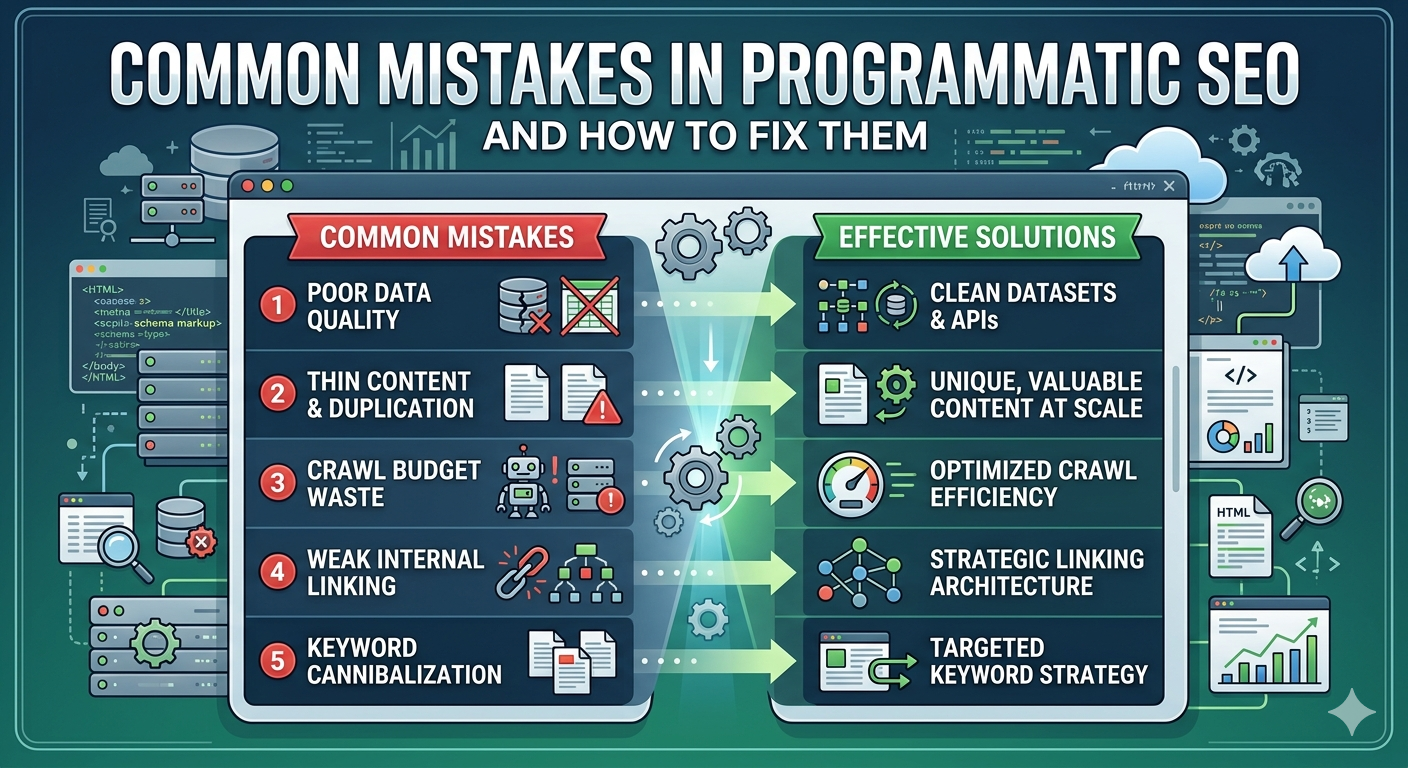
    Common Mistakes in Programmatic SEO (and How to Fix Them)

    Common Mistakes in Programmatic SEO (and How to Fix Them)

    The Programmatic SEO Mirage: A Cautionary Tale

    The calendar flipped to 2023. Promises whispered of automated content empires, websites blooming overnight with optimized pages. Programmatic SEO, they called it. A seductive dream: scaling content through code. But dreams, as they often do, crashed against reality. All that remained? A wasteland of flimsy content and disillusioned SEOs. The core issue? Foresight. Hardly anyone pondered how to fix programmatic SEO mistakes before they occurred.

    This isn’t a mere list of errors. It’s your map through the programmatic SEO wilderness. We dissect common traps, reveal battle-tested solutions, and equip you to grasp how to fix programmatic SEO mistakes to build a strategy that actually delivers.

    Mistake #1: Prioritizing Quantity Over Quality (The Content Graveyard)

    A classic misstep. Fixating on page counts, while ignoring user value. Picture it: a site spewing thousands of near-identical pages. Search engines see this. Low-quality. Penalties ensue. Organic traffic? Vanishes. We’ve witnessed this implosion. Repeatedly.

    How to Fix It: The fix? Deceptively simple. Quality trumps quantity. Period. Before launching your programmatic SEO blitz, meticulously blueprint your content strategy. Is each page truly unique? Does it tackle specific user questions? Does it dive deep? Conduct intense keyword research. Unearth those high-intent search phrases. Mold your content accordingly. When weighing how to fix programmatic SEO mistakes, let this be your mantra.

    Mistake #2: Ignoring User Intent (The Relevance Black Hole)

    Programmatic SEO thrives on data. Algorithms reign. But it’s easy to forget the beating heart: user intent. Pages adrift, failing to align with actual searches? Disaster. Imagine targeting “cheap hotels in New York.” Less effective than, say, “boutique hotels near Central Park with free breakfast,” no? Search engines champion results that nail user needs. Critical to grasp how to fix programmatic SEO mistakes tied to content-intent mismatches.

    How to Fix It: Know your audience. Intimately. Chart their search behaviors. Unleash keyword research tools. Decipher their questions, their phrases. Scrutinize competitor content. Where are the gaps? Exploit them. Crucially, test! Solicit feedback from real users. Does your content resonate? Does it deliver? Essential for understanding how to fix programmatic SEO mistakes related to user intent.

    Mistake #3: Neglecting On-Page Optimization (The Lost in the Crowd Syndrome)

    Even the noblest programmatic SEO intentions can crumble. Why? Ignored on-page fundamentals. Think title tags, meta descriptions, header tags, internal linking. Without this optimization armor, search engines struggle. Content? Unintelligible. Ranking for relevant keywords? A pipe dream. Often, the understanding of how to fix programmatic SEO mistakes of this kind only comes when it’s far too late.

    How to Fix It: Deploy a robust on-page optimization strategy. Weave target keywords into title tags, meta descriptions, header tags (H1, H2, H3, etc.). Structure content for clarity, readability. Forge internal links between related pages. Boost site navigation. Distribute link equity. Tools like Yoast SEO or Rank Math can automate. But always review. Customize. Mastering on-page SEO? Vital when considering how to fix programmatic SEO mistakes.

    Mistake #4: Overlooking Mobile Optimization (The Thumb-Twiddling Tragedy)

    Mobile-first is no longer a trend. It’s reality. Neglecting mobile optimization is SEO suicide. Programmatic SEO pages unprepared for smartphones, tablets? You’re alienating a massive audience. Mobile-unfriendly websites? Higher bounce rates. Lower engagement. Search engine disdain. Businesses stumble here. Often. When contemplating how to fix programmatic SEO mistakes, they miss the obvious.

    How to Fix It: Guarantee responsiveness. Adapt seamlessly to all screen sizes. Embrace mobile-friendly design. Large buttons. Clear typography. Optimize images for mobile. Slash load times. Test across diverse devices. Eradicate usability snags. Google’s Mobile-Friendly Test tool? Use it. Mobile optimization? Non-negotiable when considering how to fix programmatic SEO mistakes.

    Mistake #5: Ignoring Site Speed (The Patience-Testing Purgatory)

    Sluggish websites? Users flee. Rankings plummet. Instant gratification reigns. Speed is king. Programmatic SEO pages that dawdle? Visitors vanish. Bounce rates skyrocket. Conversions crater. Google notices. Site speed is a ranking determinant. Ignored by far too many when trying to determine how to fix programmatic SEO mistakes.

    How to Fix It: Optimize ruthlessly for speed. Compress images. Exploit browser caching. Minimize HTTP requests. Employ a content delivery network (CDN). Reduce latency. Consider a faster web host. Google’s PageSpeed Insights? Your ally. Improving site speed? A bedrock principle of how to fix programmatic SEO mistakes.

    Mistake #6: Neglecting Schema Markup (The Invisible Content Curse)

    Schema markup is structured data. It illuminates your content for search engines. By implementing it on your programmatic SEO pages, you provide crucial context. Bolster ranking potential. Snag those coveted rich snippets. Failing to implement schema markup? Hiding your content. A frequent error. People fail to ponder how to fix programmatic SEO mistakes born from this oversight.

    How to Fix It: Implement schema markup. Now. Select appropriate schema types. Article, Product, Event, Recipe… Google’s Structured Data Markup Helper? Use it to generate code. Test with Google’s Rich Results Test tool. Ensure proper implementation. Schema markup? A potent SEO weapon. A critical consideration when pondering how to fix programmatic SEO mistakes.

    Mistake #7: Lack of Internal Linking (The Orphaned Page Problem)

    Internal linking? Connecting your website’s pages. It aids search engines in discovery. Understanding relationships between pages? Simplified. A strategic internal linking plan? Improves navigation. Distributes link equity. Lifts rankings of programmatic SEO pages. Pages without internal links? Orphans. Difficult to find. Difficult to index. A prevalent mistake. Few realize how to fix programmatic SEO mistakes originating here.

    How to Fix It: Craft a strategic internal linking plan. Link from programmatic SEO pages to relevant counterparts. Reciprocate. Employ keyword-rich anchor text. Provide context. Avoid over-linking. Spammy signals. A thoughtful plan? Crucial for SEO. An imperative consideration when evaluating how to fix programmatic SEO mistakes.

    Mistake #8: Ignoring Data Monitoring and Analysis (The Flying Blind Fiasco)

    Launching a programmatic SEO campaign sans data monitoring? Flying blind. Instruments absent. Track key metrics. Organic traffic. Bounce rate. Conversion rate. Keyword rankings. Understand campaign performance. Without data? Improvement impossible. Strategy optimization? Unthinkable. Grasping how to fix programmatic SEO mistakes demands understanding what went awry. Data is key.

    How to Fix It: Implement a robust data monitoring system. Google Analytics. Google Search Console. Track everything. Analyze relentlessly. Identify trends. Spot patterns. Uncover improvement areas. Inform content strategy. Guide on-page optimization. Steer link building. Data-driven insights? Maximize campaign effectiveness. Monitoring data? A cornerstone of how to fix programmatic SEO mistakes.

    Mistake #9: Neglecting Content Updates (The Stale Content Stigma)

    Search engines crave fresh content. Programmatic SEO pages? Stagnant? Outdated? Rankings erode. Regular updates signal activity. Relevance. Too many neglect this essential aspect of how to fix programmatic SEO mistakes: keeping content fresh.

    How to Fix It: Establish a content update schedule. Review programmatic SEO pages regularly. Pinpoint areas needing attention. Inject new information. Refresh existing content. Repair broken links. Fix errors. Republish. Signal freshness. Maintaining fresh content? Essential for ranking retention. Attracting new visitors. Regular refreshing? A lynchpin of how to fix programmatic SEO mistakes.

    Mistake #10: Not Adapting to Algorithm Updates (The Shifting Sands Scenario)

    Search engine algorithms evolve. Constantly. Yesterday’s tactic? Today’s failure. Failure to adapt? Programmatic SEO campaign doomed. Staying informed. Adjusting strategy. Crucial for enduring success. Awareness is essential to how to fix programmatic SEO mistakes caused by algorithm shifts.

    How to Fix It: Monitor algorithm updates. Diligently. Follow industry blogs. Attend webinars. Engage in online forums. Stay informed. Analyze update impacts. Adjust accordingly. Embrace experimentation. Test new approaches. Adaptability? Survival. Thriving. In the ever-shifting SEO landscape. Learning to adapt? Integral to how to fix programmatic SEO mistakes.

    Mistake #11: Thin or Duplicate Content (The Panda’s Wrath)

    A cardinal SEO sin. Pages lacking original content? Content duplicated across multiple pages? Severe penalties await. Google’s Panda algorithm strikes. Rankings decimated. Traffic vanished. When deciphering how to fix programmatic SEO mistakes, this reigns supreme.

    How to Fix It: Guarantee unique, valuable content across all programmatic SEO pages. Shun content duplication. External sources? Internal pages? Avoid it. Similar pages? Employ canonical tags. Signal the preferred version. Prioritize high-quality, original content. Deliver genuine value. Avoiding duplicate content? A cardinal rule when addressing how to fix programmatic SEO mistakes.

    Mistake #12: Ignoring Keyword Cannibalization (The Self-Competition Conundrum)

    Keyword cannibalization? Multiple pages targeting the same keyword. Search engines become confused. Pages fail to rank. You compete against… yourself. A foundational step in how to fix programmatic SEO mistakes? Eliminate internal competition.

    How to Fix It: Conduct a keyword audit. Identify cannibalization instances. Consolidate or rewrite competing pages. Assign distinct keywords to distinct pages. Avoid self-sabotage. A well-defined keyword strategy? Essential for preventing cannibalization. Resolving cannibalization? A critical component of how to fix programmatic SEO mistakes.

    The Path Forward: Programmatic SEO Done Right

    Programmatic SEO, executed astutely, is a potent force. Scaling content. Driving organic traffic. Yet, shun the mistakes above. Prioritize quality. Understand intent. Optimize for mobile. Monitor results continuously. Unlock programmatic SEO’s true might. Always consider how to fix programmatic SEO mistakes before they materialize.

    The crucial reminder? How to fix programmatic SEO mistakes is a perpetual evolution. The search landscape morphs constantly. Prepare to adapt. Endlessly.

    Conclusion: Mastering the Art of Programmatic SEO

    Programmatic SEO? Not magic. Strategy. Avoid errors. Focus on user value. Embrace adaptability. Harness its power. Achieve remarkable SEO triumphs. Remember: generating pages is insufficient. Create valuable resources. Satisfy user needs. Drive meaningful engagement. By grasping how to fix programmatic SEO mistakes, you’re poised for success.

  • Programmatic SEO vs Traditional SEO: Which Wins?

    Programmatic SEO vs Traditional SEO: Which Wins?

    difference between programmatic SEO and traditional SEO

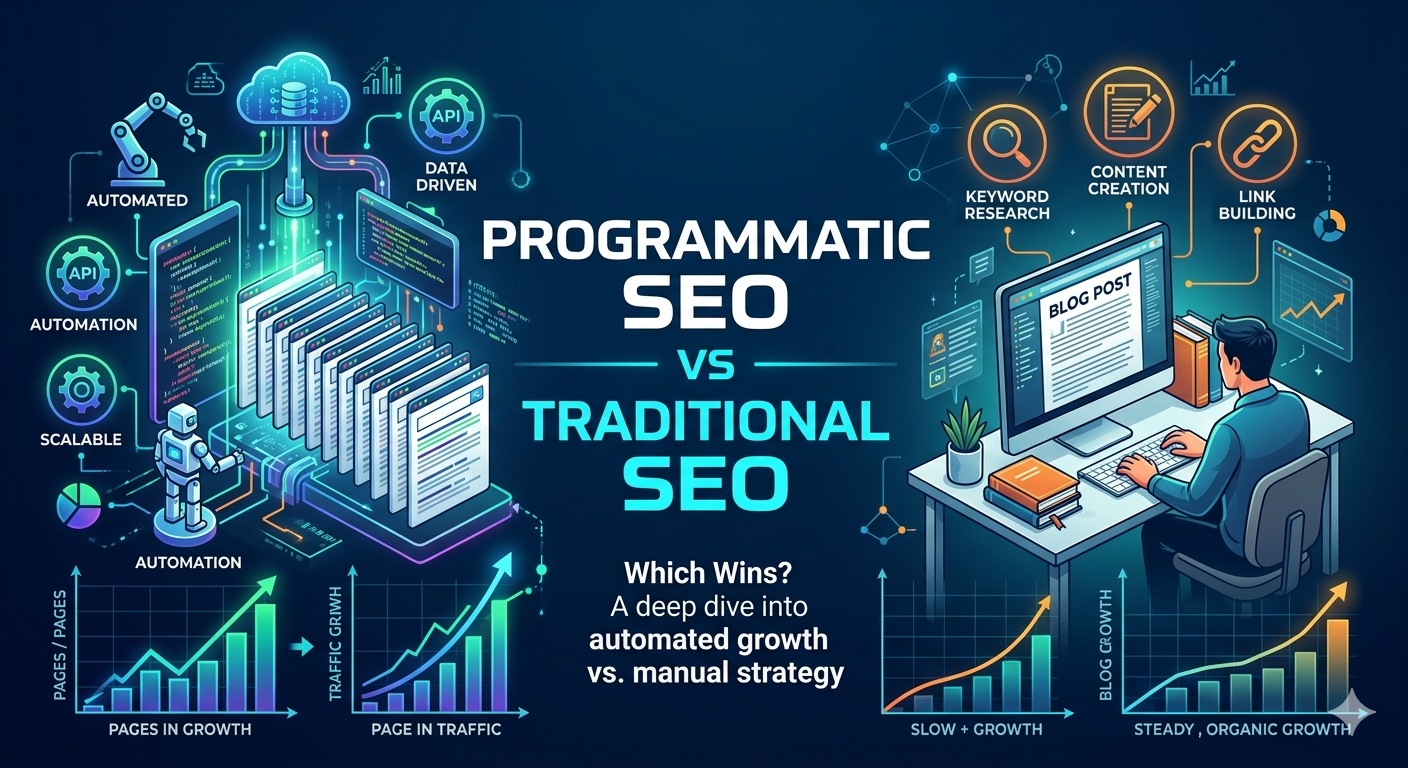
    Picture two celebrated culinary artists. Each, a distinct path toward edible brilliance. One, the paragon of precision, sourcing each element as a jeweler would a gem, coaxing flavors through practiced, time-honored ritual. The other? A maestro of metrics, an architect of algorithms, commanding data’s current to sculpt personalized palates for the masses. In SEO’s realm, these chefs embody two schools: Traditional SEO, and its data-driven progeny, Programmatic SEO. The difference between programmatic SEO and traditional SEO? Method. Scale. The sites they serve. We’ll tease out that difference between programmatic SEO and traditional SEO and weigh their merits.

    Understanding Traditional SEO: The Artisan Approach

    Traditional SEO. The bedrock of being found. Think of it: the art of coaxing a site skyward in search rankings for carefully chosen phrases. Every page, a canvas, crafted to court favor with both unseen algorithms and all-too-human eyes. It’s toil. It’s research. It’s knowing the engine’s hum.

    The Pillars of Traditional SEO

    • Keyword Research: Unearthing the gems: phrases prized by searchers, yet lightly contested.
    • On-Page Optimization: Whispering to the code: titles, descriptions, headers—all singing the keyword song.
    • Off-Page Optimization: Building bridges: earning endorsements from the web’s established voices.
    • Content Creation: The storyteller’s craft: weaving words that inform, engage, and satisfy the seeking mind.
    • Technical SEO: Ensuring smooth passage: a site navigable, decipherable, and welcoming on any device.

    Traditional SEO? Tending a garden. Each bloom demands bespoke care. It’s a strategy for those with focused visions, fewer pages, specific soil. The difference between programmatic SEO and traditional SEO here is that personalized, loving care.

    Programmatic SEO: Scaling Content Creation with Data

    Programmatic SEO, conversely, is content creation’s industrial revolution. Imagine: data streams feeding algorithmic looms, weaving bespoke pages en masse, each tailored to a niche query. Think vast data lakes—e-stores, property hubs, job sites—where volume is king. It’s science. It’s automation. It’s scale.

    The Key Components of Programmatic SEO

    • Data Feeds: The lifeblood: databases, APIs, the raw material of information.
    • Templates: Blueprints for scale: dynamic frameworks that birth unique pages on demand.
    • Keyword Research: Charting the long tail: pinpointing niche phrases lost in the broader search sea.
    • Automation: The engine of efficiency: scripts and algorithms churning out pages, optimized at speed.
    • Internal Linking: Weaving the web: connecting related pages, easing the crawler’s journey and enriching the user’s path.

    Programmatic SEO is city-building. Infrastructure. Process. Data rivers flowing through content canyons. The difference between programmatic SEO and traditional SEO lies in that daunting scale.

    The Key Difference Between Programmatic SEO and Traditional SEO: A Detailed Comparison

    The bedrock difference between programmatic SEO and traditional SEO? Approach. Traditional SEO? A sculptor’s hand, shaping each page with intent. Programmatic SEO? The factory floor, churning out customized content at velocity.

    Content Creation

    Traditional SEO: The writer reigns. Wordsmiths crafting copy, shaping arguments, engaging minds. Nuance is prized. Depth is demanded. The goal? Information, value, connection.

    Programmatic SEO? Templates and data dictate. Scalability soars, but risks arise: generic prose, repetitive phrases. The challenge? Forge templates both informative and magnetic, sidestepping duplication’s shadow. Addressing this difference between programmatic SEO and traditional SEO is paramount.

    Keyword Targeting

    Traditional SEO? Broad strokes. High-volume phrases, casting wide nets. Investment is steep, competition fierce. A battle for the summit.

    Programmatic SEO? Pinpoint precision. Long-tail whispers, capturing niche searches. Volume through variation. Understanding this difference between programmatic SEO and traditional SEO is key.

    Link Building

    Links are currency. Endorsements from trusted sites, fueling ascent in search rankings. A slow burn. A constant climb.

    Programmatic SEO often leans on internal links, fostering discoverability. But external validation still matters. A blended approach yields authority, builds trust. Recognizing this difference between programmatic SEO and traditional SEO informs strategy.

    Scalability

    Traditional SEO hits a ceiling. Toil-intensive. Resource-draining. Each page a project, each link a quest.

    Programmatic SEO? The sky’s the limit. Automation unlocks exponential growth. Sites balloon, content explodes. The scalability difference between programmatic SEO and traditional SEO? A chasm.

    Cost-Effectiveness

    Traditional SEO? The price tag can sting. Writers, specialists, link-builders—expertise demands its due. Cost per page? Significant.

    Programmatic SEO promises thrift. Automation shoulders the load. But setup demands upfront investment: data streams, templates, scripts. The cost-effectiveness difference between programmatic SEO and traditional SEO hinges on scope.

    Maintenance

    Traditional SEO demands vigilance. Rankings monitored, content refreshed, links pursued. The work never truly ends.

    Programmatic SEO shifts the focus: data streams scrutinized, templates tweaked, scripts fine-tuned. The maintenance difference between programmatic SEO and traditional SEO lies in the details.

    When to Use Traditional SEO

    Traditional SEO thrives when trust matters. Authority is paramount. Niche expertise demands a human voice. Blogs, specialized services, thought leadership all find fertile ground in its soil.

    • Niche Websites: When focus is laser-sharp.
    • Local Businesses: Drawing neighbors near.
    • Content-Driven Websites: Information is king.
    • Building Authority: Claiming the mantle of expert.

    Traditional SEO’s human touch nurtures loyalty, fuels sustained growth. Remember the difference between programmatic SEO and traditional SEO. Choose wisely.

    When to Use Programmatic SEO

    Programmatic SEO blazes when data abounds. Thousands of pages beckon. E-stores overflowing with product, property hubs sprawling across landscapes, job boards teeming with opportunity these are its natural habitats.

    • E-commerce Websites: A page for every product.
    • Real Estate Portals: Listings beyond counting.
    • Job Boards: Opportunities multiplied.
    • Data-Driven Websites: Structure is strength.

    Programmatic SEO’s speed conquers the long tail, dominating search results across a spectrum of queries. But the difference between programmatic SEO and traditional SEO requires a different mindset.

    Examples of Successful Programmatic SEO Implementations

    Many have harnessed programmatic SEO to unlock organic growth. Consider these exemplars:

    • TripAdvisor: Millions of pages for hotels, eateries, attractions all powered by user voice.
    • Zillow: Property listings rich with detail: price, dimensions, amenities.
    • Indeed: Job opportunities mapped by location, industry, title.

    These giants built vast networks, capturing a significant share of the search landscape. Understanding the difference between programmatic SEO and traditional SEO is key to replicating their triumphs.

    The Future of SEO: A Hybrid Approach?

    Algorithms evolve. Lines blur. Traditional and programmatic SEO may converge. The future may lie in harmony: programmatic SEO sculpting scale, traditional SEO crafting core experiences. Recognizing the difference between programmatic SEO and traditional SEO allows for this blended strategy.

    Integrating Traditional SEO with Programmatic SEO

    • Prioritize Key Landing Pages: Focus on quality where it counts most.
    • Use Programmatic SEO for Long-Tail Keywords: Capture the niche.
    • Build Authority with Link Building: Earn trust.
    • Monitor and Analyze Results: Adapt, refine, repeat.

    By blending strengths, a comprehensive strategy emerges: sustainable growth, maximum visibility. Knowing the difference between programmatic SEO and traditional SEO empowers you to strategize effectively.

    Overcoming the Challenges of Programmatic SEO

    Programmatic SEO is no panacea. Challenges abound. Meeting them head-on is crucial for success.

    Duplicate Content

    The specter of similarity looms large. Templates risk birthing clones, penalized by search engines. Mitigate this: craft unique, engaging frameworks brimming with value.

    Quality Control

    Accuracy is paramount. Data streams must be pristine, pages error-free. Vigilance is key. Testing essential.

    User Experience

    Navigation must be intuitive, experience seamless. Optimize layout, accelerate speed, embrace mobile. Happy users are loyal users.

    Understanding the difference between programmatic SEO and traditional SEO helps in addressing these challenges and optimizing your strategy.

    Measuring the Success of Your SEO Strategy

    Regardless of path traditional, programmatic, or blended measurement is essential. Track these metrics:

    • Organic Traffic: The lifeblood of search.
    • Keyword Rankings: Charting progress in the SERPs.
    • Conversion Rates: Turning visitors into customers.
    • Bounce Rate: Keeping visitors engaged.

    These metrics illuminate effectiveness, guide adjustments. Remember: the difference between programmatic SEO and traditional SEO shapes metric prioritization.

    The Verdict: Which Strategy Wins?

    Which reigns supreme? It depends. Goals dictate the path. Brand building? Authority seeking? Human connection desired? Traditional SEO beckons. Scale essential? Efficiency paramount? Programmatic SEO answers. The ultimate decision hinges on understanding the difference between programmatic SEO and traditional SEO.

    Yet, the future may favor the hybrid: traditional SEO’s artistry interwoven with programmatic SEO’s scale. A blended approach cultivates sustainable growth, maximizes visibility. The critical point is that knowing the difference between programmatic SEO and traditional SEO is a must.

    Conclusion

    In the ever-shifting SEO landscape, grasping the difference between programmatic SEO and traditional SEO is paramount. Traditional SEO offers an artisan’s touch, ideal for specialized sites and brand elevation. Programmatic SEO delivers scale and speed, perfect for data-saturated platforms. The most potent strategy often melds both, weaving together high-caliber content with automated page creation. Adaptability is key, aligning strategy with algorithmic shifts and user preferences. Ultimately, triumph hinges on deeply understanding the difference between programmatic SEO and traditional SEO and embracing perpetual refinement.

  • Dynamic Landing Pages for SEO: How to Do It Right

    Dynamic Landing Pages for SEO: How to Do It Right

    automated landing pages SEO

    The Day the Landing Pages Awakened

    I still recall that moment. Not a lightning strike of insight, no. More like a slow, creeping realization: our fixed landing pages? Failing. Analytics whispered grim stories – high bounce rates, conversions in the abyss. We’d poured resources into those digital brochures. Watched them… whither. Then came the pursuit: automated landing pages SEO. A transformation. New life for our online presence.

    I’ll walk you through what we did. Forget generic advice. Think battlefield-tested strategy. Dynamic content, bespoke user journeys, and automated landing pages SEO that gets real results. Consider this a map through the SEO wilderness. Create pages that convert.

    Understanding the Limitations of Static Landing Pages

    Static landing pages? Digital billboards. One message for all. Doesn’t work today. No adaptation to user behavior, searches, or demographics. A generic echo chamber. This fundamentally undermines automated landing pages SEO dreams.

    Picture this: a store. Everyone gets the same outfit. Size? Style? Preferences? Irrelevant! Absurd. That’s static pages. Missed chances. Deep connections? Gone. Guide people toward becoming customers? Nope. Automated landing pages SEO needs dynamic content. Personal touches.

    The Power of Dynamic Content: A Personalized Experience

    Dynamic content? It’s the keystone of automated landing pages SEO. Tailor-made messaging. Different images. Tailored offers. Triggered by search queries. Location. Device. Past clicks. Personal experiences mean higher engagement. Higher conversion. SEO soars. Dynamic content? Required for serious automated landing pages SEO.

    Example: “best running shoes for beginners.” A search. Dynamic content? Boom. A page showcasing shoes specifically for newbies. Beginner testimonials, highlighting relevant features. Sweeten the deal? Discount code! Static pages can’t do this. Dynamic content? Easy.

    Implementing Dynamic Content: A Step-by-Step Guide

    Sounds tough? Not really. Right tools, right moves. Here’s how to start with automated landing pages SEO:

    1. Know Your Audience: Understand who you’re talking to. Needs? Interests? Pain points? Research it.
    2. Pick the Right Tools: Platforms that handle A/B tests, personalization, and sync with your CRM. Shop wisely.
    3. Segment: Slice your audience. Demographics, behavior, searches. Smaller groups.
    4. Create Personal Touches: Content variations. Headlines, images, offers. Calls to action. Speak to each segment.
    5. Test, Optimize: Always. A/B test. Find what works. Maximize conversions.

    Follow these steps. Build pages that resonate. Drive results for your automated landing pages SEO.

    The Role of Keywords in Dynamic Landing Pages SEO

    Keywords matter. Even with dynamic content. Automated landing pages SEO depends on it. Personalization? Essential. But pages must also be optimized for searches. Balance matters. Engagement and searchability. Sprinkle relevant keywords (and variations) naturally throughout. Headlines, body, meta tags. Relevance is king for automated landing pages SEO. Match keywords to user intent.

    Don’t stuff. Hurts SEO. Instead, aim for quality. Address user needs. Keywords? Tools. Engines understand. Connect the page to searches. Harmony is key. Personal content + smart keyword targeting = automated landing pages SEO brilliance.

    Leveraging User Data for Enhanced Personalization

    User data is pure gold. Insights into behavior, preferences, needs. Personalized experiences? Driven by data. Conversions skyrocket. Automated landing pages SEO success is impossible without it.

    Collect user data. Website analytics. CRM. Automation. Track views, time, bounce rate, conversions. Collect demographics. Age, location, and more. Patterns emerge. This informs personalization. Improves automated landing pages SEO results.

    A/B Testing: The Engine of Continuous Improvement

    A/B testing? Pure power. Optimize dynamic pages. Maximize automated landing pages SEO. See what works best. Refine. Improve conversion. Essential for any automated landing pages SEO strategy.

    One element at a time. Isolate the impact. Headlines? Images? Offers? Calls to action? Test them. Track data. Fine-tune pages. Significant gains in automated landing pages SEO.

    The Importance of Mobile Optimization

    Mobile first, always. Dynamic pages must be mobile-friendly. Smartphones and tablets dominate. Ignore mobile, miss opportunities. Critical factor for automated landing pages SEO.

    Responsive design is crucial. Optimize images, videos. Test on different devices. Prioritize mobile. Boost user experience. Supercharge automated landing pages SEO.

    Measuring Success: Key Metrics to Track

    Measure results. See what’s working. What isn’t. Improve. Maximize results. Continuous monitoring is automated landing pages SEO done right.

    Track these:

    • Conversion Rate: Percentage completing the desired action.
    • Bounce Rate: Percentage leaving immediately.
    • Time on Site: Average time spent on the page.
    • Click-Through Rate (CTR): Percentage clicking a call to action.
    • Cost Per Acquisition (CPA): Cost to get a new customer.

    Data-driven decisions are key. Optimize your dynamic pages. Supercharge your automated landing pages SEO.

    Case Study: A Real-World Example of Automated Landing Pages SEO Success

    E-commerce giant. Dynamic pages. Personalized shopping. Product recommendations tailored. Offers matched to user behavior. 30% jump in conversions. 20% boost in order value. Proves the power of dynamic pages. The impact on automated landing pages SEO is undeniable.

    The Future of Landing Pages: Personalization at Scale

    Future? Personalization everywhere. Sophisticated personalization techniques. AI and Machine Learning will drive this. Automate the process. Real-time adaptation. Embrace this. Maximize your automated landing pages SEO. Differentiation through personalization. Thrive using dynamic content. User data unlocks the future. Automated landing pages SEO requires relentless adaptation.

    Common Mistakes to Avoid When Implementing Dynamic Landing Pages

    Challenges exist. Avoid these mistakes for automated landing pages SEO success:

    • Too Personal: Creepy personalization is a real thing.
    • Ignoring Privacy: Be transparent. Respect privacy. Follow the rules.
    • Mobile Neglect: Huge mistake. Mobile is vital.
    • Failing to Test: A/B test. Never launch untested pages.
    • Inconsistent Messaging: Conflicting information confuses people.

    Avoid these. Increase your odds of success with automated landing pages SEO. Create amazing dynamic pages.

    Conclusion: Embrace the Power of Dynamic Landing Pages for SEO

    Automated landing pages SEO: constant learning. Dynamic content is crucial. User data matters. Prioritize personalization. Create pages that resonate. Drive conversions. Boost rankings. Static pages are relics. Dynamic pages? The future. Embrace the power. Unlock automated landing pages SEO.

    Personalization is key. Data is your friend. Testing is essential. Turn static pages into dynamic conversion machines. Effective automated landing pages SEO blends tech with user empathy. Prioritize user experience. Deliver engagement and relevance. Act now. Experiment with dynamic pages. Discover the automated landing pages SEO revolution.

  • Step-by-Step Guide to Scalable SEO Content Using Databases

    Step-by-Step Guide to Scalable SEO Content Using Databases

    scalable SEO content

    The Day Our Content Strategy Broke

    I’ll never forget the day our carefully constructed content strategy imploded. Imagine a tidal wave of keywords, endless spreadsheets, and this relentless demand for “scalable SEO content.” Each piece? A monumental task. A unique creation, forged in fire, only to be… forgotten. We were desperate for order. A real system. A method to this madness, churning out scalable SEO content without losing our minds. Databases, it turned out, held the key.

    Forget another surface-level blog post. This is different. This is a deep dive. A blueprint for building a content-generating powerhouse. Data-fueled. Engineered to produce scalable SEO content that actually ranks and connects with people. We’re talking data structures. Content automation. Complete domination of your niche with a torrent of killer, scalable SEO content. It’s about understanding how to manage your scalable SEO content. No more chaos, just pure, focused content creation.

    Step 1: Designing Your Database for Scalable SEO Content

    Hold up! Before we unleash the code, before complex queries consume us, let’s nail the foundation. Your database? It’s the bedrock of your scalable SEO content empire. It can’t be an afterthought. Forget simple tables. We need a relational database. One that understands the web of connections between topics, keywords, and your audience. A brain, not just storage.

    Key Tables to Consider:

    • Keywords: This isn’t just a list. It’s your goldmine. Primary, secondary keywords, search volume figures, competitor breakdowns… Dig deeper! Unearth the intent lurking behind each search. Intent is vital for crafting impactful scalable SEO content.
    • Topics: Think broad strokes. Organize content around core themes. Link multiple keywords to each topic, crafting a dense web of related ideas.
    • Content Templates: Here’s where the alchemy happens. Design frameworks for every content type. Listicles, how-to guides, sizzling case studies… These templates become your automated content assembly lines.
    • Audience Personas: Who are you really talking to? Understanding your audience is paramount. Store everything: demographics, interests, the problems that keep them up at night. Craft scalable SEO content they actually crave.
    • SEO Parameters: Meta descriptions, title tags, schema markup… Store it all! Dynamically generate these for every piece. Unlock truly scalable SEO content that’s search-engine optimized from the get-go.

    Consider your database options. MySQL? PostgreSQL? Cloud solutions like Google Cloud SQL or Amazon RDS? Your choice depends on your team’s skills and the size of your war chest.

    Structure is king. A well-defined database schema, optimized for speed. Use the right data types. Indexes? Essential. Relationships? Crucial for efficient data retrieval. Remember, speed is everything when you’re churning out scalable SEO content.

    Step 2: Populating Your Database with Keyword Research

    An empty database is just a paperweight. You must feed it. Populating it with laser-targeted keywords is make-or-break for your scalable SEO content efforts. We’re not just dumping words here. We’re talking deep understanding. Uncovering the intent, sizing up the competition, estimating the potential traffic for each keyword. This is strategy.

    Tools and Techniques:

    • Keyword Research Tools: Arm yourself! Ahrefs, SEMrush, Google Keyword Planner, Moz Keyword Explorer… Hunt down those high-volume, low-competition gems.
    • Competitor Analysis: Spy on your rivals! Dissect their content. What keywords are they obsessed with? What sneaky tactics are they using?
    • Long-Tail Keywords: Don’t dismiss the long tail! These longer, ultra-specific phrases often face less competition and boast higher conversion rates.
    • Search Intent Analysis: Get inside the user’s head! What are they really after when they type that query? Information? A product? A solution to a nagging problem?

    Once you’ve gathered your keyword intel, meticulously log it in your database. Add relevant data: search volume, competition scores, user intent… Arm yourself with knowledge. This data fuels your content creation priorities. Ensure you’re laser-focused on the most valuable keywords for your scalable SEO content assault.

    Stay vigilant! Update your keyword data constantly. Search trends shift. Competition intensifies. Stale data leads to stale content, and missed opportunities. Staying current is a cornerstone of our scalable SEO content approach.

    Step 3: Crafting Content Templates for Scalability

    Content templates: the secret weapon for truly scalable SEO content. These templates provide the framework. Consistency. Pure efficiency. Think Mad Libs, but for SEO. Feed it the data, and the template births the content.

    Types of Content Templates:

    • Listicles: “Top 10 [Keyword]”, “5 Ways to [Achieve a Goal]”
    • How-To Guides: “How to [Perform a Task]”, “A Step-by-Step Guide to [Achieving a Result]”
    • Case Studies: “[Company] Achieves [Result] with [Strategy]”, “The Impact of [Technology] on [Industry]”
    • Comparison Articles: “[Product A] vs. [Product B]”, “The Best [Type of Product] for [Specific Need]”
    • Definition Articles: “What is [Keyword]?”, “Understanding [Complex Term]”

    Each template demands placeholders. Keywords. Data points. Supporting information. A listicle template? Needs spaces for list items, snappy descriptions, and eye-catching images. A how-to guide? Demands placeholders for steps, clear explanations, and helpful screenshots.

    Flexibility is key. Design templates adaptable enough to handle diverse topics and keywords, yet rigid enough to maintain consistency in structure and tone. This ensures your scalable SEO content maintains both quality and efficiency.

    Consider templating engines. Jinja2 (Python) or Handlebars.js (JavaScript) can dynamically spin content from your templates. These tools smoothly inject data from your database. Fully formed articles emerge with minimal effort. The right template? Essential for scalable SEO content.

    Step 4: Automating Content Generation with Scripts and APIs

    Automation: This is where scalable SEO content transforms from dream to reality. Automate the process, and you’ll explode your output while slashing your workload. Unleash scripts and APIs. Extract data from your database. Populate your templates. Auto-publish your masterpieces.

    Tools and Technologies:

    • Python: A versatile scripting language. Libraries for database interaction (psycopg2 for PostgreSQL, pymysql for MySQL), web scraping (Beautiful Soup, Scrapy), and even text generation (GPT-3).
    • APIs: Tap into the power of APIs. Keyword research tools. Content optimization platforms. Social media giants. Gather data, automate tasks.
    • Cloud Functions: Deploy your scripts as cloud functions (AWS Lambda, Google Cloud Functions). Automate content generation on a schedule, or trigger it with specific events.

    The automation process usually flows like this:

    1. Data Retrieval: Your script commands the database, retrieving relevant keywords, data points, and audience personas.
    2. Template Population: The script expertly fills your content templates with the retrieved data, birthing a fresh draft article.
    3. Content Optimization: The script leans on APIs to optimize your content for SEO. Keyword density. Readability. Killer meta descriptions.
    4. Publishing: The script boldly publishes the optimized content to your website or blog, either directly or via a content management system (CMS) API.

    Respect API rate limits and terms of service! Implement robust error handling and logging. Ensure your automation runs reliably, efficiently. The target? Scalable SEO content. Automation makes it real.

    Step 5: Optimizing for SEO and User Experience

    Generating scalable SEO content? That’s only half the game. You must optimize it. For search engines. For the user. Content must be keyword-rich, readable, engaging, and accessible to all.

    Key Optimization Techniques:

    • Keyword Optimization: Weave your target keywords naturally throughout your content. Title, headings, body text, image alt text… No keyword stuffing!
    • Readability: Write with clarity. Concise. Engaging. Short sentences. Punchy paragraphs. Bullet points to break the monotony. Aim for a readability score of 60+ (Flesch Reading Ease test).
    • Visual Appeal: Dazzle the eye! Images, videos, multimedia elements. Enhance the user experience. Banish the dreaded wall of text.
    • Internal Linking: Connect the dots! Link to other relevant content on your site. Boost SEO. Keep users engaged.
    • External Linking: Cite your sources! Link to authoritative websites. Add credibility.
    • Mobile Optimization: Mobile-first! Ensure your content is responsive and looks stunning on any device.
    • Accessibility: Open to all! Make your content accessible to users with disabilities. Proper HTML structure. Descriptive alt text for images. Captions for videos.

    Arm yourself! Content optimization platforms like Surfer SEO or Clearscope. Analyze your content. Identify weaknesses. These tools optimize for specific keywords. Ensure you meet your target audience’s needs. Never, ever forget the user when crafting scalable SEO content.

    Step 6: Measuring and Iterating on Your Strategy

    The final act: Measure. Iterate. Build a scalable SEO content engine, and you must track your results, analyze the data, and constantly tweak your templates, scripts, and optimization techniques.

    Key KPIs to Track:

    • Organic Traffic: The lifeblood! How much traffic are search engines sending your way?
    • Keyword Rankings: Where does your content rank for your target keywords? Track your progress!
    • Engagement Metrics: Time on page. Bounce rate. Social shares. Are people paying attention?
    • Conversion Rates: The golden metric! What percentage of visitors are taking the desired action (newsletter signup, purchase, etc.)?
    • Lead Generation: Are you attracting new leads with your content?

    Employ the power of analytics. Google Analytics and Google Search Console are your friends. Track those KPIs! Spot areas for improvement. What’s working? What’s failing? Are your keywords driving traffic? Is your audience captivated by your articles? Are you snagging new leads?

    Based on your findings, adapt! Refine your content templates. Refresh your keyword research. Experiment with new optimization methods. The key? Continuous improvement. Maximize results with your scalable SEO content engine. The best strategy for scalable SEO content is always a work in progress.

    Conclusion: From Chaos to Content Kingdom

    Building a scalable SEO content engine is an odyssey. A journey, not a quick stop. It demands planning, meticulous execution, and relentless commitment to improvement. The rewards, however, are immense. Harness the power of databases, automation, and optimization. Forge a content strategy that delivers consistent results and fuels sustainable growth. Remember, scalable SEO content must be the North Star. The steps above are your map to crafting stellar scalable SEO content. Ultimately, scalable SEO content should inform the user. Quality content yields more scalable SEO content. Generating scalable SEO content can be straightforward. Once structured, scalable SEO content flows. When crafting scalable SEO content, the user is paramount. Data-driven scalable SEO content wins. After all, powerful scalable SEO content distills to its core data. Remember these tips when you craft scalable SEO content for peak results! Now, build your content empire!

  • Programmatic SEO Examples That Generated Millions of Traffic

    Programmatic SEO Examples That Generated Millions of Traffic

    programmatic SEO examples

    The Dawn of Our Automated SEO Story

    It unfurled, as pivotal narratives often do, from a knotty predicament. Our digital foot traffic had flatlined. Rivals were breathing down our necks. We needed a way to amplify our content engine and engage with a wider digital audience, all while staying true to excellence and relevance. That’s when we began to glimpse the potential of automated SEO. No sudden epiphany here. Just an evolving awareness that the future of search engine visibility rested on automation and content crafted from the bones of data. Picture it: constructing a content powerhouse. Not churning out robotic prose, but fashioning bespoke, high-value experiences geared to individual digital explorers. The endgame? A sprawling web of pages, each honed for a distinct cluster of search terms, all singing the same tune: drive remarkable, organic growth.

    Automated SEO: Stripping Away the Mystery

    Before we showcase automated SEO illustrations, let’s clarify its essence. In simplest terms, it’s leveraging data and structure to instantly spin up a multitude of web pages targeting those niche, long-tail searches. Forget hand-crafting each digital doorway. Instead, you forge a framework and populate it with intelligence pulled from databases, APIs, or wherever the digital trail may lead. Its allure? Sheer expansion potential. Once the machine is humming, you can birth thousands even millions of pages with minimal hands-on effort. Each meticulously designed to capture precise searcher intent. Forget those robotic, algorithm-spun articles. These are carefully built destinations, designed to deliver real substance. That’s the secret ingredient in those automated SEO illustrations that truly flourish.

    Automated SEO Illustrations: The Urban Landscape Blueprint

    One of the earliest and most resounding automated SEO illustrations we stumbled upon involved gathering specifics for every town in the nation. We built templates for town pages, each highlighting population, demographics, local businesses, points of interest, and housing market realities. The insight? Digital nomads frequently hunt for town specifics. By dedicating a page to each, we seized a sizable chunk of that exploratory digital traffic. The linchpin? Supplying comprehensive, verifiable, and real-time specifics. We bolted on various APIs to ensure our data stream was always fresh, and we channeled major energy into user experience, ensuring each town page offered intuitive navigation and visual appeal. This is among the most instructive automated SEO illustrations because its practicality shines through.

    The Recipe Vault: A Culinary Automated SEO Illustration

    Another winning automated SEO illustration centered around a recipe repository. We harvested details from a range of digital sources, carefully refining and ordering it, then used it to spin up recipe destinations. Each page featured a roster of components, step-by-step instructions, nutrition insights, and user feedback. The project’s secret sauce? Its aptitude for targeting precise dietary wants and desires. Digital gourmand could pinpoint recipes that were gluten-free, vegan, low-carb, or molded to any other dietary boundary. This degree of refinement allowed us to hook a highly focused audience and establish ourselves as a primary digital resource for culinary inspiration. The might of this automated SEO illustration stemmed from a meticulously structured database.

    E-Commerce Product Variations: Automated SEO in Reality

    Digital storefronts can reap substantial gains from automated SEO through destinations designed for product variations. Imagine peddling footwear in different sizes, hues, and designs. Rather than building a lone digital space for each shoe style, you can use automated SEO to conjure destinations for every imaginable permutation. Think: “Crimson Running Shoes, Size 10” or “Azure Suede Loafers, Size 9.” This tactic explodes your visibility across search results, since you’re zeroing in on extremely narrow product hunts. The vitality of this automated SEO illustration hinges on well-mapped product specifics. It’s also key to ward off redundant content troubles by leveraging canonical tags and ensuring each page delivers a distinct advantage to the searcher, like customer stories or measurement guides. This way, it’s more than simply a list of automated SEO illustrations.

    Job Board Compilation: Uniting Talent and Opportunity

    Digital job boards present yet another fertile patch for automated SEO cultivation. By aggregating job postings from a spectrum of sources and birthing pages for precise job titles in precise places, you can seize a large slice of the job-search sphere. Consider: “Software Engineer Roles in San Francisco” or “Marketing Lead Roles in New York.” The golden rule for triumph in this domain? Real-time refreshes of job postings, along with supplemental resources like compensation data, employer feedback, and interview pointers. This stands out as an exceptional example within the portfolio of automated SEO illustrations where swiftness reigns supreme. The quicker you serve up information, the greater the reward.

    Housing Market Spotlights: A Location-Aware Automated SEO Illustration

    The housing sector is innately place-centric, making it a natural fit for automated SEO. By crafting pages for properties across different communities, towns, or postal codes, you can beckon potential buyers and renters hunting for abodes in targeted areas. Each destination needs to spotlight detailed property facts, visuals, virtual tours, and neighborhood draws. The hurdle? Maintaining listings that are both current and exact. Plugging into local MLS (Multiple Listing Service) databases proves pivotal in this pursuit. This automated SEO illustration is a tale of data integrity and currency. Tossing in localized SEO strategies—like optimizing for local search terms and cultivating citations—can further amplify the footprint of these pages.

    The Might of Data: The Fuel for Automated SEO Success

    All these automated SEO illustrations share a common thread: they thirst for data. The caliber, precision, and structuring of your data stream reign supreme to the flourishing of your automated SEO endeavors. Injecting resources into data cleansing, validation, and expansion looms large. Don’t overlook tapping into APIs to snag real-time data and mechanize the update cadence. Data serves as the propellant for the automated SEO engine. Stint on it, and your best-laid plans will crumble. Furthermore, you must stand up the proper digital scaffolding to shepherd and massage vast troves of data. This could mean embracing cloud-native databases, data warehouses, or other big data wizardry.

    Technical SEO Considerations for Automated SEO

    Data is king, but technical SEO dons the crown in the realm of automated SEO. You must ensure your digital presence is structured to perfection, that each page is mobile-ready, and that your site loads at lightning speed. You’ll also want to deploy proper schema markup to guide search engines in understanding the narrative within your pages. Canonical tags emerge as vital in fending off redundant content storms, especially when you’re spinning up a throng of pages singing from the same hymnbook. Beyond this, vigilantly monitor your website’s vital signs using suites like Google Search Console and Google Analytics to sniff out and squash any glitches. It’s vital that automated SEO illustrations weave in robust technical SEO practices.

    Content Quality and User Experience

    Even armed with the finest data and technical SEO blueprint, your automated SEO gambit will falter if your content lacks punch and pizzazz. You must make certain that your pages spark genuine value for the searcher, that they’re composed with skill, and that they flow effortlessly. Focus on shaping content that’s enlightening, on-point, and actionable. Harness high-definition images and videos to elevate the digital journey. Above all else, tailor your pages to mobile devices. This automated SEO illustration throws the spotlight on user-centric design. Bear in mind, user experience now carries considerable weight as a ranking factor, so place it at the core of your automated SEO design.

    Measuring and Optimizing Your Automated SEO Campaigns

    Automated SEO transcends a simple “set it and forget it” ethos. You must continuously scrutinize your campaigns, chart your progress, and calibrate as needed. Employ Google Analytics to measure your digital foot traffic, levels of engagement, and success rates. Track your keyword placements leveraging toolsets like SEMrush or Ahrefs. Keep a close watch on metrics like bounce rate and time on page. When you spot pages underperforming, drill down to unearth the reasons and pivot accordingly. This might entail breathing new life into your content, refining your aesthetic blueprint, or zeroing in on your search terms. The most compelling automated SEO illustrations are in perpetual motion, ever-evolving.

    The Ethical Considerations of Automated SEO

    As with any potent marketing lever, automated SEO arrives bearing ethical baggage. Safeguarding the precision, impartiality, and transparency of your content looms large. Sidestep strategies steeped in trickery or deceit designed to game search rankings. Be forthright about the mechanics of how your pages come into being. Always champion the user’s digital experience above the pursuit of search engine position. Recall, the end goal of automated SEO is to enrich the user, not mislead them. A cardinal lesson drawn from dissecting a myriad of automated SEO illustrations. Nurturing trust with your digital audience emerges as essential for enduring triumphs.

    The Future of Automated SEO

    Automated SEO marches on, propelled by strides in artificial intelligence, machine learning, and natural language processing. In the years ahead, anticipate even more finely tuned automated SEO toolsets capable of fashioning deeply personalized content, optimizing for voice-activated searches, and forecasting searcher intent. The secret to riding this wave? Embrace continuous exploration, absorb new insights, and adapt. Embrace groundbreaking technologies, stay attuned to emerging patterns, and never lose sight of the user’s digital journey. The most avant-garde automated SEO illustrations remain unwritten. AI and machine learning will spark that unfolding story.

    Automated SEO Illustrations: A Retrospective

    We’ve journeyed together through a spectrum of automated SEO illustrations, spanning from town data aggregation to e-commerce product variance pages. Each paints a common theme: the triumph of automated SEO rests on superior data, technical SEO mastery, a laser focus on user experience, and a never-ending cycle of refinement. Automated SEO transcends simply pumping out reams of pages. It’s about sculpting indispensable resources that speak directly to the unmet needs of your audience. Now is the moment to mobilize these automated SEO illustrations. By embracing these design principles, you can unlock the immense latent power of automated SEO and command exponential organic growth for your digital presence. The trick is to begin small, experiment boldly, and glean wisdom from every misstep. Forget cookie-cutter solutions. Instead, seek what resonates with your business and your digital audience.

    Parting Thoughts: Cultivating the Automated SEO Mindset

    Automated SEO amounts to more than simply a technique. It’s a way of seeing things. It’s about creatively leveraging data as a means to unravel digital searcher challenges and offer indispensable insights. It’s about unleashing automation to scale your content creation pipeline. Above all, it’s about lifelong learning and adapting to the ever-shifting sands of search engine visibility. By nurturing this perspective, you unlock uncharted growth potential and hit stratospheric heights of achievement. Grasping how these automated SEO illustrations take shape and how they evolve carries immense weight. The future of SEO is inextricably linked to automation. The opportune moment to embrace it has arrived.